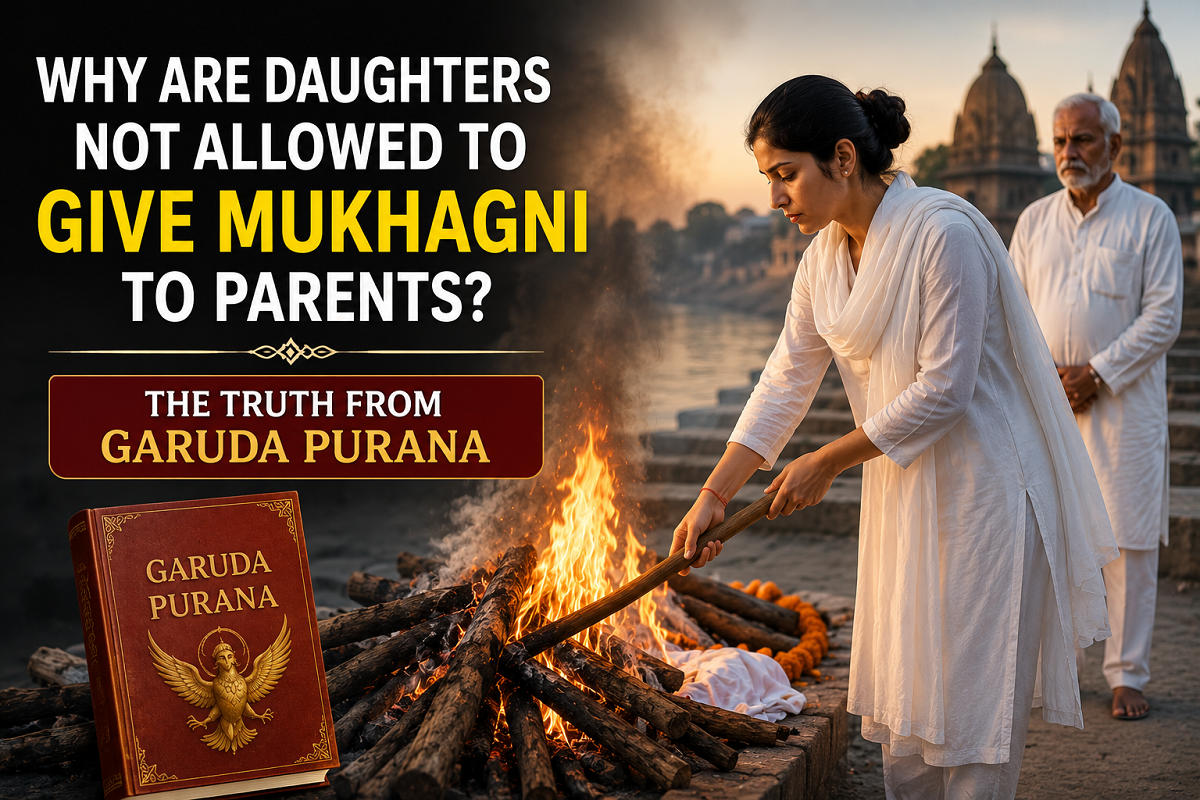
In Hindu traditions, the rituals performed after a person's death hold deep spiritual and cultural significance. One of the most important ceremonies is Mukhagni, the act of lighting the funeral pyre, which is traditionally carried out by the eldest son or another male member of the family. This long-standing custom has often raised an important question: Why have daughters traditionally not been expected to perform this final rite?
Ancient Hindu scriptures, including the Garuda Purana, discuss funeral rituals and the responsibilities of family members after death. However, interpretations of these teachings have evolved over time, and many families today are rethinking traditional practices. It is important to note that religious customs and beliefs can differ across regions, communities, and spiritual traditions.
The Traditional Role of the Son in Hindu Funeral Rituals
According to traditional Hindu beliefs, the son was considered the primary heir responsible for carrying forward the family's lineage and performing ancestral rites. Ancient texts describe the son as the person expected to conduct important post-death rituals, including offering Pind Daan, Tarpan, and lighting the funeral pyre.
The Garuda Purana explains that these rituals are believed to assist the departed soul on its spiritual journey. Historically, this responsibility was linked to the family's religious duties rather than to any belief that daughters were spiritually incapable of performing the rites.
Why Were Daughters Traditionally Excluded?
Many religious scholars explain that the exclusion of daughters from performing Mukhagni was largely influenced by social customs that existed in earlier times.
Traditionally, daughters were expected to move to their husband's household after marriage, while sons remained with their parents and assumed responsibility for family rituals and ancestral obligations. Because of this social structure, funeral responsibilities gradually became associated with male family members.
It is worth noting that these practices were shaped by the customs of their time and are interpreted differently by various religious authorities today.
Does the Garuda Purana Explicitly Prohibit Daughters?
A common misconception is that the Garuda Purana strictly forbids daughters from performing the last rites of their parents. However, many scholars point out that the scripture primarily emphasizes that funeral rituals should be performed sincerely by a rightful family member. Interpretations vary, and not all religious experts agree that daughters are prohibited from carrying out these responsibilities.
Different Hindu traditions and schools of thought may interpret these scriptures in different ways.
Can Daughters Perform the Last Rites Today?
In modern India, many families have chosen to allow daughters to perform the final rites of their parents. In several cases, daughters have lit the funeral pyre when there was no son or when parents had specifically expressed such a wish during their lifetime.
Many priests and religious scholars now acknowledge that if a daughter performs the rituals with devotion, respect, and proper religious guidance, the ceremonies can be considered valid in numerous Hindu traditions. At the same time, some communities continue to follow older customs that reserve this responsibility for male relatives.
Changing Social Perspectives
Indian society has witnessed significant changes over the past few decades. Daughters today often take equal responsibility for caring for their parents, managing family affairs, and fulfilling emotional as well as financial obligations.
As social attitudes continue to evolve, many families now believe that the final act of honoring a parent should depend on love, responsibility, and the wishes of the deceased rather than solely on gender. Courts in India have also, in various instances, recognized the right of daughters to perform the last rites of their parents.
Conclusion
The tradition of sons performing Mukhagni has deep historical and cultural roots in Hindu society. While the Garuda Purana discusses the importance of funeral rituals, interpretations regarding who may perform them are not universally identical and vary across religious traditions.
Today, many Hindu families accept daughters performing the final rites, especially when it aligns with family beliefs and local customs. Since religious practices differ widely, individuals are encouraged to seek guidance from knowledgeable priests or spiritual leaders while respecting both family traditions and the wishes of the deceased.