UPI Payment Safety Tips 2026: Digital payments have transformed the way people manage everyday transactions in India. Whether purchasing groceries, paying restaurant bills, shopping at local markets or transferring money to family members, millions of people rely on the Unified Payments Interface (UPI) for convenient bank-to-bank transfers.
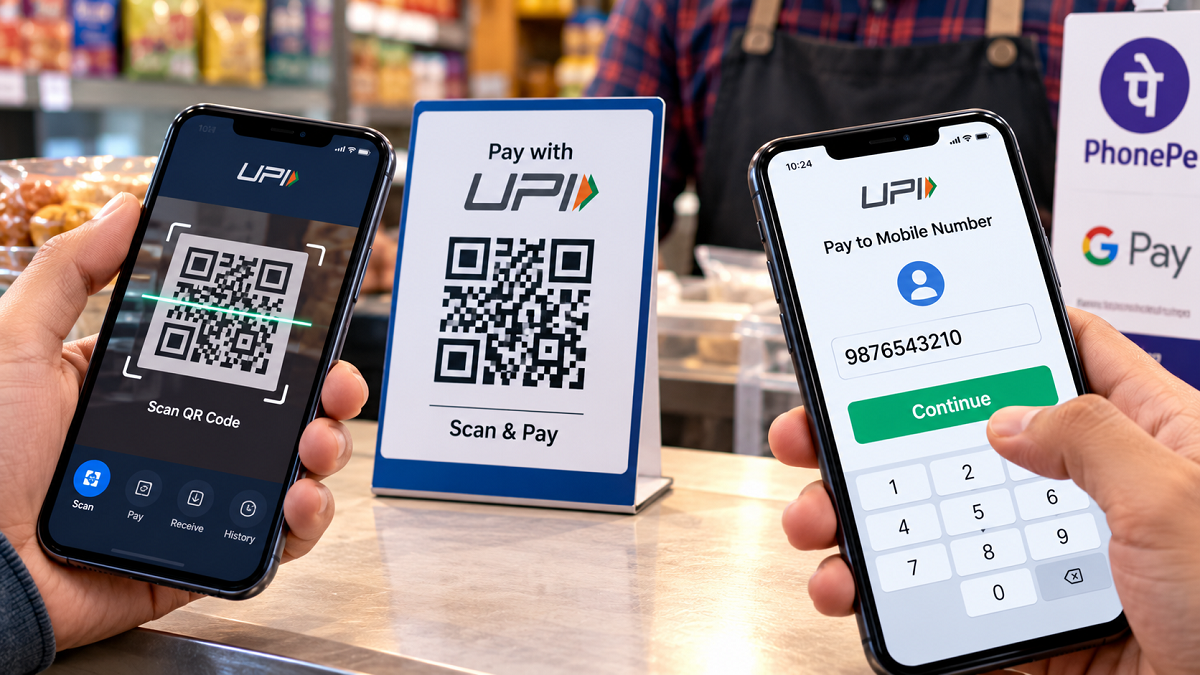
Two of the most commonly used payment methods are scanning a QR code and sending money through a mobile number. Both options are simple and generally allow users to complete payments within seconds.
However, many people are unsure which method is safer, faster and more suitable for different situations.
Although QR code payments and mobile number transfers use the same underlying UPI infrastructure, the process of identifying the recipient is different. Each method also carries certain risks if users fail to verify payment details.
Here is a detailed comparison to help you understand how these payment methods work and how to avoid common UPI mistakes.
QR Code vs Mobile Number: How Do These UPI Payment Methods Work?
UPI allows users to transfer money directly between supported bank accounts through participating payment applications.
Instead of entering bank account numbers and IFSC codes for every transaction, users can initiate payments through a QR code, UPI ID or eligible mobile number.
How QR Code Payments Work
A QR code contains encoded payment information that helps the UPI application identify the intended recipient.
When a customer scans a merchant's QR code, the payment application reads the information and displays the available recipient details.
The customer can then enter the payment amount, if it has not already been specified, and review the transaction.
After confirming the details, the user authorises the payment using the applicable UPI authentication process.
This method is particularly popular among shopkeepers, restaurants, supermarkets and street vendors because customers do not need to type the recipient's payment details manually.
How Mobile Number Payments Work
Mobile number-based UPI transfers operate differently.
The sender enters or selects a mobile number in a supported payment application.
The application attempts to identify an eligible UPI recipient associated with that number.
Depending on the payment app and the recipient's UPI registration, the system may display the relevant account name or payment identity for confirmation.
The sender then enters the amount and authorises the transaction.
However, not every mobile number can necessarily receive UPI payments through every application. The recipient must be discoverable through the supported payment system.
Which Is Faster: QR Code or Mobile Number Payment?
Both payment methods can be completed quickly when the recipient's details are available and the UPI service is functioning normally.
QR code payments are often more convenient for shopping because the customer simply scans the code displayed by the merchant.
There is usually no need to search for the recipient or manually enter a phone number.
For example, when paying ₹200 at a grocery store, scanning the merchant's QR code can be quicker than typing a mobile number and searching for the correct account.
On the other hand, mobile number transfers may be more convenient when sending money to someone whose registered number is already saved in your contacts.
If you frequently transfer money to family members or friends, selecting their mobile number can make the process straightforward.
Ultimately, neither method is universally faster. Convenience depends on the situation, payment application and availability of recipient information.
QR Code vs Mobile Number: Key Differences
| Feature | QR Code Payment | Mobile Number Payment |
|---|---|---|
| Payment Initiation | Scan a QR code | Enter or select a mobile number |
| Common Usage | Shops, restaurants and businesses | Friends, relatives and personal transfers |
| Recipient Identification | Details encoded in QR code | UPI recipient associated with mobile number |
| Manual Entry | Usually minimal | Mobile number may need to be entered |
| Main Risk | Fake or replaced QR code | Incorrect number or recipient selection |
| Recipient Verification | Required | Required |
| UPI PIN for Sending Money | Generally required | Generally required |
Both methods are convenient, but the most important safety measure is confirming the recipient before approving the transfer.
Which Payment Method Is Safer?
Many people believe that QR code payments are automatically safer because they do not require entering a mobile number.
Others prefer mobile number transfers because they can identify the recipient from their contacts.
In reality, neither method is completely free from risk.
The security of a transaction depends largely on whether the sender verifies the payment details and follows safe banking practices.
Risks Associated With QR Code Payments
One possible threat involves fraudulent or replaced QR codes.
For example, a scammer may place a different QR code over a genuine merchant's payment code.
If a customer scans the fraudulent code without checking the recipient's identity, the money could be transferred to the scammer instead of the shopkeeper.
Therefore, customers should check the recipient name displayed by the payment application.
If the details do not match the intended merchant, the transaction should not be completed.
Risks Associated With Mobile Number Payments
Mobile number transfers can also result in mistakes.
A sender may accidentally enter an incorrect digit or select the wrong contact.
If the displayed recipient details are not checked, the payment could go to an unintended person.
This risk becomes more significant when transferring large amounts.
Before approving any mobile number-based payment, verify that the recipient's name and other available details match the person you intend to pay.
Important UPI Safety Rules Everyone Should Follow
UPI transactions are convenient, but users should remain alert while making payments.
1. Always Verify the Recipient's Name
Before entering your UPI PIN, check the name displayed on the confirmation screen.
Do not approve a payment merely because you scanned a QR code or selected a familiar-looking mobile number.
2. Never Share Your UPI PIN
Your UPI PIN is confidential and should not be disclosed to anyone.
Fraudsters may impersonate customer care representatives, bank employees or merchants to obtain payment credentials.
Do not share your PIN, OTP or banking password.
3. You Do Not Need a UPI PIN to Receive Money
This is one of the most important rules for avoiding UPI fraud.
Receiving an ordinary UPI payment does not require you to enter your UPI PIN.
If someone claims that you must scan a QR code or enter your PIN to receive money, treat the request as suspicious.
Entering a UPI PIN generally authorises a debit or another transaction requiring authentication.
4. Avoid Unknown Payment Requests
Fraudsters sometimes send collect requests or payment mandates while pretending that the recipient is receiving a refund or reward.
Before approving any request, read the information carefully.
Do not authorise an unfamiliar payment request.
5. Check the Payment Amount
Always confirm the amount before entering your PIN.
A simple typing mistake can result in transferring more money than intended.
This is especially important when making payments to unfamiliar recipients.
6. Use Trusted UPI Applications
Install payment applications only through trusted sources.
Keep your application updated and avoid clicking suspicious links that claim to offer cashback, refunds or special rewards.
What Should You Do If Money Is Sent to the Wrong Person?
If you accidentally transfer money to an unintended recipient, contact your bank and payment application as quickly as possible.
Provide the transaction reference number, amount, date and other relevant details.
The bank or payment service provider may guide you through the applicable dispute process.
However, a successful UPI transfer cannot always be reversed automatically.
Recovery may depend on the circumstances, the recipient's cooperation and the procedures followed by the participating banks.
Therefore, verifying payment details before transferring money remains extremely important.
What If You Become a Victim of UPI Fraud?
If you suspect that money has been transferred through a fraudulent transaction, report the incident immediately.
Contact your bank using its official customer support channels and register a complaint through the relevant payment application.
You can also report suspected financial cybercrime in India through the national cybercrime helpline 1930 or the official National Cyber Crime Reporting Portal.
Keep the transaction ID, payment details, relevant screenshots and messages available for the complaint.
Quick reporting may improve the chances of taking timely action, although recovery of funds is not guaranteed.
QR Code or Mobile Number: Which Should You Choose?
For payments at shops, restaurants and other commercial establishments, scanning a QR code is often the more convenient option.
For transferring money to friends, family members or known contacts, mobile number-based payments may be easier.
However, convenience should never come at the expense of verification.
Both payment methods can be reliable when used correctly, but both can also lead to financial losses if users approve transactions without checking the recipient.
The safest UPI payment method is the one where you carefully verify the recipient's identity, confirm the amount and authorise the transaction only after reviewing all details.
Whether you scan a QR code or enter a mobile number, a few seconds of caution can help prevent costly mistakes.
Disclaimer: This article provides general information about UPI payments and digital transaction safety. Payment features, recipient discovery and dispute procedures may vary across banks and UPI applications.