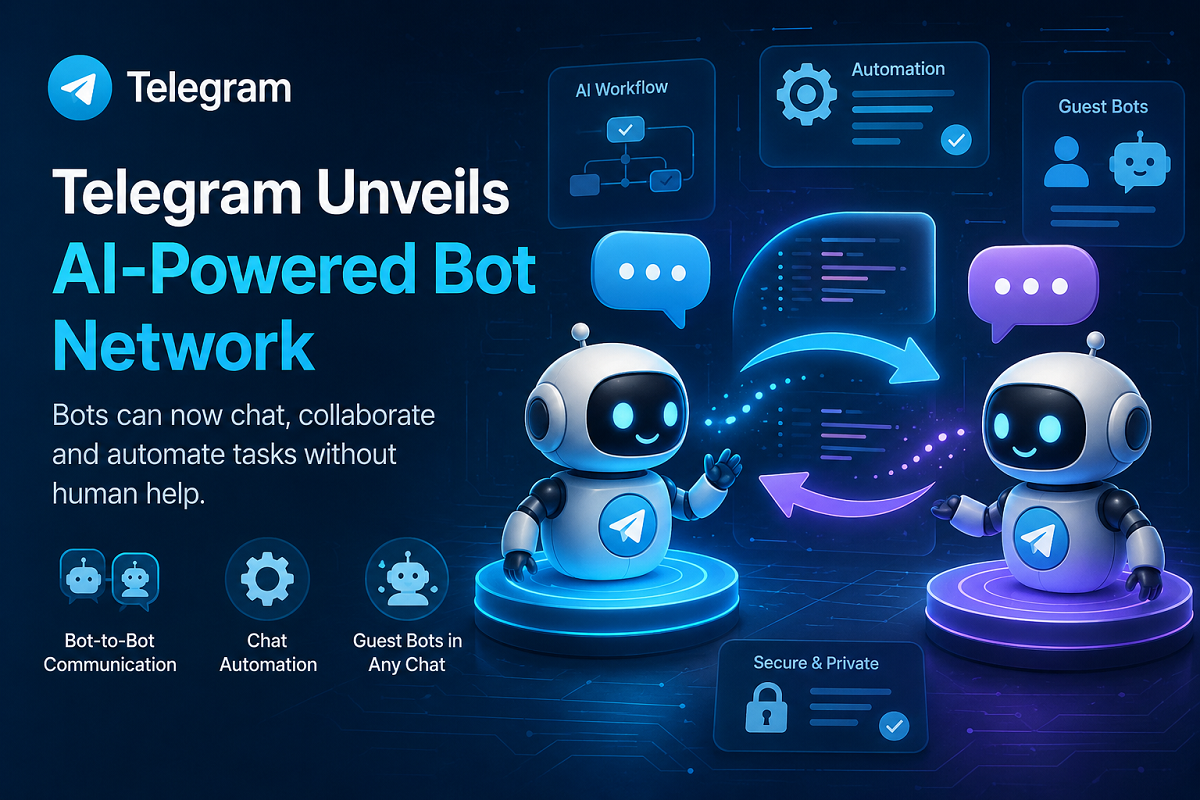
Telegram has rolled out a major upgrade to its platform by introducing autonomous bot interaction features that allow bots to communicate directly with one another without needing human involvement. The new update marks a significant step toward advanced automation inside messaging apps and highlights Telegram’s growing focus on AI-powered workflows and smart digital assistance.
The announcement was made by Telegram founder and CEO Pavel Durov, who revealed that developers had long requested the ability for bots to exchange information independently. With this update now live, Telegram is opening the door to more sophisticated automation systems that can perform complex tasks across chats, groups, and business accounts.
Telegram Launches Direct Bot-to-Bot Messaging System
One of the biggest highlights of the update is the introduction of a dedicated “Bot-to-Bot Communication Mode.” This new system enables two or more bots to send messages, process information, and respond to each other automatically inside the Telegram ecosystem.
Previously, Telegram bots were designed mainly to interact with human users. Their functionality was limited to responding to commands, answering queries, or performing tasks initiated by people. However, the latest update changes that entirely by allowing bots to collaborate directly in real time.
According to Telegram, the feature can support a wide range of automated workflows. For instance, one bot may generate content, another bot could review or edit it, while a third bot handles publishing or delivery — all without requiring any manual action from users.
This capability could prove useful for developers, businesses, customer support systems, and AI-based applications that rely heavily on automation.
AI Workflows on Telegram Become More Advanced
Telegram says the new update is designed to improve how artificial intelligence tools function within chats and groups. Bots can now work together like connected services, making automation more efficient and flexible.
For example, a booking bot could manage restaurant reservations, while another AI bot handles customer questions simultaneously. A separate backend bot may then process data, confirm bookings, or send updates automatically.
The company believes this interconnected system will help developers create smarter AI-driven experiences inside the app. Instead of relying on a single bot for every task, developers can now divide operations among multiple specialized bots that communicate with each other seamlessly.
This move also positions Telegram as one of the few messaging platforms actively experimenting with collaborative AI systems within user conversations.
New Chat Automation Feature Added for Users
Alongside bot-to-bot communication, Telegram has also introduced a new Chat Automation feature aimed at simplifying message management for users who receive a large number of chats every day.
The feature allows users to connect their Telegram accounts to automation bots that can reply to messages on their behalf. Users can manually choose which chats or conversations they want automated through the app’s settings section.
This functionality is expected to benefit businesses, creators, influencers, and professionals who regularly manage customer inquiries or community interactions.
For example, automated bots can instantly answer common questions, provide updates, share links, or handle basic support requests even when the user is offline.
The addition reflects Telegram’s broader strategy to turn the platform into a more powerful communication and productivity tool instead of just a messaging application.
Telegram Introduces “Guest Bots” for Private Conversations
Another important feature included in the update is the arrival of “Guest Bots.” This new functionality allows bots to participate in private chats or group conversations even if they are not official members of the chat.
Users simply need to mention a bot’s username in a message, and the tagged bot can instantly respond within the same conversation.
Telegram says these bots can assist with multiple tasks such as answering questions, generating text, creating images, sharing information, or executing commands directly inside chats.
However, Telegram has also emphasized that privacy protections remain active. Guest Bots are only allowed to access the specific message in which they are tagged, along with replies connected to that message.
The bots cannot view the complete conversation history, read unrelated messages, or access personal information about other participants in the chat.
This limitation is designed to maintain user privacy while still enabling interactive AI functionality inside conversations.
Telegram Expands Its Push Into AI and Automation
The latest update clearly shows Telegram’s growing interest in artificial intelligence and automation technologies. Rather than limiting bots to simple commands and basic replies, the company now wants bots to collaborate, manage tasks independently, and create advanced automated systems within chats.
Industry observers are already comparing the feature to AI-powered platforms where automated agents create and respond to content autonomously. However, Telegram appears to be taking a more practical and utility-focused approach by emphasizing productivity, customer service, and workflow automation.
As AI integration becomes increasingly common across messaging platforms, Telegram’s latest update could help the company stand out by offering more flexible automation tools for developers, businesses, and everyday users alike.
With autonomous bots, chat automation, and privacy-focused Guest Bots now entering the platform, Telegram is signaling that the future of messaging may involve conversations not only between people — but also between intelligent digital assistants working together behind the scenes.