Business
SBI FD Returns 2026: How Much Will ₹1 Lakh Grow in 1, 3, 5 and 10 Years? Check Interest Rates
SBI Fixed Deposit Calculator 2026: Fixed deposits remain one of the most preferred savings options among Indian investors who want relatively stable returns without directly exposing their money to stock market fluctuations. Whether someone is saving for retirement, planning future expenses or simply looking for a secure place to park surplus funds, bank fixed deposits continue to attract considerable interest.
The State Bank of India (SBI), India's largest public sector bank, offers fixed deposit options across different maturity periods. The interest earned depends on the deposit amount, applicable interest rate, investment tenure and compounding frequency.
For someone planning to invest ₹1 lakh, choosing between a one-year, three-year, five-year or ten-year FD can make a significant difference to the final maturity amount.
Here is a detailed look at the illustrative SBI FD returns, additional benefits for senior citizens and important tax rules investors should understand.
SBI FD Interest Rates 2026: How Much Can Regular Customers Earn?
SBI offers fixed deposits with different interest rates depending on the selected tenure. Longer investment periods may generate higher total interest because the deposited money remains invested for more years.
However, a longer FD does not necessarily offer a higher annual interest rate.
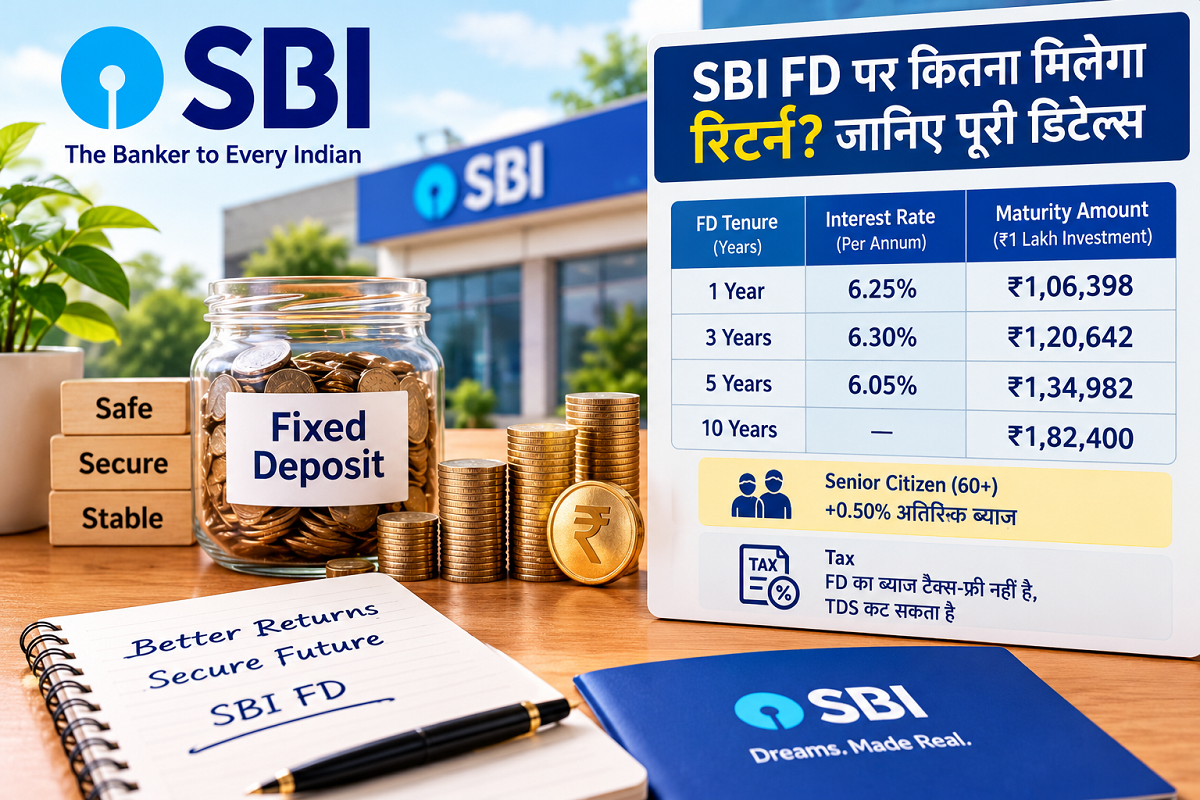
Based on the rates mentioned in the supplied comparison, the following returns are illustrated for a ₹1 lakh investment.
| FD Tenure | Annual Interest Rate | Estimated Maturity Amount |
|---|---|---|
| 1 year | 6.25% | ₹1,06,398 |
| 3 years | 6.30% | ₹1,20,642 |
| 5 years | 6.05% | ₹1,34,982 |
| 10 years | Not specified | ₹1,82,400 |
Note: These are the indicative figures quoted in the supplied article, not independently verified SBI quotations. Actual maturity values may differ with compounding conventions and applicable rates.
The table suggests that keeping ₹1 lakh invested for ten years could produce the largest total maturity amount among the illustrated options.
However, investors should not compare maturity amounts without considering the different investment durations.
SBI 1-Year FD: How Much Interest Will ₹1 Lakh Earn?
A one-year fixed deposit may suit investors who want to preserve their savings while keeping the investment period relatively short.
Using the illustrative annual interest rate of 6.25%, the supplied calculation estimates that a ₹1 lakh deposit could grow to approximately ₹1,06,398 after one year.
This represents an estimated interest earning of ₹6,398.
One-year FDs can be useful for individuals planning expenses within the next 12 months, such as education payments, travel or other anticipated financial needs.
However, the exact return depends on the applicable deposit rate and compounding method.
SBI 3-Year FD: Can ₹1 Lakh Grow Beyond ₹1.20 Lakh?
Investors who do not require immediate access to their savings may consider a three-year fixed deposit.
At the illustrative interest rate of 6.30%, the original comparison estimates that an investment of ₹1 lakh could reach approximately ₹1,20,642.
The estimated interest component would therefore be around ₹20,642.
A three-year deposit provides a longer investment horizon than a one-year FD while avoiding the extended commitment associated with five-year or ten-year deposits.
However, premature withdrawal may attract penalties or result in a lower applicable interest rate.
SBI 5-Year FD: What Returns Can Investors Expect?
A five-year fixed deposit can be considered by investors looking for medium- to long-term savings.
Based on the quoted annual interest rate of 6.05%, the supplied article estimates a maturity value of approximately ₹1,34,982 for a ₹1 lakh deposit.
This would represent an estimated interest earning of ₹34,982.
Investors should also distinguish between ordinary five-year deposits and the bank's eligible five-year tax-saving fixed deposit scheme.
Qualifying investments in a tax-saving FD may be eligible for a deduction under Section 80C under the old income tax regime, subject to the applicable overall limit.
Such tax-saving deposits generally carry a mandatory five-year lock-in period.
Importantly, the interest earned on these deposits is not automatically tax-free.
SBI 10-Year FD: Can ₹1 Lakh Become More Than ₹1.80 Lakh?
For investors with a long-term savings objective, a ten-year fixed deposit provides an opportunity to benefit from compounding over an extended period.
The supplied comparison suggests that a ₹1 lakh investment could grow to approximately ₹1,82,400 after ten years.
That would represent total interest of approximately ₹82,400.
However, the original calculation does not specify the annual interest rate used for this estimate.
Consequently, investors should treat the figure as an illustration rather than a confirmed maturity quotation.
Long-term fixed deposits can help investors lock in an interest rate, but they also involve certain trade-offs.
For example, if market interest rates increase after the deposit is opened, the investor may continue earning the previously agreed rate unless the deposit is closed and reinvested, subject to applicable conditions.
Inflation can also reduce the purchasing power of the maturity amount over time.
SBI Senior Citizen FD: Additional Interest Benefits Explained
SBI generally offers eligible senior citizens aged 60 years and above higher interest rates on qualifying domestic fixed deposits.
The standard additional benefit is commonly 0.50 percentage points above the corresponding regular customer rate, although special schemes and tenure-specific benefits may differ.
The supplied comparison provides the following illustrative maturity estimates.
| FD Tenure | Quoted Senior Citizen Rate | Estimated Maturity Value |
|---|---|---|
| 1 year | 6.75% | ₹1,06,920 |
| 3 years | 6.80% | ₹1,22,430 |
| 5 years | 7.05% | ₹1,41,680 |
| 10 years | Depends on applicable scheme | Potentially above ₹2 lakh |
These are source-provided estimates. The five-year rate shown is not simply 0.50 percentage points above the regular rate in the earlier table, so the applicable SBI scheme and rate should be checked.
Senior citizens should compare standard fixed deposits with any special tenure-based schemes available at the time of investment.
Is SBI Fixed Deposit Interest Tax-Free?
One important point investors must understand is that interest earned from ordinary bank fixed deposits is generally taxable.
FD interest is normally included in the investor's taxable income and taxed according to the applicable income tax provisions.
The final tax liability depends on the taxpayer's total income, applicable tax regime and eligibility for deductions or other relief.
Banks may also deduct Tax Deducted at Source (TDS) when interest payments or credits exceed the prescribed threshold.
For FY 2026–27, the generally applicable annual TDS thresholds under Section 194A are ₹50,000 for non-senior citizens and ₹1,00,000 for senior citizens, subject to the relevant conditions.
TDS is not an additional tax. It represents tax collected in advance and is adjusted against the taxpayer's final income tax liability.
Eligible individuals may also be able to submit the prescribed declaration to avoid TDS where the statutory conditions are satisfied.
Which SBI FD Tenure Is Better for a ₹1 Lakh Investment?
The most suitable FD tenure depends on the investor's financial goals and when the money will be needed.
A one-year FD may be appropriate for short-term savings, while a three-year deposit can suit medium-term requirements.
Five-year deposits may appeal to investors planning longer-term expenses or considering eligible tax-saving investments.
A ten-year FD can generate a larger total interest amount if funds remain invested for the full tenure, but investors must consider inflation, liquidity requirements and the possibility of changing interest rates.
It is also worth remembering that bank deposits are covered by deposit insurance through the Deposit Insurance and Credit Guarantee Corporation (DICGC), subject to a limit of ₹5 lakh per depositor per bank, including eligible principal and interest across deposits held in the same capacity and right.
Final Takeaway
SBI fixed deposits offer several tenure options for investors who prefer relatively predictable returns.
The supplied illustrations suggest that ₹1 lakh could grow to approximately ₹1.06 lakh in one year, ₹1.20 lakh in three years, ₹1.35 lakh in five years and ₹1.82 lakh over ten years.
Senior citizens may receive additional interest benefits, potentially increasing their maturity amounts.
However, the FD offering the largest total maturity amount is not necessarily the one offering the highest annual interest rate.
Before investing, customers should verify SBI's latest deposit rates, select the appropriate tenure and review the applicable tax and premature withdrawal conditions.
Disclaimer: The rates and maturity amounts discussed are illustrative and based on the supplied article. They are not verified live SBI rates. Investors should confirm the latest terms and maturity calculations with SBI before opening a fixed deposit.