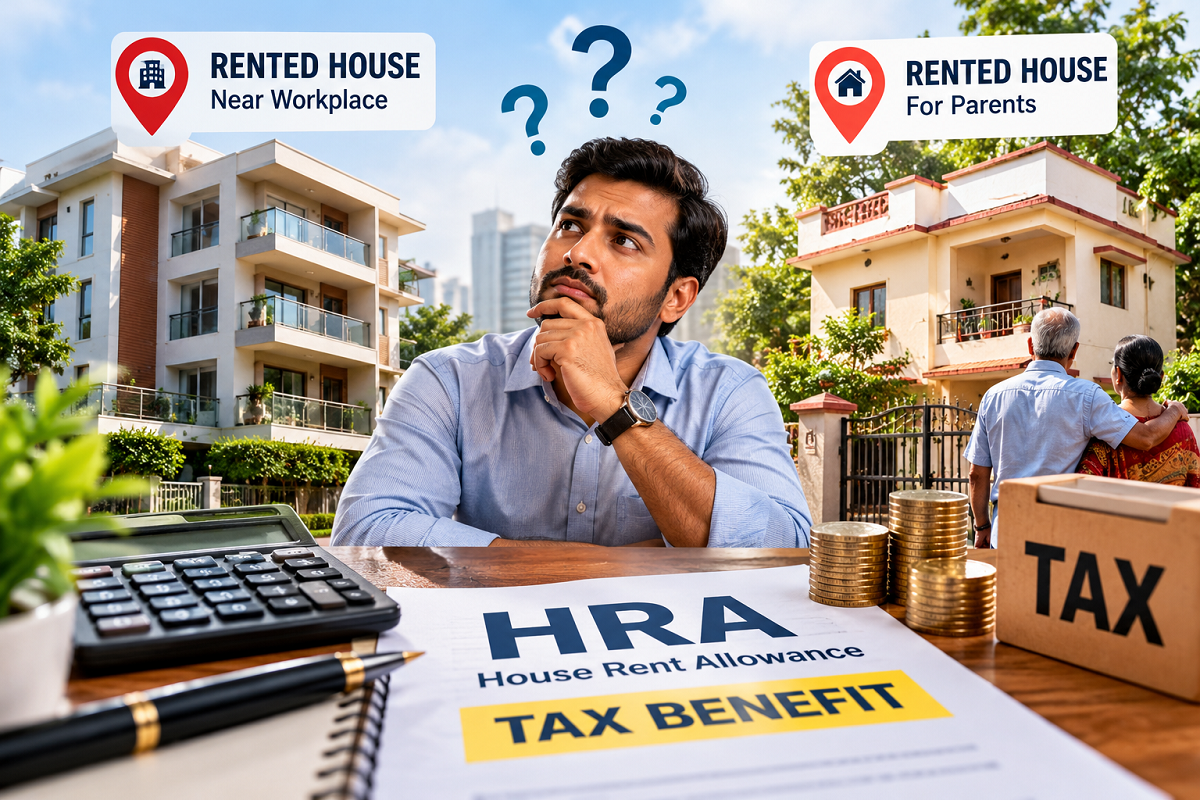
HRA Tax Exemption Rules 2026: Many salaried employees in India live in rented accommodation because of their jobs, while also financially supporting family members residing in another city. In some situations, an individual may pay rent for two separate properties—one near their workplace and another occupied by their parents.
This arrangement raises an important income tax question: Can an employee claim House Rent Allowance (HRA) tax exemption for both properties?
HRA is an important component of salary packages and can help eligible employees reduce their taxable income. However, the benefit is subject to specific conditions under income tax rules.
The exemption is generally available under the old income tax regime, while employees choosing the new tax regime cannot ordinarily claim HRA exemption.
Understanding these provisions can help taxpayers avoid incorrect claims and calculate their eligible tax benefits more accurately.
Can You Claim HRA Tax Exemption for Two Rented Properties?
Under Section 10(13A) of the Income-tax Act, 1961, HRA exemption is linked to rent paid by an employee for residential accommodation occupied by them.
Simply paying rent for multiple houses does not automatically make both payments eligible for exemption.
Consider an employee working in Bengaluru who rents an apartment near the office. The same employee also pays rent for a separate property in Jaipur where their parents reside.
In this situation, the employee can generally claim HRA exemption for the Bengaluru accommodation, provided all applicable conditions are satisfied.
However, the rent paid for the Jaipur property occupied exclusively by the parents would not ordinarily qualify for the employee's HRA exemption.
The main consideration is whether the rented accommodation is actually occupied by the employee.
Therefore, paying rent for two properties does not necessarily mean that the taxpayer can claim double HRA benefits.
What Happens If You Pay Rent to Your Parents?
Some employees live in properties owned by their parents and pay them monthly rent.
Such arrangements may qualify for HRA exemption when the rental relationship is genuine and the employee actually occupies the accommodation.
However, proper documentation is important.
A taxpayer should maintain evidence of rent payments, details of the property owner and other relevant records.
The rental income received by the parents should also be appropriately reported in their income tax returns wherever required.
An artificial arrangement created only to claim a tax benefit may be questioned by the tax authorities.
Importantly, paying rent for a house where only the parents live is different from paying rent to parents for accommodation occupied by the employee.
How Is HRA Tax Exemption Calculated?
The amount of HRA that can be claimed as tax-exempt is determined using a prescribed calculation.
Under the applicable rules, the exemption is generally the lowest of the following three amounts:
- Actual HRA received from the employer.
- Rent paid during the relevant period minus 10% of eligible salary.
- 50% of eligible salary for specified metro cities or 40% for other cities.
For this purpose, eligible salary generally includes basic salary, qualifying dearness allowance and commission calculated as a fixed percentage of turnover, where applicable.
The specified metro cities under the traditional HRA calculation are Delhi, Mumbai, Kolkata and Chennai.
Other locations generally fall under the 40% calculation.
HRA Calculation Example: How Much Tax Can You Save?
Suppose an employee working in Delhi receives the following salary components and pays rent for a residential property.
| Particulars | Monthly Amount | Annual Amount |
|---|---|---|
| Basic salary | ₹50,000 | ₹6,00,000 |
| HRA received | ₹20,000 | ₹2,40,000 |
| Rent paid | ₹18,000 | ₹2,16,000 |
| 10% of basic salary | ₹5,000 | ₹60,000 |
| 50% of basic salary | ₹25,000 | ₹3,00,000 |
Assuming there is no additional eligible salary component, the exemption is calculated as follows:
Actual HRA received: ₹2,40,000
Annual rent minus 10% of salary: ₹2,16,000 − ₹60,000 = ₹1,56,000
50% of eligible salary: ₹3,00,000
The lowest amount is ₹1,56,000.
Therefore, the employee can claim an annual HRA exemption of ₹1,56,000 under the old tax regime, subject to meeting the relevant conditions.
The remaining ₹84,000 of the annual HRA would be taxable.
The actual income tax saving depends on the employee's applicable tax slab and other circumstances.
Is HRA Exemption Available Under the New Tax Regime?
One of the most important considerations for salaried taxpayers is the choice between the old and new income tax regimes.
Under the old regime, eligible employees can claim HRA exemption along with other permitted deductions and exemptions.
However, the new tax regime generally does not allow an exemption for HRA received from an employer.
This means employees choosing the new regime must ordinarily include their entire HRA component in taxable salary.
Therefore, someone paying substantial monthly rent should compare the overall tax liability under both regimes before making a decision.
Although the old regime permits HRA exemption, the new regime may still result in lower total tax for some employees because of its different slab rates and other provisions.
What If Your Employer Does Not Provide HRA?
Not every salaried employee receives House Rent Allowance as part of their salary structure.
Employees without HRA cannot claim the exemption available under Section 10(13A).
However, eligible individuals may be able to claim a deduction for rent paid under Section 80GG.
This provision can apply to qualifying salaried individuals and self-employed taxpayers who meet the prescribed conditions.
The deduction is generally calculated as the lowest of:
- ₹5,000 per month.
- 25% of adjusted total income.
- Rent paid minus 10% of adjusted total income.
Additional restrictions apply, including conditions relating to residential property ownership.
The Section 80GG deduction is generally available under the old tax regime and requires compliance with the relevant declaration requirements.
Which Documents Are Important for Claiming HRA?
Employees should maintain accurate records to support their HRA exemption claims.
Important documents may include rent receipts, a rental agreement, bank transaction records and landlord information.
Where annual rent exceeds ₹1 lakh, employees generally need to provide the landlord's PAN to their employer for HRA exemption documentation. Where the landlord does not have a PAN, the prescribed declaration requirements should be followed.
Taxpayers should ensure that the rent declared is genuine and consistent with their supporting records.
Incorrect rental claims, fabricated receipts or unsupported deductions can create difficulties during income tax verification.
Can You Claim HRA If You Live in Your Own House?
An employee who lives in a self-owned house without paying rent cannot claim HRA exemption merely because the employer includes HRA in the salary package.
The exemption is intended for eligible rental expenses actually incurred for occupied residential accommodation.
However, certain situations involving home loans, owned properties in another city and rented accommodation near the workplace may require a separate assessment under the applicable income tax rules.
Taxpayers should examine the specific facts before claiming any related benefits.
Final Takeaway
Paying rent for two houses does not automatically make an employee eligible for HRA tax exemption on both properties.
Under the traditional HRA provisions, the exemption generally relates to rent paid for residential accommodation actually occupied by the employee.
If an individual lives in a rented property near the workplace while separately paying rent for parents living elsewhere, the second payment would not ordinarily qualify for the employee's HRA exemption.
Employees should also remember that HRA exemption is generally available only under the old tax regime, subject to the relevant conditions.
Understanding the calculation method, maintaining proper rental records and choosing the appropriate tax regime can help salaried taxpayers claim legitimate tax benefits while avoiding errors in their income tax returns.
Disclaimer: This article provides general information about HRA tax treatment. Eligibility depends on the applicable law, assessment year and individual circumstances. Taxpayers should check the relevant provisions or consult a qualified tax professional before filing a claim.