Business
EPF vs PPF: Which Is Better for Retirement? Compare Contributions, Lock-In, Benefits and Flexibility
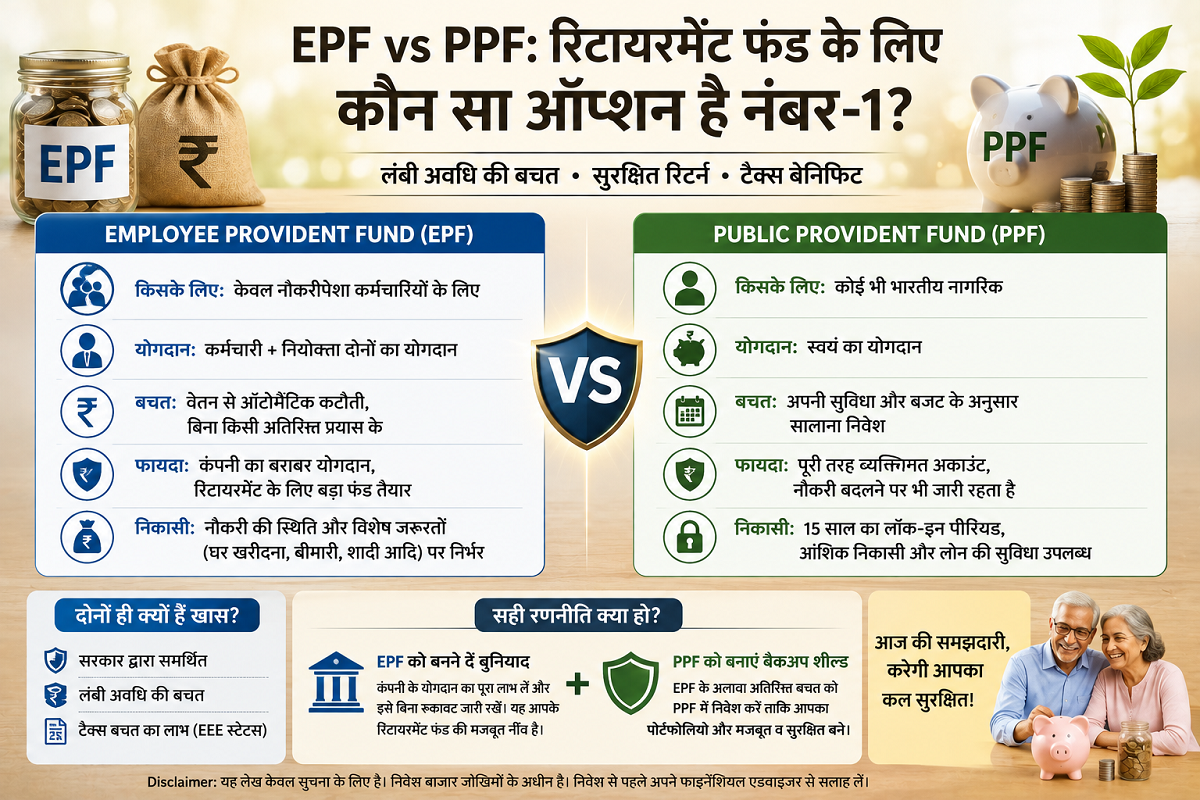
EPF vs PPF for Retirement Planning: Building a retirement corpus often comes down to choosing the right mix of long-term savings options. For salaried employees in India, two of the most familiar choices are the Employees' Provident Fund (EPF) and the Public Provident Fund (PPF).
Both are designed to encourage long-term savings, but they work very differently.
EPF is primarily linked to employment and is available to eligible employees working in establishments covered under the Employees' Provident Funds and Miscellaneous Provisions Act. PPF, on the other hand, is a voluntary small-savings scheme that individuals can open independently through eligible banks or post offices.
For most salaried employees who already fall under EPF coverage, the comparison is not necessarily about choosing one and rejecting the other. EPF can form the core of retirement savings, while PPF can be used as an additional long-term savings option.
What Makes EPF Different?
One of the biggest strengths of EPF is that contributions happen automatically through payroll.
Under the standard EPF framework, the employee generally contributes 12% of basic wages plus dearness allowance, and the employer also contributes 12%. The employer's contribution is divided between EPF and other applicable components such as the Employees' Pension Scheme, depending on the rules that apply.
This employer contribution is one of EPF's most important advantages.
An employee does not build the retirement fund entirely from personal savings. The employer also contributes as part of the statutory structure, which can significantly strengthen long-term accumulation over a full career.
Because the deduction happens before salary reaches the employee's bank account, EPF also encourages disciplined saving without requiring a fresh investment decision every month.
Why EPF Often Becomes the First Retirement Layer
For employees already covered by EPF, stopping or ignoring this benefit usually makes little sense because employer contributions are part of the overall compensation structure.
Regular contributions can continue throughout employment and accumulate over many years.
This makes EPF particularly useful for people who find it difficult to maintain investment discipline on their own.
The system is also linked to the employee's Universal Account Number, allowing the provident fund relationship to continue across eligible job changes rather than forcing the employee to start from scratch each time.
For this reason, EPF is commonly treated as a foundation of retirement planning for salaried workers.
How PPF Works Differently
PPF is not tied to an employer.
An eligible individual can open a Public Provident Fund account independently and continue it regardless of whether they remain in the same job, switch employers, become self-employed or take a career break.
That independence is one of PPF's biggest advantages.
According to India Post, a PPF account has an original tenure of 15 years and can be extended thereafter in blocks of five years.
PPF therefore works well for people looking for a long-term savings vehicle that remains completely separate from their employment.
It can also complement EPF for individuals who want to allocate additional money towards retirement or another long-term financial goal.
EPF vs PPF: Key Differences at a Glance
| Feature | EPF | PPF |
|---|---|---|
| Linked to employment | Yes | No |
| Employee contribution | Typically 12% of basic wages + DA | Voluntary within scheme limits |
| Employer contribution | Yes, subject to EPF rules | No |
| Initial tenure | Linked to employment and scheme rules | 15 years |
| Can continue after job change | Yes, through EPF account/UAN | Yes |
| Suitable for salaried employees | Highly relevant | Useful as additional savings |
| Partial withdrawal | Allowed under prescribed conditions | Allowed under prescribed conditions |
| Primary purpose | Retirement-linked employee savings | Long-term personal savings |
The biggest structural difference is clear: EPF gives eligible employees the advantage of an employer contribution, while PPF is funded entirely by the account holder.
What About Withdrawals From EPF?
EPF is meant primarily for long-term savings, but the money is not completely inaccessible.
EPFO provides for advances or withdrawals under specified conditions. These can include circumstances connected with housing, illness, marriage, education and retirement-related needs, subject to eligibility requirements and limits.
EPFO has also introduced reforms in recent years to simplify and expand access to eligible withdrawals.
However, frequent withdrawals can weaken the retirement corpus.
An employee who repeatedly withdraws from EPF during the working years loses not only the principal amount withdrawn but also the future compounding that money could have generated.
Therefore, EPF is usually best treated as long-term retirement money unless there is a genuine need.
How Liquid Is PPF?
PPF is also a long-term product and should not be treated like a regular savings account.
Its standard maturity period is 15 years. However, the scheme contains provisions for partial withdrawals and loans subject to prescribed conditions and timelines.
This makes PPF less liquid than ordinary bank deposits but also helps maintain long-term savings discipline.
For people saving specifically for retirement or another goal several years away, that restricted access can actually be useful because it reduces the temptation to spend the money prematurely.
Which Option Offers Greater Flexibility?
PPF has an advantage when it comes to independence from employment.
You can continue the account even if you change jobs, stop working temporarily or move into self-employment.
EPF, by contrast, is fundamentally employment-linked.
However, EPF offers a different kind of advantage: systematic payroll contributions and employer participation.
So the better option depends on what kind of flexibility matters most to you.
If you want an account that is completely under your personal control and separate from your employer, PPF is more flexible.
If you are an eligible salaried employee and want automatic retirement savings with employer contributions, EPF has a powerful structural advantage.
Should Salaried Employees Choose EPF First?
For an employee covered under EPF, it can be reasonable to treat EPF as the primary retirement-savings layer.
The key reason is not simply the interest rate.
It is the combination of automatic monthly investing and employer contributions.
Giving up or underusing an employer-backed retirement benefit just to invest the same money elsewhere may not always be an efficient strategy.
Once EPF contributions are taken care of, employees who still have surplus cash can evaluate whether PPF fits their broader asset allocation and long-term goals.
Where Does PPF Fit Into the Retirement Plan?
PPF can serve as a supplementary long-term savings bucket.
For example, a salaried person may already have EPF building in the background but still want another relatively stable long-term allocation.
PPF can be used for this purpose.
It can also be useful for people who do not have access to EPF, including many self-employed professionals and individuals outside EPF-covered employment.
The Department of Economic Affairs continues to administer PPF as part of the government's small-savings framework, with interest rates reviewed periodically.
Interest Rates Should Not Be the Only Deciding Factor
Many investors compare EPF and PPF purely on the basis of which scheme is offering the higher interest rate.
That approach can be too simplistic.
Interest rates can change, particularly in government-administered savings schemes.
A more useful comparison should consider employer contribution, liquidity, tenure, tax treatment, job status and the role each account plays in the overall retirement plan.
For a salaried employee, the value of the employer's EPF contribution can be more important than a small difference in headline interest rates.
Tax Treatment Also Matters
Both EPF and PPF have historically enjoyed favourable tax treatment, but the exact tax benefit available to an investor can depend on prevailing income-tax provisions, contribution levels and individual circumstances.
Investors should therefore avoid assuming that every contribution or withdrawal will always receive identical tax treatment under all conditions.
Tax rules can change, and high contributions can sometimes be subject to separate provisions.
For major retirement-planning decisions, checking the latest tax rules is advisable.
EPF or PPF: Which One Wins?
There is no universal winner because the two products solve slightly different problems.
For an eligible salaried employee, EPF generally has the stronger case as the primary retirement foundation because it combines automatic deductions with employer contributions.
PPF can then act as an additional long-term savings option for people who want to build a larger retirement corpus or diversify their savings beyond EPF.
For someone who does not have access to EPF, PPF can still be a useful long-term savings instrument.
In other words, the more practical question may not be “EPF or PPF?” but rather “How should EPF and PPF fit together in my retirement plan?”
Using EPF as the core retirement account and PPF as an additional long-term savings layer can provide salaried employees with a disciplined and diversified approach to building financial security for later years.
Disclaimer: This article is for general information only and should not be treated as personalised investment or tax advice. Contribution limits, withdrawal rules, interest rates and tax provisions can change. Investors should verify the latest rules and consider consulting a qualified financial adviser before making investment decisions.