
NEWS
Village Land Patta: How to Get Documents for Rural Land or a House, Know the Application Process
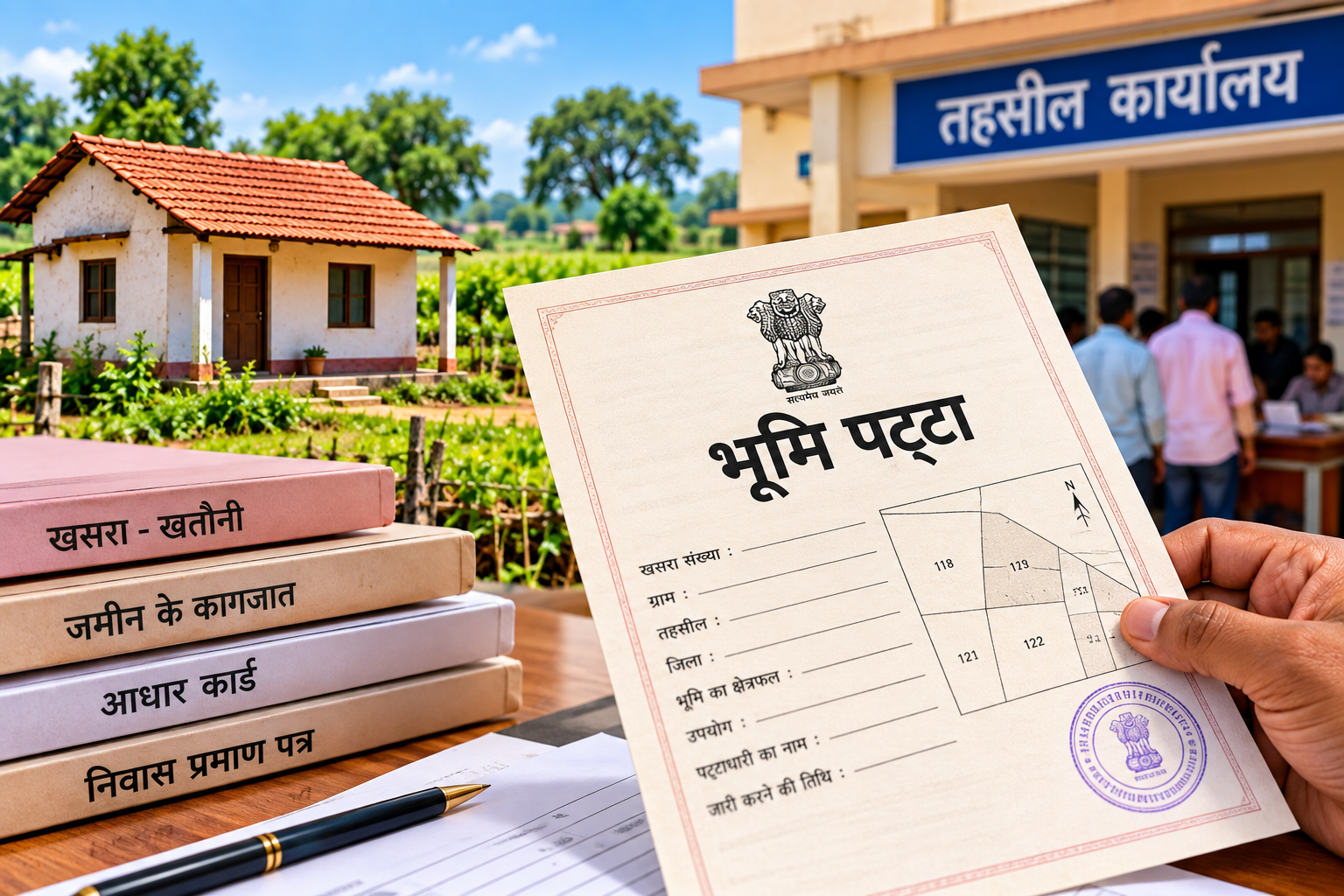
Many families move from villages to cities for jobs, education or business while continuing to have ancestral houses or land in their native places. Problems can arise when the family does not have clear or updated government records relating to that property.
Depending on the nature of the land and the applicable state rules, a patta, lease deed or government allotment document can establish certain recorded rights over land. However, the meaning of "patta" is not identical across India. Its legal effect depends on the state, type of land, terms of allotment and the law under which it was issued.
Therefore, anyone trying to obtain documents for village land should first determine whether the property is privately owned ancestral land, government land, Gram Sabha land, leasehold land or another category. The procedure for each can be different.
What Is a Patta?
In a broad sense, a patta can refer to a land-related record, allotment or lease document issued or recognized by the competent government or revenue authority.
In some government land-allotment schemes, eligible beneficiaries may be granted rights to use or occupy land subject to specified conditions.
Depending on the applicable scheme and state rules, land may be allotted for purposes such as housing, agriculture, fisheries, pottery or other traditional occupations and approved community purposes.
A patta should not automatically be treated as equivalent to an unrestricted freehold sale deed. Some allotments may contain restrictions on transfer, sale, mortgage or change of land use.
How Can a Village Land Patta Be Obtained?
The procedure depends heavily on the state in which the land is located. Even within one state, requirements can change depending on whether the application concerns residential, agricultural or government land.
In rural areas, the process commonly involves the Gram Panchayat and revenue authorities.
For example, in certain land-allotment proceedings in Uttar Pradesh, the process may involve identifying eligible land and beneficiaries, scrutiny at the village level, preparation of records and subsequent examination by revenue officials.
Public notice or an announcement may also form part of the applicable process where required.
After initial scrutiny, the proposal and supporting records can move to the appropriate revenue authorities for verification. Officials may inspect the site, examine the status of the land and verify the applicant's eligibility before an allotment is approved.
The exact authority competent to approve a patta depends on the relevant law and type of land.
Who May Receive Priority?
Government land cannot normally be claimed simply because a person has occupied it for a long time. Eligibility must arise under the applicable law or government allotment scheme.
Certain schemes may establish priority categories for allocation of eligible land. These can include members of specified disadvantaged communities, landless persons, economically weaker households or other categories recognized under state rules.
Some schemes may also contain special provisions for eligible families connected with members of the armed forces or other specified groups.
The order of priority should always be checked against the current state rules and the particular scheme rather than assuming that the same hierarchy applies everywhere.
Documents That May Be Required
The documents required will vary according to the state, district, type of land and application category.
Applicants may be asked to provide identity proof such as Aadhaar or another accepted document, residence proof and recent photographs. A ration card, BPL certificate or category certificate may also be required where eligibility depends on those factors.
Land-related documents can include the khasra number, available revenue records, map or boundary details and previous receipts or records connected with the property.
Where an applicant is required to demonstrate long-standing residence or lawful possession, authorities may seek supporting material such as electricity or water bills, old house-tax receipts or other records.
An affidavit or declaration in the prescribed format may also be required.
Importantly, possession-related documents alone do not necessarily establish legal ownership. Applicants should allow the revenue authority to determine the legal status of the land from official records.
How to Apply Offline
For an offline application, the first step is to identify the competent local authority.
An applicant can approach the Gram Panchayat, Panchayat Secretary, concerned revenue office or Tehsil to determine whether the particular land is eligible for the requested patta or allotment.
After obtaining the prescribed application form, the applicant should enter all required personal and land details accurately and attach the necessary supporting records.
The application should then be submitted to the authority specified under the local procedure.
Revenue officials may subsequently verify the land records, inspect the site and examine whether the applicant satisfies the eligibility conditions.
A patta or allotment document can be issued only after the prescribed verification and approval process is completed.
Can You Apply for a Patta Online?
Digital availability differs significantly between states.
Many states operate Revenue Department, Bhulekh, e-District or other land-record portals, but the services offered through them are not identical. A portal that allows people to view land records may not necessarily permit a fresh patta application online.
Where the relevant service is available digitally, applicants may be able to select the appropriate land service, enter property and personal details, upload supporting documents and submit the application electronically.
After submission, the acknowledgement or application number should be saved so that the case can be tracked.
Applicants should use only their state government's official portal and verify whether the entire procedure can be completed online or whether physical verification or a visit to the Tehsil is still required.
What Are the Benefits of Having Proper Land Records?
Properly issued land documents can provide an official record of the rights granted to the beneficiary.
Such records can be important if a dispute arises regarding possession, boundaries or competing claims. They can also help when dealing with government departments or applying for schemes where documented land rights are relevant.
Depending on the nature of the document and applicable banking rules, land records may also form part of the documentation considered for certain financial transactions.
However, obtaining a patta does not necessarily give the holder an unrestricted right to sell, transfer or mortgage the land. These rights depend on the conditions attached to the allotment and the applicable state law.
Check the Land Status Before Applying
Before starting the process, applicants should first obtain the available revenue record for the property and check its classification, recorded holder, khasra or survey details and boundaries.
This step is particularly important for families dealing with old ancestral houses or land where records have not been updated for years.
If the property is already privately owned but the name of an heir has not been entered in revenue records, the required procedure may involve inheritance, mutation or succession-related formalities rather than applying for a fresh government patta.
Similarly, occupying government or community land does not by itself create a legal entitlement to a patta.
For this reason, applicants should confirm the land category and current procedure with the concerned Tehsil, revenue authority or Gram Panchayat before paying any fee or submitting documents. This can help determine whether a patta application, mutation, lease, allotment or another land-record procedure is actually required.