
NEWS
UPI Payments Above ₹2,000: Will Customers Pay Extra Charges? Here’s What the New MDR Rule Means
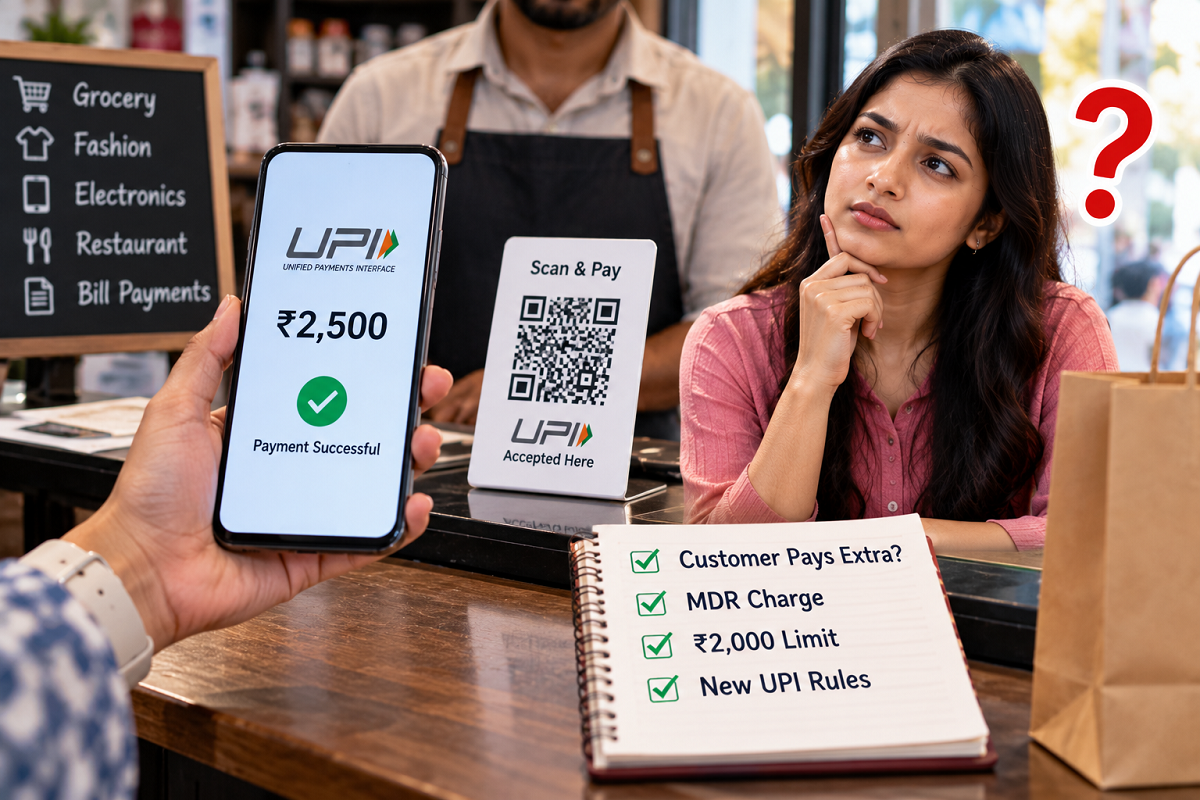
Digital payments have become part of everyday life in India, with UPI being used for everything from grocery shopping and utility bills to restaurant payments and money transfers between friends. Against this backdrop, reports about a new Merchant Discount Rate (MDR) on certain UPI transactions have created confusion among users.
One of the biggest questions being asked is simple: Will customers have to pay an extra charge whenever they make a UPI payment of more than ₹2,000?
According to the details cited in the report, a 0.4% MDR is proposed to apply to certain eligible merchant UPI transactions above ₹2,000 from October 15, 2026. GST at the applicable rate would relate to the MDR charged for the payment-processing service.
However, the key distinction for users is that MDR is a merchant-side payment-processing charge and should not automatically be interpreted as a fee that every customer must pay simply because a UPI transaction exceeds ₹2,000.
Here's how the reported system works and what ordinary UPI users need to understand.
What Is MDR in a Digital Payment?
MDR stands for Merchant Discount Rate.
It is essentially a fee associated with processing a digital payment received by a merchant. Depending on the payment system and applicable rules, the charge can involve different participants in the payments ecosystem.
This is different from a customer being directly charged a transaction fee.
That distinction is particularly important when interpreting reports about a 0.4% MDR.
For example, if an eligible merchant receives a transaction covered by the reported MDR framework, the applicable merchant-side processing charge should not automatically be added to the customer's UPI payment as a separate UPI fee.
Will Customers Pay Extra for UPI Transactions Above ₹2,000?
According to the information provided, ordinary customers would not be required to pay an additional UPI transaction charge merely because their payment is above ₹2,000.
In other words, the ₹2,000 threshold mentioned in the reported MDR structure relates to eligible merchant transactions rather than creating a universal consumer fee.
This means users should not assume that sending ₹2,500, ₹5,000 or another amount through UPI will automatically result in a 0.4% deduction from their account as a transaction fee.
The reported MDR is intended to apply on the merchant side in eligible cases.
What Happens to Person-to-Person UPI Transfers?
Payments between individuals are another area where confusion can arise.
According to the details cited in the report, regular person-to-person (P2P) UPI transfers—such as sending money to a friend or family member—would continue without an MDR charge under this framework.
Therefore, the reported merchant-payment rules should not be confused with ordinary personal money transfers.
A payment to a business and a transfer to another individual can fall into different transaction categories within the UPI ecosystem.
Merchant Payments of ₹2,000 or Less
The reported framework also distinguishes between transactions based on value.
According to the information provided, merchant UPI payments of up to ₹2,000 would remain outside the 0.4% MDR charge.
The 0.4% rate is stated to apply to qualifying merchant payments above that threshold.
Again, this is described as a merchant-side charge rather than a blanket fee imposed directly on consumers.
Small Merchants May Receive Different Treatment
Another important part of the reported arrangement concerns smaller merchants.
Under the details cited, merchants classified under the P2PM category may be exempt from the MDR arrangement.
The report describes small merchants receiving up to ₹1 lakh per month through UPI as being outside the new charge.
It further states that if a small merchant receives more than ₹1 lakh per month for three consecutive months, the merchant may be moved into a regular merchant category.
Businesses should verify their classification and applicable conditions with their bank, payment service provider or official payment-system guidance rather than relying solely on general summaries.
Some Transactions May Have a Flat ₹5 Charge
The information also indicates that certain merchant categories could have a different charging structure.
Instead of the percentage-based 0.4% MDR, some specified transactions may reportedly attract a flat ₹5 merchant charge.
The exact applicability depends on the transaction and merchant category, so users and businesses should avoid assuming that one rate applies universally to every UPI payment.
What About GST on the MDR?
Another source of confusion is the reference to 18% GST.
If GST applies to an MDR or payment-processing service, it is calculated on the relevant service charge—not on the entire value of the customer's purchase.
For example, saying that GST applies to a merchant-processing charge is different from saying that 18% GST will suddenly be added to a ₹2,000 or ₹5,000 UPI transfer.
This distinction is essential when reading claims circulating on social media.
UPI Charges Are Different From Other Fees
Even where the UPI transaction itself does not impose a direct customer fee, consumers may still encounter other charges associated with a purchase or service.
An online platform, for example, may separately impose a convenience fee, delivery fee, late-payment charge or another service-related amount where permitted and disclosed.
Such charges should not automatically be described as UPI transaction fees.
Consumers should therefore check the final payment breakdown whenever a merchant or platform asks for more than the advertised price.
Don't Confuse the ₹2,000 MDR Threshold With PIN-Free UPI Features
The ₹2,000 threshold discussed in relation to the reported MDR arrangement should also not be confused with separate UPI features involving small-value or authentication-related payments.
UPI includes different products and transaction mechanisms, each of which can have its own limits and conditions.
A limit associated with one UPI feature does not automatically determine the rules for every other UPI transaction.
What UPI Users Should Remember
The most important takeaway is that reports of a 0.4% MDR on certain merchant transactions above ₹2,000 do not mean every UPI user will automatically pay an extra 0.4% when making a purchase above ₹2,000.
According to the details cited, P2P transfers remain outside the merchant MDR structure, payments of ₹2,000 or less receive different treatment, and eligible small merchants may also be exempt.
Because payment rules can be revised and their implementation can depend on transaction and merchant classifications, users and businesses should verify the latest instructions from official payment-system authorities, banks and payment service providers before treating viral claims as final.
For consumers, the most important distinction is straightforward: a merchant-processing charge and a direct customer UPI fee are not the same thing.