
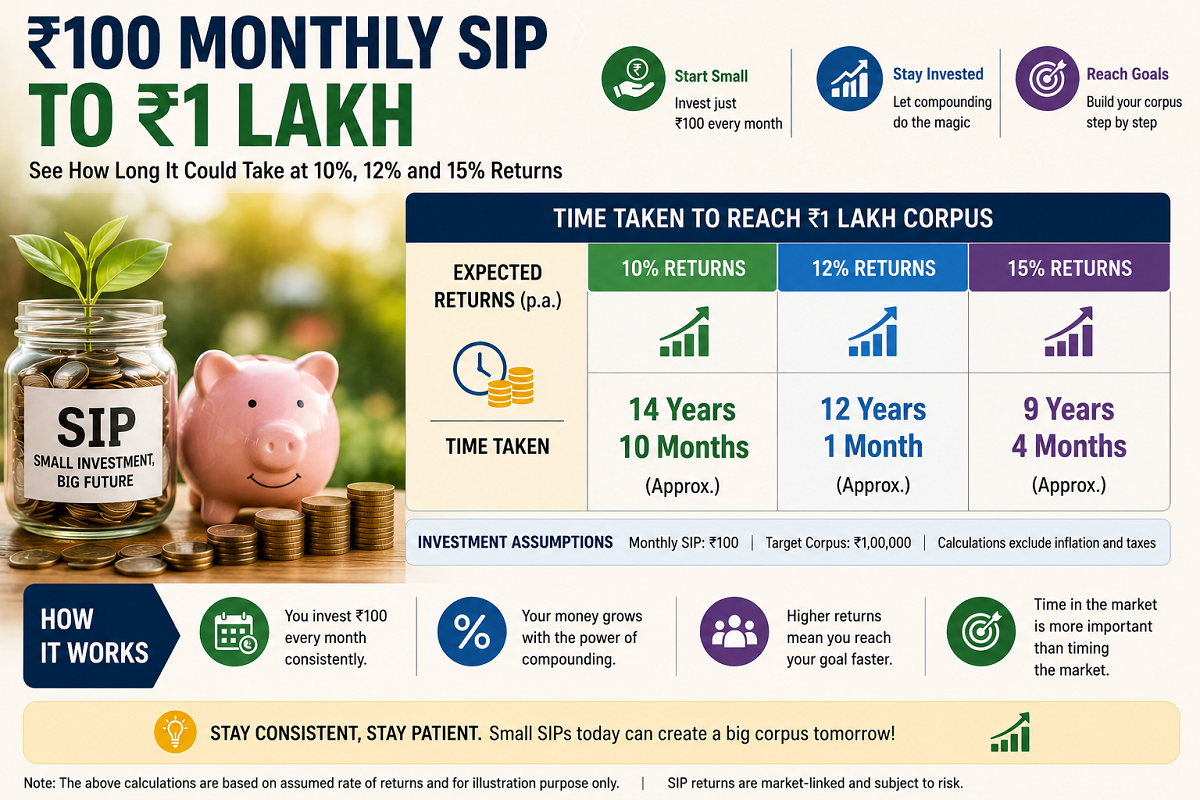
SIP Calculator: Can investing just ₹100 every month eventually create a corpus of ₹1 lakh? Mathematically, yes—but the journey could take many years. The biggest factors are time, consistency and the returns generated by the investment.
A Systematic Investment Plan (SIP) allows investors to put a fixed amount into a mutual fund at regular intervals. While ₹100 a month may appear too small to make a meaningful difference, long-term compounding can gradually increase the value of those contributions.
Depending on the assumed annual return, a ₹100 monthly SIP could potentially reach ₹1 lakh in roughly 17 to 23 years. However, these are illustrative calculations, not guaranteed outcomes, because mutual fund returns depend on market performance.
How Long Can ₹100 SIP Take to Reach ₹1 Lakh?
The time required changes considerably depending on the return generated by the investment.
Here is an approximate illustration:
| Assumed Annual Return | Approximate Time to Reach ₹1 Lakh |
|---|---|
| 10% | 22 years 5 months |
| 12% | Around 20 years |
| 15% | 17 years 5 months |
These calculations assume that ₹100 is invested every month without interruption and that the investment earns the assumed return consistently.
Actual mutual fund performance will fluctuate, so investors should treat these numbers only as projections.
At 10% Return, How Much Would You Actually Invest?
Suppose an investor starts a ₹100 monthly SIP and the investment generates an average annualised return of 10%.
According to the illustration, reaching ₹1 lakh could take approximately 22 years and 5 months.
During this period, the investor would contribute around ₹26,900 from their own pocket.
The remaining approximately ₹73,100 would represent the estimated growth generated by the investment.
This example highlights one of the most important features of long-term investing: over sufficiently long periods, investment growth can become much larger than the original contribution.
What Happens if Returns Average 12%?
Increasing the assumed return from 10% to 12% significantly changes the calculation.
At an annualised return of 12%, a ₹100 monthly SIP could potentially reach the ₹1 lakh milestone in roughly 20 years.
The investor's total contribution during that period would be around ₹24,000, depending on the exact number and timing of instalments.
The remaining amount would come from estimated investment growth.
This means that even a relatively small difference in long-term returns can reduce the time required to achieve a financial target.
But investors should not select a mutual fund simply because it delivered a higher historical return. Higher-return investments generally involve market risk, and past performance cannot guarantee future results.
Could 15% Returns Make the Goal Much Faster?
The difference becomes even more noticeable if an annualised return of 15% is assumed.
Under this scenario, the ₹1 lakh target could potentially be reached in approximately 17 years and 5 months.
The total amount invested would be around ₹20,900, while approximately ₹79,100 of the final value would represent estimated investment growth.
Here's a comparison of all three scenarios:
| Return Assumption | Approx. Time | Approx. Investment | Estimated Growth |
|---|---|---|---|
| 10% | 22 years 5 months | ₹26,900 | ₹73,100 |
| 12% | Around 20 years | ₹24,000 | ₹76,000 |
| 15% | 17 years 5 months | ₹20,900 | ₹79,100 |
The higher-return scenarios look attractive, but a 15% annual return over nearly two decades should never be treated as assured.
Why Does Compounding Make Such a Big Difference?
Compounding means that returns generated by an investment can themselves generate additional returns over time.
Consider a simple example.
You invest money and it earns a return during the first year. In the following year, returns may be generated not only on your original contribution but also on the gains accumulated earlier.
When this process continues for many years, the growth can accelerate.
This is why time is particularly valuable for young investors. Starting with a small amount early can sometimes be more useful for developing long-term wealth-building habits than waiting several years to begin with a much larger amount.
₹100 SIP Is More About Starting Than Getting Rich
A ₹100 monthly SIP is unlikely to create substantial wealth quickly.
Its biggest advantage may instead be behavioural.
Someone making their first investment can learn how SIPs work, become comfortable with market fluctuations and develop the discipline of investing every month.
Once income increases, the investor can gradually raise the SIP amount.
That is when the combination of higher contributions and compounding can become much more powerful.
What if You Increase the SIP to ₹500?
Increasing the monthly contribution has a much greater impact on the time required to reach ₹1 lakh.
At an assumed annual return of around 12%, a monthly SIP of ₹500 could potentially reach ₹1 lakh in roughly nine years, according to the illustrative calculation.
That is dramatically faster than investing only ₹100 each month.
The reason is simple: compounding helps, but the amount of money being invested also matters.
What About a ₹1,000 Monthly SIP?
Increasing the monthly contribution to ₹1,000 shortens the journey further.
At the same illustrative 12% annualised return, the ₹1 lakh target could potentially be achieved in around five years and nine months.
So while investors often focus heavily on finding funds with higher returns, increasing the amount invested can be an equally powerful strategy.
Trying to move from a 12% return to 15% involves uncertainty. Increasing your monthly SIP from ₹500 to ₹1,000, on the other hand, is something you can control if your income and expenses permit it.
Step-Up SIP Can Make a Bigger Difference
Instead of keeping the SIP fixed for decades, investors can consider increasing their contribution as their income rises.
This approach is commonly called a Step-Up SIP.
For example, someone may start with ₹500 per month and increase it by 10% each year.
The SIP could then progress approximately like this:
- Year 1: ₹500 per month
- Year 2: ₹550 per month
- Year 3: ₹605 per month
- Year 4: about ₹666 per month
- Year 5: about ₹732 per month
Over a long investment period, these annual increases can have a substantial impact on the final corpus.
Don't Chase 15% Returns Just to Reach the Target Faster
SIP calculators often show attractive results when investors enter assumptions such as 15%, 18% or even 20% annual returns.
But a calculator does not predict future market performance.
Equity mutual funds are market-linked. Their value can rise and fall, and there may be periods when returns are negative.
Therefore, financial planning should ideally use reasonable assumptions and allow some margin for lower-than-expected returns.
Investors should select funds based on their goals, time horizon and risk capacity rather than simply choosing the product with the highest recent return.
Inflation Is Another Important Factor
There is another issue with a 20-year investment horizon: ₹1 lakh in the future will not have the same purchasing power as ₹1 lakh today.
Inflation gradually increases the cost of education, healthcare, housing, travel and everyday goods.
Therefore, while reaching ₹1 lakh through a ₹100 SIP can demonstrate the power of long-term compounding, it should not necessarily be treated as a meaningful long-term financial goal by itself.
For major goals, investors should estimate how much money they will actually require after accounting for inflation.
Starting Small Can Still Be Valuable
Someone who cannot invest ₹5,000 or ₹10,000 every month does not necessarily need to wait until their income improves.
Starting with a small affordable amount can build investing discipline.
The contribution can then be increased whenever salary or income rises.
The important thing is to avoid choosing a SIP amount so high that it becomes difficult to maintain during normal financial pressures.
Consistency over many years can matter more than starting aggressively and stopping after a few months.
₹100 SIP Calculator: The Bottom Line
A monthly SIP of ₹100 can theoretically grow to ₹1 lakh, but investors need considerable patience.
At an assumed annual return of 10%, the journey could take around 22 years and five months. At 12%, the target could be reached in roughly 20 years, while an assumed 15% return could shorten the period to approximately 17 years and five months.
The bigger lesson, however, is not that ₹100 can magically turn into ₹1 lakh.
It is that time, regular investing and compounding can make even small contributions grow, while increasing the SIP as income rises can accelerate progress considerably.
Investors should also remember that mutual fund returns are market-linked and none of the return assumptions used in SIP calculations are guaranteed.
Disclaimer: This article is for educational and informational purposes only. Mutual fund investments are subject to market risks. Projected returns are illustrative and do not guarantee future performance. Investors should evaluate their financial goals and risk profile before investing.