Business
Petrol Diesel Price Update: Government Revises Fuel Export Tax Before Diwali, Will Pump Prices Rise?
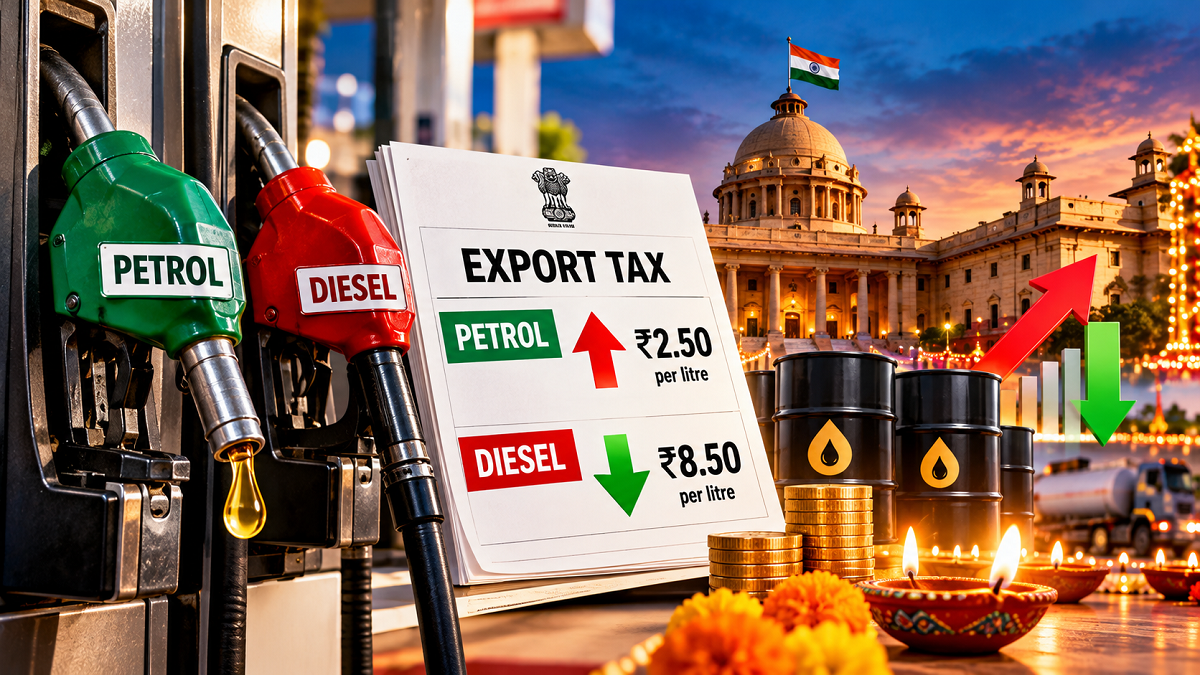
Petrol Diesel Price Today, October 16, 2026: Ahead of the Diwali festive season, the central government has reportedly introduced important changes to export duties on petrol and diesel. The decision, announced late Thursday night, involves an increase in the levy on petrol exports and a substantial reduction in the duty applicable to diesel exports.
According to the reported changes, the export duty on petrol has been increased to ₹2.50 per litre, while the levy on diesel exports has been reduced to ₹8.50 per litre.
The revised rates are reported to have taken effect on Friday, October 16, 2026.
The announcement has attracted attention among motorists, transport operators and businesses, particularly as fuel expenses remain an important component of household and commercial budgets.
However, the reported changes concern fuel exports rather than petrol and diesel sold at domestic filling stations. Therefore, the revision does not automatically mean that consumers will have to pay more when refuelling their vehicles.
Here is what the reported tax adjustment means, how it may affect oil companies and whether retail fuel prices could change in the coming days.
Government Changes Petrol and Diesel Export Duties
The latest reported decision involves separate tax adjustments for petrol and diesel shipped outside India.
While the export duty on petrol has increased, the tax applicable to diesel exports has been reduced considerably.
The reported revisions are as follows:
| Fuel Category | Previous Export Duty | Revised Export Duty | Change |
|---|---|---|---|
| Petrol | ₹0.50 per litre | ₹2.50 per litre | Increased by ₹2 |
| Diesel | ₹16 per litre | ₹8.50 per litre | Reduced by ₹7.50 |
| Aviation Turbine Fuel (ATF) | No reported revision | Unchanged | No change |
The figures are based on the supplied report, which attributes the changes to Reuters.
The higher petrol export duty could increase the tax burden on companies exporting petrol, while the reduction in diesel duty could provide some relief to exporters.
The actual financial impact would depend on export volumes, international fuel prices and refining margins.
Will Petrol and Diesel Become More Expensive Before Diwali?
The biggest concern for ordinary consumers is whether the government's reported decision will lead to higher petrol and diesel prices.
The distinction between export duties and domestic fuel taxes is important.
Export duties apply to products shipped outside the country. They are different from the taxes and pricing components that determine the amount paid by consumers at Indian petrol pumps.
According to the supplied report, the government has not announced a corresponding increase in domestic fuel taxes as part of this decision.
Therefore, motorists should not interpret the reported export duty revision as an immediate nationwide increase in retail petrol or diesel prices.
However, domestic fuel rates may still change because of other market developments, including fluctuations in international crude oil prices and changes in fuel pricing policies.
Petrol Diesel Price Today: Latest Reported Rates in Delhi
Following the reported overnight tax revision, public-sector oil marketing companies, including Indian Oil Corporation, Bharat Petroleum Corporation and Hindustan Petroleum Corporation, were said to have continued their regular fuel price announcements.
The supplied report lists the following prices for Delhi on October 16, 2026:
- Petrol: ₹102.12 per litre
- Diesel: ₹95.20 per litre
The report also states that petrol and diesel prices in Mumbai and Pune remained unchanged.
These figures have not been independently verified against live oil company price listings. Consumers should check their local fuel retailer's latest published rates before relying on them.
What Is Windfall Tax and Why Is It Imposed?
A windfall tax is a special levy that governments may introduce when companies earn unusually high profits because of unexpected market conditions.
In the petroleum industry, sharp movements in international crude oil and refined fuel prices can sometimes create exceptionally favourable margins for producers or exporters.
Governments may respond by introducing or adjusting additional taxes on certain petroleum products.
Such measures can help capture part of the extraordinary gains generated during periods of market disruption.
In India, windfall-related petroleum levies have historically been adjusted in response to changing international oil prices and refining conditions.
These duties should not be confused with the ordinary taxes included in domestic retail fuel prices.
Why Has the Government Revised Export Duties?
International petroleum markets can experience sudden changes because of geopolitical tensions, supply disruptions, production decisions and shifts in global demand.
When fuel prices move sharply, export economics can change significantly.
A higher duty on petrol exports may reduce the additional financial benefit available from overseas sales, while a lower diesel export duty may improve the economics of exporting diesel.
The supplied report describes the latest adjustment as part of the government's approach to responding to international petroleum market conditions.
However, the precise official reasoning behind the October 16 revision should be established from the relevant government notification rather than assumed from the rate changes alone.
How Are Petrol and Diesel Prices Decided in India?
Retail petrol and diesel prices in India depend on several components.
International crude oil prices are an important factor because crude petroleum is the principal raw material used in refining fuel.
The exchange rate between the Indian rupee and the US dollar also matters, since international crude oil transactions are generally priced in dollars.
Other components include refining and distribution costs, central excise duty, state-level value-added tax, and dealer commissions.
Public-sector oil marketing companies play a major role in India's retail fuel market, while private companies such as Nayara Energy and Reliance BP Mobility also operate filling stations.
Although petrol and diesel pricing is formally deregulated, actual retail price revisions do not always follow every short-term movement in international crude oil markets.
This is why a rise or fall in crude prices does not necessarily produce an immediate equivalent change at petrol pumps.
India's Windfall Tax Policy: What Has Changed Over the Years?
India introduced windfall-related taxes on domestic crude oil production and certain petroleum product exports in July 2022.
The measures were introduced during a period of elevated international energy prices and significant volatility in global petroleum markets.
The earlier windfall tax framework was subsequently withdrawn in December 2024.
According to the supplied article, the government reintroduced export-related levies in March 2026 amid renewed international oil market disruptions.
The report further indicates that the latest October revision follows adjustments made in response to changing market conditions.
Any claim about the legal status or effective date of a particular levy should be checked against the applicable government notification.
What Should Consumers Watch in the Coming Days?
For households and vehicle owners, the most important development will be whether oil marketing companies announce any separate changes to domestic petrol and diesel prices.
Changes in export duties alone do not establish a new retail price.
Consumers should also watch international crude oil trends, currency movements and official announcements concerning domestic fuel taxation.
Transport businesses and commercial vehicle operators may pay particular attention to diesel prices because fuel represents a significant operating expense.
Final Takeaway
The central government's reported October 16, 2026, decision raises the export duty on petrol to ₹2.50 per litre while reducing the diesel export duty to ₹8.50 per litre.
The revision could affect the economics of fuel exports, but it does not automatically increase the amount consumers pay at petrol pumps.
For now, the key distinction is that an export tax change is not the same as a retail fuel price hike.
Motorists should continue checking official daily fuel price updates for their respective cities rather than assuming that the reported windfall tax revision will immediately make petrol or diesel more expensive.