
LIFESTYLE
How Do Starfish Walk Without Legs or Bones? Discover the Amazing Science Behind Hundreds of Tube Feet
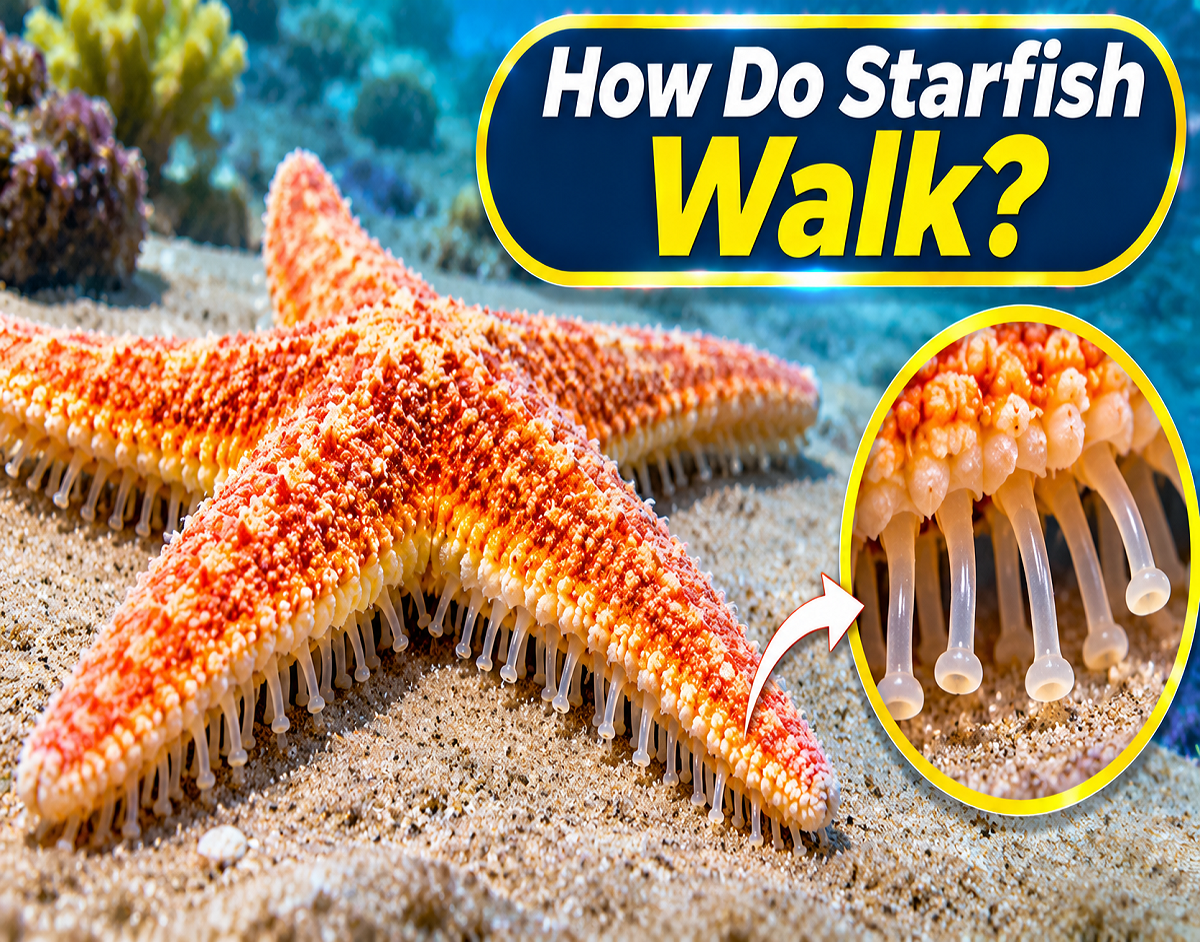
Starfish Facts: The ocean is home to some of the most extraordinary creatures on Earth, and starfish are among the most fascinating. Also known as sea stars, these marine animals can move across sandy seabeds, climb underwater rocks and attach themselves firmly to surfaces despite having no legs like humans or most land animals.
Their secret lies in an unusual biological system that combines hundreds of tiny tube feet, hydraulic pressure and coordinated movements.
Unlike animals that depend on muscles attached to a conventional bony skeleton for walking, sea stars use a specialized water vascular system to control their movement.
This remarkable adaptation allows them to navigate uneven underwater surfaces, withstand strong currents and even capture prey.
Here are eight fascinating scientific facts explaining how starfish move without conventional legs or bones.
1. Starfish Have a Flexible Internal Skeleton Instead of Conventional Bones
Starfish belong to a group of marine invertebrates called echinoderms.
Other members of this group include sea urchins, sand dollars and sea cucumbers.
Although starfish do not possess bones like humans, they are not completely without skeletal support.
Their bodies contain a specialized internal skeleton made of small calcium carbonate structures called ossicles.
These ossicles are connected by flexible tissues, allowing the animal to maintain its shape while remaining capable of movement.
This flexible skeletal arrangement helps sea stars adjust to irregular surfaces such as rocks, coral structures and sandy seabeds.
Their body design is particularly useful in marine environments where they must move across different underwater terrains.
2. Hundreds of Tiny Tube Feet Help Starfish Move
One of the most remarkable features of a starfish is the presence of numerous tube feet.
These small, flexible structures are generally located along grooves on the underside of the animal's arms.
Depending on the species and size, a sea star may possess hundreds or even thousands of tube feet.
Each tube foot can extend, contact a surface and help the animal move.
Individually, a single tube foot produces only a limited amount of force.
However, when large numbers of tube feet operate together, they can generate enough combined traction to move the entire animal.
This coordinated activity allows sea stars to crawl slowly but effectively across the ocean floor.
3. The Water Vascular System Works Like a Natural Hydraulic Network
The movement of starfish depends on a specialized biological structure known as the water vascular system.
This system consists of interconnected fluid-filled canals that help operate the tube feet.
In many sea stars, seawater enters the system through a porous structure called the madreporite, which is usually located on the upper surface of the body.
The fluid passes through a network of canals associated with the animal's internal hydraulic system.
These include structures such as the stone canal, ring canal and radial canals.
The fluid-filled network allows pressure changes to operate the tube feet.
However, the system is more complex than simply pumping fresh seawater directly into each foot with every movement.
Internal fluid circulation, muscular contractions and pressure regulation work together to support locomotion.
4. Hydraulic Pressure Helps Tube Feet Extend and Retract
The water vascular system operates through changes in fluid pressure.
Each tube foot is associated with a small internal muscular structure called an ampulla.
When the ampulla contracts, fluid can be pushed into the tube foot, causing it to extend.
The extended tube foot can then make contact with the surface.
Muscular activity and fluid movement help the tube foot change its shape and position.
As the animal moves, some tube feet remain attached while others release their grip and extend toward new positions.
This repeated sequence produces a slow but coordinated crawling motion.
It is an impressive example of how animals can use hydraulic mechanisms rather than conventional jointed limbs for movement.
5. Starfish Coordinate Their Arms Without a Centralized Brain
Most familiar starfish species have five arms, although some species possess many more.
These arms contain numerous tube feet that must work together to move the animal.
Interestingly, sea stars do not have a centralized brain like humans.
Instead, they possess a nervous system that includes a nerve ring and radial nerves extending into the arms.
This system helps coordinate movement and responses to environmental conditions.
Sea stars can move in different directions without needing to turn their entire body in the same way many land animals do.
Their tube feet respond to signals that help organize movement across the arms.
Researchers continue to study how these distributed control systems produce coordinated locomotion.
6. Tube Feet Help Starfish Hold Onto Rocks in Strong Currents
Starfish frequently live in environments where waves and underwater currents create considerable force.
Despite their relatively slow movement, many species can remain firmly attached to rocks and other underwater surfaces.
Their tube feet play a major role in this ability.
In numerous sea star species, the tips of the tube feet can attach to surfaces using specialized adhesive substances.
This attachment is not always produced by suction alone.
Chemical adhesion and controlled release mechanisms are important in many species.
The ability to attach and detach repeatedly helps sea stars maintain their position while moving across challenging surfaces.
This is especially useful in rocky coastal habitats exposed to wave action.
7. Starfish Move Slowly but With Remarkable Control
Sea stars are not generally known for speed.
Most species move relatively slowly compared with fish and many other marine animals.
However, rapid movement is not always necessary for their survival.
Their locomotion system is well suited to exploring the seabed, navigating rocky areas and searching for food.
The large number of tube feet provides numerous points of contact with the surface.
This can help the animal maintain stability while moving across uneven terrain.
Different starfish species have different movement capabilities, and some can move considerably faster than others.
Their speed depends on factors such as species, body size, environmental conditions and surface type.
8. Tube Feet Also Help Starfish Capture and Eat Prey
Tube feet are not used only for movement.
They also play an important role in feeding.
Many sea stars prey on marine animals such as mussels and clams.
These shellfish protect themselves inside hard shells that can be difficult for predators to open.
Some starfish use their tube feet to attach to the two halves of a shell.
By maintaining a sustained pulling force, they can sometimes create a small opening between the shells.
Certain sea stars then extend part of their stomach outside their body and into the prey.
This process allows digestion to begin outside the sea star's body.
The partially digested material is subsequently processed further.
This feeding strategy is one of the most unusual adaptations found among marine invertebrates.
How Do Starfish Tube Feet Actually Work?
The movement process can be understood through a simple sequence.
| Stage | What happens |
|---|---|
| 1. Fluid pressure changes | The water vascular system regulates pressure within the tube-foot mechanism |
| 2. Tube foot extends | Fluid movement helps the tube foot stretch outward |
| 3. Surface contact | The tube foot reaches and attaches to a suitable surface |
| 4. Pulling movement | Coordinated muscular action helps move the body |
| 5. Detachment | The tube foot releases its attachment |
| 6. Repetition | Numerous tube feet repeat the process to produce locomotion |
The coordinated action of many tube feet allows the sea star to move without conventional legs.
Do Starfish Really Have No Bones?
Starfish do not have a vertebrate skeleton made of bones like those found in humans.
However, they do possess a mineralized internal support system.
Their calcium carbonate ossicles provide structural strength while allowing flexibility.
This distinction is important because describing sea stars as completely skeleton-free would be scientifically inaccurate.
They are invertebrates, meaning they lack a backbone, but they still have specialized skeletal structures.
Can Starfish Walk on Vertical Surfaces?
Yes, many sea star species can climb underwater rocks and other relatively steep surfaces.
Their tube feet provide the attachment needed to maintain contact while moving.
However, climbing ability varies according to the species, surface texture and environmental conditions.
Their adhesive mechanisms are especially useful when navigating rocky underwater habitats.
Why Are Starfish Important to Marine Ecosystems?
Starfish are important members of many marine ecosystems.
Some species act as predators that help regulate populations of mussels and other marine organisms.
Their feeding behaviour can influence the balance of species living in coastal habitats.
Other sea stars feed on different types of organisms or organic material.
Because their ecological roles vary, starfish contribute to marine environments in several ways.
Changes in sea star populations can sometimes affect the wider ecosystem.
Conclusion
Starfish demonstrate how nature can develop extraordinary solutions to the challenge of movement.
Although they lack conventional legs and vertebrate bones, they can travel across the seabed using hundreds of specialized tube feet.
Their water vascular system, hydraulic pressure mechanisms and distributed nervous system work together to coordinate locomotion.
These same structures also help sea stars attach to rocks, withstand currents and capture prey.
From their flexible internal skeleton to their unusual feeding behaviour, sea stars remain among the most remarkable examples of adaptation in the marine world.
Science Note: Starfish anatomy, locomotion and feeding behaviour vary among species. The explanations above describe common features of sea stars rather than characteristics shared identically by every species.