
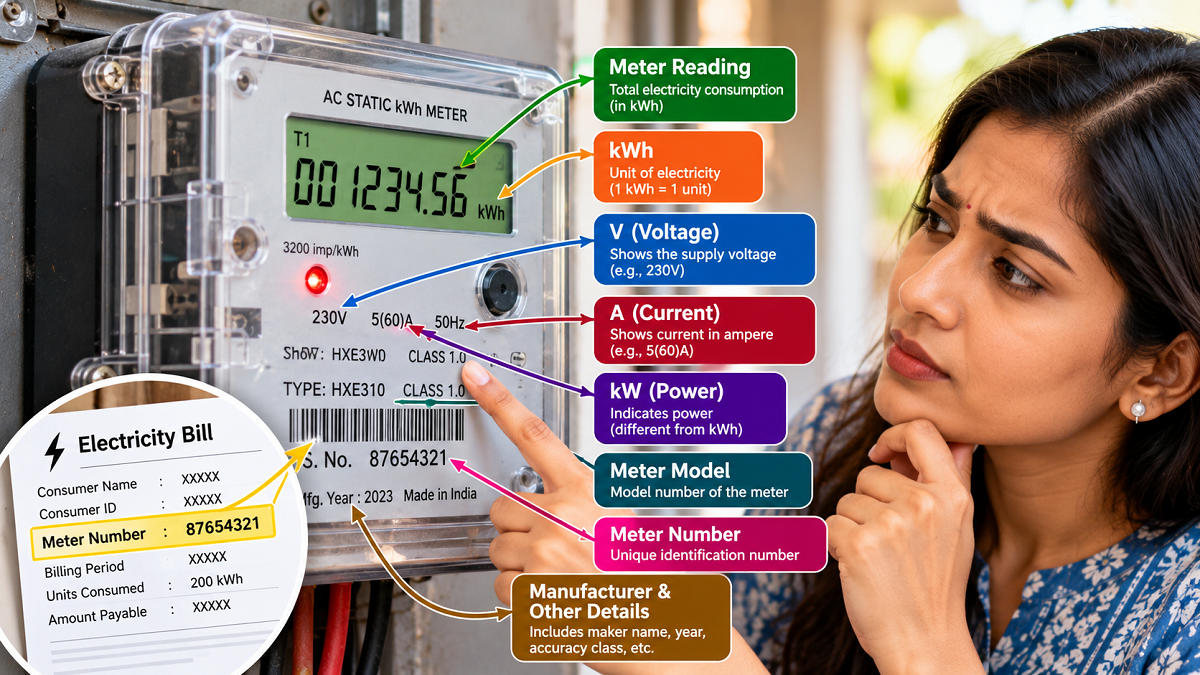
An electricity meter is something most households see regularly, but few people pay attention to the numbers, symbols and technical details printed or displayed on it. Apart from checking the reading or noticing the blinking indicator light, information such as kWh, kW, V, A, meter number and model details can easily be overlooked.
These markings are not random. They provide useful information about the meter's identity, electricity consumption and technical specifications. Understanding some of these basic terms can also make it easier to read your electricity bill and verify whether the meter details mentioned on the bill match the device installed at your home.
Digital and smart meters may display even more information, although the exact data available can vary depending on the meter model and electricity distribution company.
Here's what some of the most common numbers and codes on an electricity meter mean.
1. Meter Number Identifies Your Electricity Meter
One of the most important details printed on an electricity meter is its Meter Number, which may also be described as a Meter Serial Number.
This number acts as an identification reference for the physical meter. Electricity distribution companies use it in their records to distinguish one meter from another.
The meter number is generally also mentioned on the consumer's electricity bill, although its location, name and format can differ between electricity providers.
Checking this number is particularly useful when you want to confirm that the meter information printed on your bill corresponds to the meter installed at your premises.
2. What Does kWh Mean on an Electricity Meter?
The abbreviation kWh stands for kilowatt-hour. It is a unit used to measure electrical energy consumption.
This is one of the most important readings for electricity consumers because billing is generally based on the amount of electrical energy consumed during a billing period, along with applicable tariff components and other charges.
For example, if your electricity consumption during a particular period is recorded as 200 kWh, that represents 200 units of electrical energy for billing purposes, subject to the applicable tariff structure.
In everyday electricity billing terminology in India, 1 kWh is commonly referred to as 1 unit of electricity.
3. Why Do Numbers Keep Changing on a Digital Meter?
Unlike older meters, digital electricity meters can cycle through several pieces of information on their screens.
You may notice one reading appearing for a few seconds before it automatically switches to another.
Depending on the meter model and configuration, the display may show information such as cumulative electricity consumption, current meter reading, energy consumption in kWh, voltage, current and power.
Smart meters may provide additional parameters and communication-related information.
The sequence and type of readings are not necessarily identical across all electricity meters. Consumers should therefore refer to their distribution company's instructions or meter documentation if they need to identify a specific display code.
4. What Does 'V' Mean?
The letter V represents volts, the unit used to express voltage.
Some digital electricity meters can display the voltage being supplied at a particular point in time.
Voltage is different from electricity consumption. A voltage figure does not tell you how many units of electricity you have consumed; instead, it represents an electrical characteristic of the supply.
5. What Does 'A' Represent?
If you see A on the meter display or technical specifications, it refers to ampere, the unit of electric current.
Certain digital and smart meters can show information related to the current being drawn.
You may also find current-related ratings printed permanently on the meter's label. These form part of the meter's technical specifications and should not automatically be interpreted as your current electricity consumption.
6. kW and kWh Are Not the Same
The terms kW and kWh may look similar, but they represent different electrical quantities.
kW, or kilowatt, measures power, while kWh, or kilowatt-hour, measures electrical energy used over time.
A simple way to understand the distinction is to consider an appliance rated at 1 kW. If that appliance continuously operates at that power level for one hour, it would theoretically consume 1 kWh of electrical energy.
Therefore:
kW = Power
kWh = Electrical energy consumed over time
Understanding this difference can prevent confusion when reading a digital meter or checking electricity-related information.
7. Why Are Model Number and Manufacturer Details Printed on the Meter?
Electricity meters usually carry much more information than household consumption readings.
Depending on the device, the label may include the manufacturer's name, model number, serial or meter number, accuracy class, voltage rating, current rating and other technical specifications or certification markings.
These details help identify the exact meter and describe its technical characteristics.
Consumers generally do not need to interpret every technical code for routine billing purposes. If there is a meter-related complaint or technical issue, however, some of these details may be useful when communicating with the electricity distribution company.
8. Compare the Meter Number With Your Electricity Bill
A simple check consumers can perform is comparing the meter number printed on their electricity meter with the meter number mentioned on their electricity bill.
If the numbers match, it helps confirm that the meter referenced in the bill corresponds to the device installed at the premises.
Keep in mind that electricity providers may use different terminology or billing formats. If you cannot locate the meter number on your bill, check your distribution company's official website or contact its authorised customer-support service.
If you notice a mismatch between the meter installed at your property and the details on the electricity bill, contact your electricity distribution company instead of attempting to alter or open the meter yourself.
Understanding Your Meter Can Make Electricity Bills Easier to Read
You do not need to be an electrical engineer to understand the most useful information displayed on your electricity meter.
Knowing that kWh measures energy consumption, kW represents power, V refers to voltage and A represents current can make the meter display much easier to understand. Checking the meter number can also help verify the connection between your physical meter and billing records.
The exact display codes and technical information can vary between meter models and electricity distribution companies, so consumers should use their provider's official guidance whenever they need clarification about a specific reading or symbol.