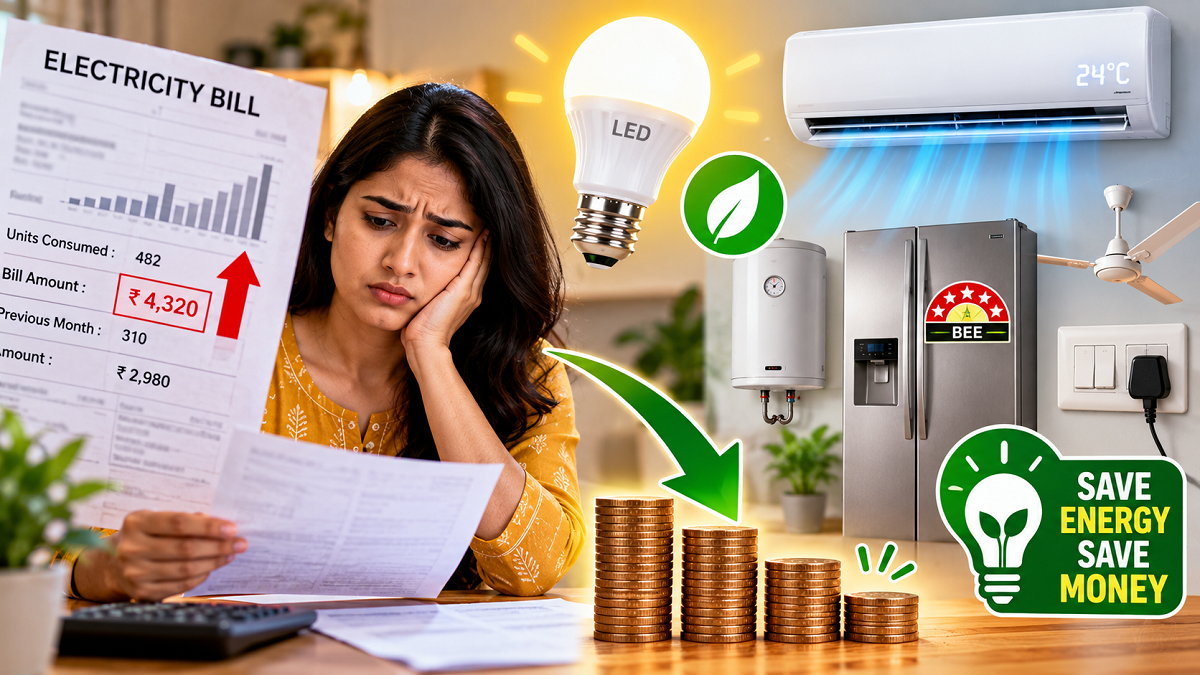
Electricity Bill Saving Tips 2026: Rising electricity expenses have become a concern for many Indian households. From air conditioners and coolers during the summer to geysers and room heaters in winter, everyday appliances can significantly increase monthly power consumption.
While electricity tariffs vary across states and consumer categories, the way household appliances are used also plays an important role in determining the final bill.
Many families unknowingly consume more electricity than necessary because of outdated appliances, inefficient cooling settings and devices left running when they are not needed.
The good news is that reducing electricity consumption does not always require expensive upgrades or major lifestyle changes. Small improvements in daily habits can help households manage their energy usage more efficiently.
Here are five practical electricity-saving tips that may help lower your monthly power bill without compromising everyday comfort.
1. Replace Old Bulbs With Energy-Efficient LED Lights
Lighting is one of the easiest areas where households can reduce unnecessary electricity consumption.
Traditional incandescent bulbs consume considerably more power than modern LED lights while producing a similar amount of illumination.
LED bulbs are designed to provide efficient lighting and generally last longer than conventional filament bulbs.
For example, an LED bulb rated at 9 watts may provide brightness comparable to a traditional 60-watt incandescent bulb, depending on the products being compared.
This difference can translate into meaningful electricity savings when several lights are used regularly.
Simple lighting habits that can help save power:
- Replace old incandescent bulbs with suitable LED alternatives.
- Switch off lights when leaving an empty room.
- Turn off fans when nobody is using the room.
- Use daylight whenever possible instead of keeping indoor lights on.
- Avoid running decorative lighting unnecessarily for long periods.
Although each individual change may appear small, the combined impact can reduce electricity consumption over time.
2. Set Your Air Conditioner at a Sensible Temperature
Air conditioners are among the major electricity-consuming appliances in many Indian homes, particularly during hot summer months.
Running an AC at an unnecessarily low temperature can increase energy consumption because the cooling system must work harder to maintain the selected setting.
For many households, a temperature setting between 24°C and 26°C can provide a practical balance between cooling comfort and energy efficiency.
However, the ideal temperature depends on outdoor conditions, humidity, room insulation and personal comfort.
Ways to improve AC efficiency:
- Set the thermostat at a comfortable temperature instead of automatically choosing the lowest setting.
- Keep doors and windows closed while the AC is operating.
- Clean or replace air filters according to the manufacturer's instructions.
- Use sleep mode or a timer when appropriate.
- Reduce direct sunlight entering the room with curtains or blinds.
- Ensure the AC is properly maintained and suitable for the room size.
Using a ceiling fan alongside an air conditioner may also help distribute cool air more effectively, allowing some users to maintain a higher thermostat setting.
Actual savings will depend on the AC model, operating hours and surrounding conditions.
3. Avoid Unnecessary Use of Geysers and Room Heaters
Water heaters and room heaters can consume substantial amounts of electricity, especially during colder months.
Keeping these appliances running longer than necessary may increase monthly electricity usage.
An electric geyser, for example, uses considerable power while heating water. Although thermostats help regulate temperature in many models, unnecessary heating and heat loss can still contribute to energy consumption.
Tips for using heating appliances efficiently:
- Switch on the geyser when hot water is needed rather than keeping it running unnecessarily.
- Turn it off after use, where appropriate for the appliance.
- Choose a reasonable temperature setting.
- Use room heaters only when necessary.
- Turn off portable heaters when leaving the room.
- Keep heaters away from curtains, furniture and other flammable materials.
- Follow the manufacturer's operating and safety instructions.
Proper use of heating appliances can help reduce wasted electricity while maintaining household comfort.
Safety should always remain the priority when operating electrical heating equipment.
4. Check the BEE Star Rating Before Buying Appliances
Choosing the right appliance can make a difference to electricity expenses over several years.
In India, the Bureau of Energy Efficiency (BEE) provides star ratings for various categories of electrical appliances.
These ratings help consumers compare energy efficiency within the applicable product category and rating period.
Generally, a higher star rating indicates better energy efficiency when comparing suitable appliances under the same rating standards.
However, customers should also check the estimated annual energy consumption printed on the energy label.
Important points to consider before buying an appliance:
- Compare the energy consumption of similar models.
- Check the BEE star rating and applicable rating period.
- Choose an appliance that matches your household's actual requirements.
- Consider both the purchase price and expected running costs.
- Maintain the appliance regularly to support efficient operation.
For instance, an energy-efficient refrigerator may have a higher initial price than a less efficient alternative, but lower electricity consumption could help offset part of that difference over its useful life.
The actual financial benefit depends on usage patterns, electricity tariffs and the price difference between models.
5. Reduce Unnecessary Electricity Consumption at Home
Apart from major appliances, several smaller devices can contribute to household electricity usage.
Televisions, computers, chargers, kitchen equipment and other electronic products may consume power when operating or, in some cases, while remaining in standby mode.
Although standby consumption varies significantly between devices, switching off equipment that is not required can help reduce avoidable energy use.
Everyday habits that may lower electricity consumption:
- Turn off televisions, computers and other devices when they are not being used.
- Disconnect unnecessary chargers and accessories.
- Run washing machines with suitable loads and efficient wash settings.
- Avoid repeatedly opening the refrigerator door.
- Ensure refrigerator door seals are in good condition.
- Keep appliances clean and properly maintained.
- Have malfunctioning electrical equipment inspected by a qualified technician.
Households should pay particular attention to appliances that consume large amounts of electricity or operate for many hours each day.
How Much Electricity Can You Save by Changing Daily Habits?
Electricity savings depend on the wattage of appliances and how long they operate.
A simple calculation can help estimate electricity consumption.
Electricity consumed (units or kWh) = Appliance power in watts × Hours used ÷ 1,000
For example, consider replacing a 60-watt incandescent bulb with a 9-watt LED bulb.
If the light operates for five hours daily, the approximate consumption would be:
| Particulars | 60W Traditional Bulb | 9W LED Bulb |
|---|---|---|
| Daily usage | 5 hours | 5 hours |
| Daily electricity consumption | 0.30 units | 0.045 units |
| Monthly consumption (30 days) | 9 units | 1.35 units |
| Monthly electricity saved | — | 7.65 units |
This is an illustrative calculation based on the stated wattages and usage hours.
Actual electricity bill savings depend on the applicable tariff, taxes, fixed charges and other billing components.
Why Does Your Electricity Bill Remain High Even After Reducing Usage?
Sometimes households notice that their electricity bill remains high despite using fewer appliances.
There can be several reasons for this.
Electricity tariffs may vary according to consumption slabs, while fixed charges and other billing components may affect the final amount.
Seasonal changes can also increase the operating time of air conditioners, refrigerators and heating equipment.
Other possible reasons include malfunctioning appliances, unusually high consumption or problems involving meter readings and billing.
If your bill increases unexpectedly, compare the number of electricity units consumed rather than looking only at the total payable amount.
Review previous bills to identify unusual changes in consumption.
If the difference cannot be explained, contact your electricity distribution company to request clarification.
Additional Tips to Manage Monthly Electricity Expenses
Households can improve energy management by monitoring their consumption regularly.
If your electricity provider offers a smart meter application or online usage information, use it to understand when power consumption is highest.
Check whether your state electricity distribution company provides any applicable household subsidy or concessional tariff.
Eligible households may also explore rooftop solar options under government programmes, subject to technical suitability, eligibility and applicable scheme conditions.
However, energy-saving habits should remain the first step because they can be adopted without significant upfront investment.
Final Thoughts
Reducing your monthly electricity bill does not necessarily require giving up essential household comforts.
Simple steps such as switching to LED lighting, using air conditioners efficiently, limiting unnecessary heating, purchasing energy-efficient appliances and turning off unused devices can help reduce electricity consumption.
The biggest savings generally come from managing high-consumption appliances and reducing unnecessary operating hours.
By making these practical changes and monitoring electricity usage regularly, households can improve energy efficiency and potentially lower their monthly power expenses.
Disclaimer: Electricity savings vary depending on appliance efficiency, household usage, local tariffs and seasonal conditions. The examples in this article are illustrative and do not guarantee a specific reduction in electricity bills.