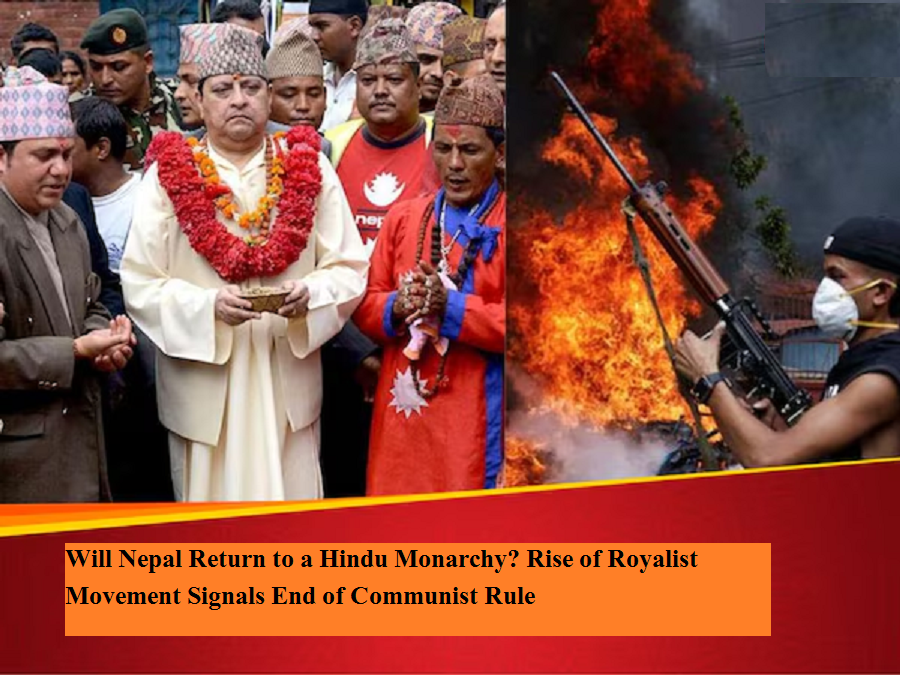
Nepal is witnessing a major political shift as supporters of the monarchy and Hindu nation ideology gain momentum following the recent fall of the communist-led government. Led by influential figures such as Balendra Shah and Sudan Gurung, this powerful movement is receiving widespread public support, sparking speculation about the possible return of monarchy and the end of communist governance in the country.
The Background: A Growing Royalist Sentiment
The recent political upheaval in Nepal traces its roots back to March 2025, when thousands of citizens gathered in Kathmandu to protest against government corruption and centralized power. This uprising was dubbed Nepal’s version of activism—a systematic attempt to take power away from established political elites and give control back to the people.
The movement was notably backed by Balendra Shah, the Mayor of Kathmandu, who belongs to the Maithili Madheshi community and is a well-known advocate of monarchy and the Hindu nation concept. Alongside him, Sudan Gurung also lent his voice and political support to the cause, calling for fundamental change in Nepal’s political structure.
A Turning Point: September 8–9, 2025
On September 8, 2025, significant events unfolded in the capital. Gurung called for a large-scale protest urging students to join the movement wearing school uniforms and carrying books, emphasizing the role of youth in shaping Nepal’s political future. Meanwhile, the ruling CPN-UML party, led by KP Sharma Oli, attempted to bypass constitutional limits by holding a party meeting aimed at scrapping the age limit for the Prime Minister post, which currently restricts anyone over 70 from holding the office.
However, the movement’s strategic planning and mass mobilization gained the upper hand. On September 9, protestors led by Shah and Gurung overtook the government’s authority, marking a symbolic end to Oli’s three-day constitutional assembly meeting and, arguably, to his political power.
The Push for Monarchy and Hindu State
The protest has ignited renewed calls for reinstating the monarchy under King Gyanendra, who ruled Nepal before it became a republic in 2008. Royalist supporters are increasingly asserting that Nepal should return to its Hindu roots and monarchy system, arguing that the democratic and communist frameworks have failed to serve the nation’s interests.
Many believe that the recent movement parallels the Occupy Wall Street movement of 2011 in the United States, where people protested economic inequality and corporate greed. In Nepal, however, the protest has focused on government corruption, concentration of power, and a push for traditional governance structures.
What’s Next for Nepal?
At present, royalist supporters appear to dominate Nepal’s political sentiment. Political analysts suggest that in the coming weeks, the pressure will mount on the current system, with growing demands to restore constitutional monarchy. Speculation is rife that King Gyanendra and constitutional changes may jointly take charge, effectively reversing Nepal’s republican status.
Meanwhile, the international community and neighboring India are closely monitoring the situation. With tourism already suffering amid protests and growing unrest, there is a rising call for political stability to protect both foreign nationals and the future of Nepal.
Final Takeaway
Nepal’s political landscape stands at a critical crossroads. Will it return to being a Hindu monarchy, or will democratic ideals prevail in the face of rising royalist sentiment? The coming weeks are likely to be crucial in determining the future trajectory of this Himalayan nation. As the situation develops, the eyes of the world remain firmly fixed on Kathmandu.