NEWS
UPI May Soon Support AI-Powered Payments: NPCI Working on Protocol for AI Agents to Complete Authorized Transactions
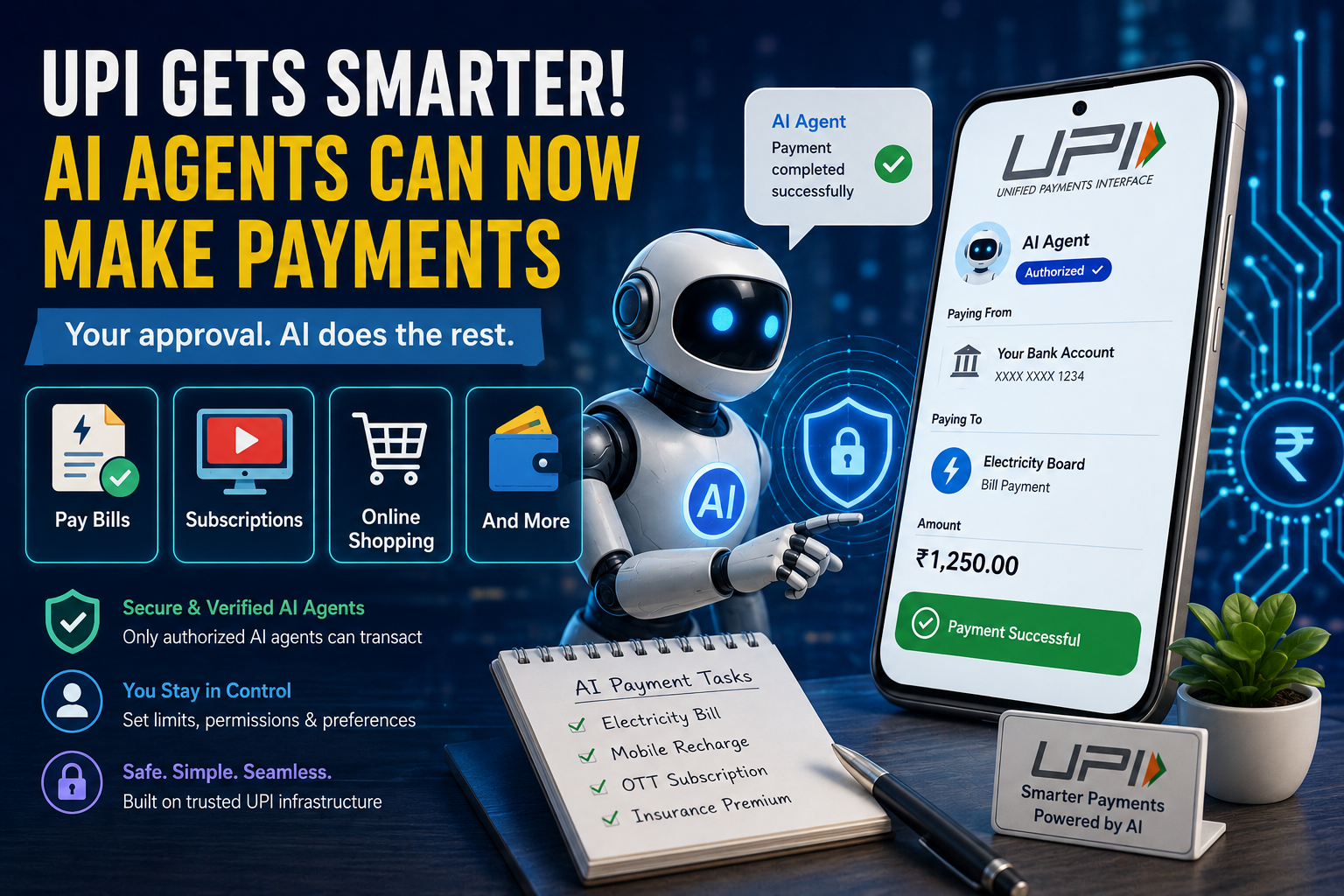
India's digital payments ecosystem could soon take another major step forward as work progresses on a framework that would allow AI-powered agents to perform UPI transactions on behalf of users—with their prior authorization.
The proposed system is being developed through a Unified Agent Protocol (UAP), which aims to integrate artificial intelligence with the existing Unified Payments Interface (UPI). If implemented, AI assistants could help users automate routine financial tasks such as paying utility bills, renewing subscriptions, and completing other approved digital payments.
The initiative is intended to make digital transactions more convenient while maintaining strong security and user control.
What Is the Unified Agent Protocol?
The proposed Unified Agent Protocol (UAP) is designed to create a secure framework that allows verified AI agents to interact with the UPI ecosystem.
Rather than replacing the current payment infrastructure, the protocol is expected to work alongside the existing UPI network, enabling AI applications to perform selected financial activities only after receiving user authorization.
The goal is to introduce intelligent automation without disrupting the way people currently use UPI.
NPCI Leading Development Efforts
According to available information, the National Payments Corporation of India (NPCI) is leading the development of the proposed protocol in collaboration with technology companies and industry experts.
The project focuses on creating common technical standards that can be adopted across different digital platforms while ensuring compatibility with future technological advancements.
Industry consultations are also expected to help build a system that balances innovation with security and regulatory compliance.
How AI Agents Could Handle Payments
Under the proposed framework, AI agents would first undergo a formal registration and verification process before being allowed to participate in financial transactions.
Only authenticated and approved AI agents would be permitted to access payment functions.
Once authorized by the user, AI assistants could potentially perform tasks such as:
- Paying electricity, water, and gas bills.
- Renewing streaming and digital subscriptions.
- Completing recurring online payments.
- Managing routine digital purchases.
- Executing other pre-approved financial transactions.
Every transaction would remain subject to permissions defined by the user, ensuring that AI agents operate only within approved limits.
Strong Focus on Security
Security is expected to remain a central component of the proposed system.
The protocol aims to introduce:
- Verified AI agent registration.
- Identity authentication.
- Secure authorization mechanisms.
- Permission-based transaction controls.
- Standardized operational guidelines.
These safeguards are intended to reduce the risk of unauthorized access, fraudulent activity, and misuse of AI-powered payment capabilities.
Existing UPI Infrastructure Will Continue
One of the key advantages of the proposed framework is that it is not expected to require major changes to the current UPI ecosystem.
Consumers would continue using UPI applications as they do today, while AI-powered payment features would be introduced as an additional layer of functionality.
This approach could simplify adoption by allowing banks, payment providers, merchants, and technology platforms to gradually integrate AI-based services without disrupting existing payment systems.
Potential Benefits for Users
If successfully implemented, AI-powered payment assistants could make everyday financial management more convenient.
Possible advantages include:
- Automatic payment of recurring utility bills.
- Timely renewal of digital subscriptions.
- Reduced manual effort for repetitive transactions.
- Faster completion of routine financial tasks.
- Improved convenience across smartphones and connected devices.
Instead of remembering multiple payment dates each month, users may be able to authorize AI assistants to manage selected recurring expenses according to predefined instructions.
A Step Toward Smarter Digital Payments
Experts believe that integrating artificial intelligence with India's digital payment infrastructure could significantly transform the future of financial services.
Beyond improving convenience for consumers, the technology may also encourage businesses to develop new AI-driven financial products, personalized payment services, and intelligent digital assistants capable of handling increasingly complex financial tasks.
If the initiative progresses successfully, India could become one of the first countries to introduce AI-authorized digital payment capabilities on a national-scale real-time payment network.
User Control Remains Central
Despite the growing role of automation, the proposed framework emphasizes that AI agents will not operate independently without authorization.
Users are expected to retain full control by deciding:
- Which tasks AI agents may perform.
- Spending limits.
- Transaction permissions.
- Duration of authorization.
- Other applicable security settings.
This permission-based model is intended to combine the convenience of automation with the safeguards required for financial transactions.
Disclaimer: The Unified Agent Protocol is under development, and implementation details, features, timelines, and regulatory approvals may change. Users should rely on official announcements from NPCI and relevant authorities for confirmed information regarding future AI-enabled UPI services.