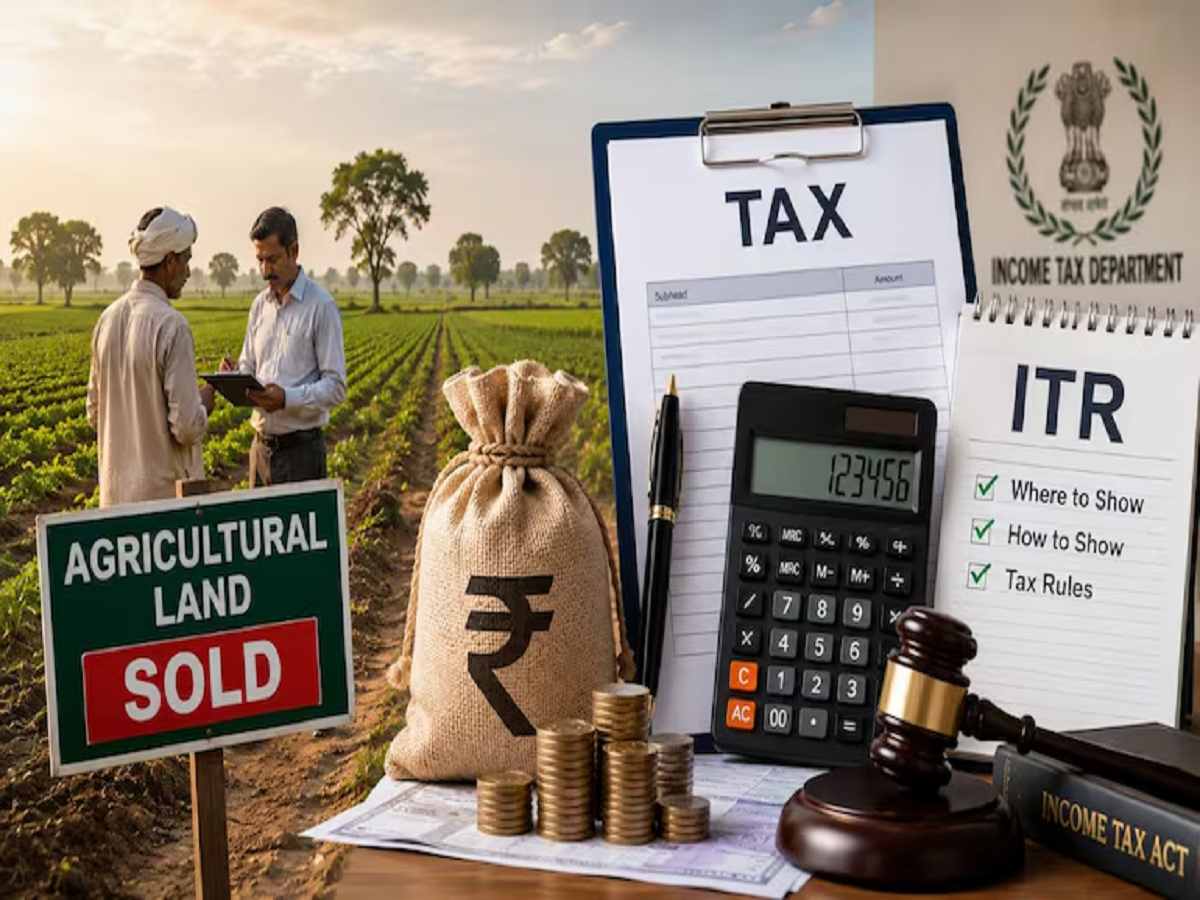
Many landowners in India believe that selling agricultural land is always exempt from income tax. However, the tax treatment of such transactions depends entirely on whether the land is classified as rural agricultural land or urban agricultural land under the Income Tax Act.
Even when no tax is payable, failing to disclose the transaction correctly in your Income Tax Return (ITR) can result in a mismatch with tax records and may trigger an inquiry from the Income Tax Department.
Here is a detailed guide explaining when tax applies, where the income should be reported in your ITR, and the documents you should keep to support your claim.
Rural Agricultural Land Is Generally Exempt from Capital Gains Tax
Under Section 2(14) of the Income Tax Act, rural agricultural land is not treated as a capital asset.
As a result, any profit earned from selling eligible rural agricultural land is generally not subject to capital gains tax.
However, many taxpayers make the mistake of assuming that because the income is tax-free, it does not need to be disclosed in the ITR.
That assumption can lead to unnecessary tax notices.
Where Should the Income Be Reported in the ITR?
Although the gain from selling qualifying rural agricultural land is exempt, it should still be reported in the correct section of the Income Tax Return.
Tax professionals advise taxpayers to disclose such exempt income under Schedule EI (Exempt Income).
Reporting it under Schedule CG (Capital Gains) by mistake may cause the tax filing system to calculate tax automatically, leading to avoidable complications.
Proper disclosure also helps reconcile information available with the Income Tax Department through property registration records and the taxpayer's Annual Information Statement (AIS).
Urban Agricultural Land Is Taxable
If the agricultural land falls within the definition of urban agricultural land, the tax treatment changes significantly.
Profits arising from the sale of urban agricultural land are generally treated as capital gains and become taxable according to the applicable provisions of the Income Tax Act.
However, taxpayers may be eligible for relief under Section 54B.
Tax Relief Under Section 54B
Section 54B allows eligible taxpayers to claim exemption from capital gains tax if the sale proceeds from agricultural land are reinvested in purchasing another agricultural land within the prescribed conditions.
The exemption is available only if all eligibility requirements under the Income Tax Act are satisfied.
Taxpayers should carefully review these conditions or seek professional advice before claiming the benefit.
How Is Agricultural Land Classified?
Whether agricultural land is considered rural or urban is not determined simply by agricultural use.
Instead, classification depends on:
- The population of the nearest municipality or municipal corporation.
- The aerial distance between the land and the municipal limits.
The broad classification criteria are as follows:
| Population of Nearest Municipality | Minimum Distance from Municipal Limits | Classification |
|---|---|---|
| 10,000 to 1 lakh | More than 2 km | Rural Agricultural Land |
| 1 lakh to 10 lakh | More than 6 km | Rural Agricultural Land |
| Above 10 lakh | More than 8 km | Rural Agricultural Land |
If the land falls within these prescribed distance limits, it is generally treated as urban agricultural land, making any capital gains potentially taxable.
Important Documents to Keep Ready
Tax experts recommend maintaining proper documentation in case the Income Tax Department seeks clarification regarding the exemption claimed.
Some key documents include:
Tehsildar's Certificate
An official certificate from the local revenue authority confirming:
- The aerial distance from the nearest municipality.
- Population details of the nearby municipal area.
Land Revenue Records
Official records such as:
- Jamabandi
- RTC (Record of Rights)
- 7/12 Extract
- Other state-specific land records
These documents help establish that the property is officially recorded as agricultural land.
Proof of Agricultural Activity
Keeping evidence of actual farming activity can strengthen your case.
Examples include:
- Seed purchase invoices.
- Fertilizer bills.
- Irrigation records.
- Crop sale receipts.
- Agricultural produce market (mandi) receipts.
These documents demonstrate that agricultural operations were genuinely carried out on the land.
Sale Documents and Banking Records
Maintain copies of:
- Registered sale deed.
- Bank statements reflecting the sale consideration.
- Payment records showing that the transaction was completed through legitimate banking channels.
These records help establish transparency and reduce the risk of future disputes.
Common Mistakes That May Trigger Tax Notices
Many taxpayers receive notices because of avoidable filing errors.
Some common mistakes include:
Not Reporting the Sale at All
Even if the gain is exempt, completely omitting the transaction from the ITR can create a mismatch.
Property registration data is routinely shared with the Income Tax Department and often appears in the taxpayer's Annual Information Statement (AIS).
Failure to disclose the transaction may result in a compliance notice.
Claiming Agricultural Exemption Without Actual Farming
Simply owning land classified as agricultural is not always sufficient.
If agricultural operations have not been carried out for several years, tax authorities may question the exemption claim.
Maintaining evidence of cultivation and agricultural income can help support the taxpayer's position.
Final Takeaway
The tax treatment of agricultural land sales depends primarily on whether the land qualifies as rural or urban under the Income Tax Act. While eligible rural agricultural land is generally exempt from capital gains tax, taxpayers should still disclose the transaction correctly in their Income Tax Return to avoid unnecessary scrutiny.
For urban agricultural land, capital gains tax may apply, although relief under Section 54B may be available if the proceeds are reinvested in another agricultural property. Given the complexity of property taxation, taxpayers should carefully review applicable rules or consult a qualified tax professional before filing their returns.
Disclaimer: This article is intended for informational purposes only and should not be treated as tax or legal advice. Tax laws may change over time, and individual circumstances may vary. Readers should consult a qualified tax advisor before making any tax-related decisions.