NEWS
Ration Card Update: Face Verification Can Help Beneficiaries When Fingerprints Fail at Ration Shops
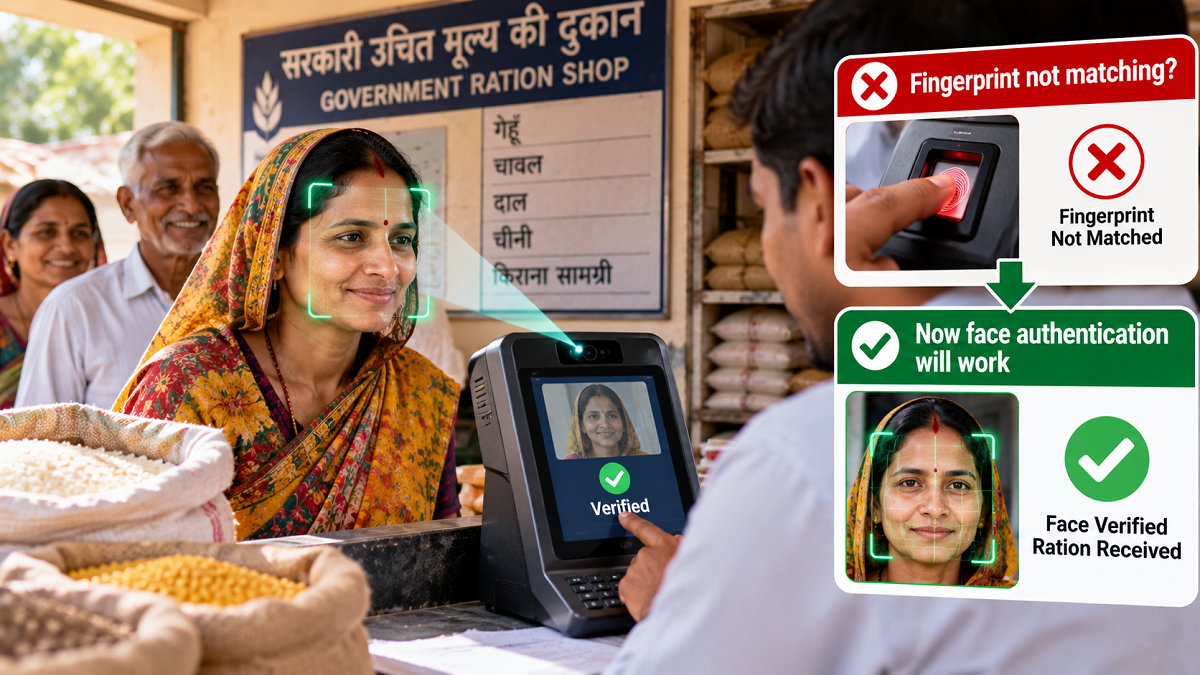
Ration card beneficiaries who face difficulties with fingerprint authentication while collecting subsidised food grains may have another verification option available. Face authentication can be used as an alternative biometric method at supported ration distribution points, helping beneficiaries complete identity verification when fingerprints cannot be successfully matched.
The facility is particularly useful for people who repeatedly experience fingerprint authentication failures because of worn fingerprints, skin conditions, ageing or other technical issues.
Under the existing digital ration distribution system, beneficiaries generally authenticate their identity through electronic Point of Sale (e-POS) devices at Fair Price Shops. Fingerprint-based Aadhaar authentication is commonly used during this process.
Where face authentication has been enabled and supported, a beneficiary's face can instead be used for Aadhaar-based identity verification, reducing dependence on fingerprint matching alone.
Why Fingerprint Authentication Can Sometimes Fail
Biometric verification was introduced to improve identification and transparency in the Public Distribution System (PDS). However, fingerprint authentication may not work smoothly for every beneficiary.
Senior citizens, manual labourers and people whose fingerprints have become faint or worn can sometimes experience difficulties with fingerprint scanners.
There may also be situations where authentication is affected by device-related or connectivity issues.
Repeated biometric failures can create inconvenience for beneficiaries trying to collect their monthly ration. Providing an additional authentication method can therefore make the distribution process more accessible.
How Face Authentication Can Help Ration Card Holders
Face authentication provides another way to verify a beneficiary's identity without depending entirely on a fingerprint scan.
At supported locations, the beneficiary's face is captured through a compatible device or camera and processed through the prescribed Aadhaar-based authentication system.
Once the identity is successfully authenticated, the ration transaction can proceed according to the applicable PDS rules.
This can be especially useful when a beneficiary's fingerprint does not match despite repeated attempts.
The purpose is not necessarily to remove fingerprint authentication altogether. Instead, face authentication provides an additional biometric option where the necessary infrastructure and facility are available.
Who Could Benefit the Most?
The facility could be particularly useful for elderly beneficiaries and people involved in occupations that affect their fingerprints.
Construction workers, farmers and other manual workers may sometimes have fingerprints that are difficult for biometric scanners to read accurately.
Ageing can also affect fingerprint quality.
In these situations, an alternative method such as facial authentication can reduce the need for repeated fingerprint attempts and make identity verification more convenient.
What Happens at the Ration Shop?
When collecting food grains under an eligible ration scheme, a beneficiary generally needs to complete the required authentication at a Fair Price Shop.
Normally, fingerprint authentication can be performed using an e-POS device.
If fingerprint authentication fails and face authentication is available at that location, the beneficiary may be able to complete verification using the supported facial-authentication process.
After successful verification, ration can be issued according to the beneficiary's entitlement and applicable scheme rules.
The exact process can vary depending on the technology deployed by the state or Union Territory and the facilities available at a particular Fair Price Shop.
Face Authentication Can Make the System More Accessible
Introducing alternative authentication options can help make digitally managed welfare schemes more inclusive.
A biometric system works effectively only when eligible beneficiaries can successfully use it. If one authentication method repeatedly fails for genuine users, having another supported method can help reduce inconvenience.
Face authentication may therefore be useful in strengthening accessibility while retaining digital identity verification.
It can also reduce dependence on a single biometric identifier.
Availability May Differ Across Locations
Ration card holders should note that face authentication facilities may not necessarily be available in exactly the same manner at every Fair Price Shop.
Implementation can depend on state-level systems, compatible devices, software availability and local deployment.
Beneficiaries experiencing repeated fingerprint failures should ask their Fair Price Shop dealer or the relevant food and civil supplies department about the alternative authentication methods available in their area.
Consumers should also avoid assuming that every authentication failure automatically makes them ineligible for ration benefits.
Be Careful About Aadhaar and OTP Scams
Whenever Aadhaar-related services are discussed, beneficiaries should remain alert to fraudulent calls, messages and links.
Do not share Aadhaar OTPs, banking passwords, UPI PINs or card credentials with unknown callers claiming that they can activate ration benefits or biometric services.
Beneficiaries should rely on authorised government channels and designated ration distribution centres for assistance.
What Ration Card Beneficiaries Should Know
The availability of face authentication can provide important relief to beneficiaries who struggle with fingerprint verification at ration shops.
Instead of relying exclusively on a thumb or fingerprint scan, supported systems can provide another Aadhaar-based method for completing identity authentication.
This could be particularly helpful for senior citizens, manual workers and other beneficiaries whose fingerprints are difficult to capture accurately.
However, beneficiaries should remember that the availability and exact procedure for face authentication can differ by location. Those facing repeated biometric failures should check with their local Fair Price Shop or food and civil supplies authorities to understand which alternative verification options are currently supported.
The broader objective is to make ration distribution easier and more accessible while ensuring that subsidised food grains reach eligible beneficiaries through a transparent verification system.