Business
Power Bank Rules for Flights 2026: Can You Carry a 20,000mAh Battery? Check Airline Restrictions
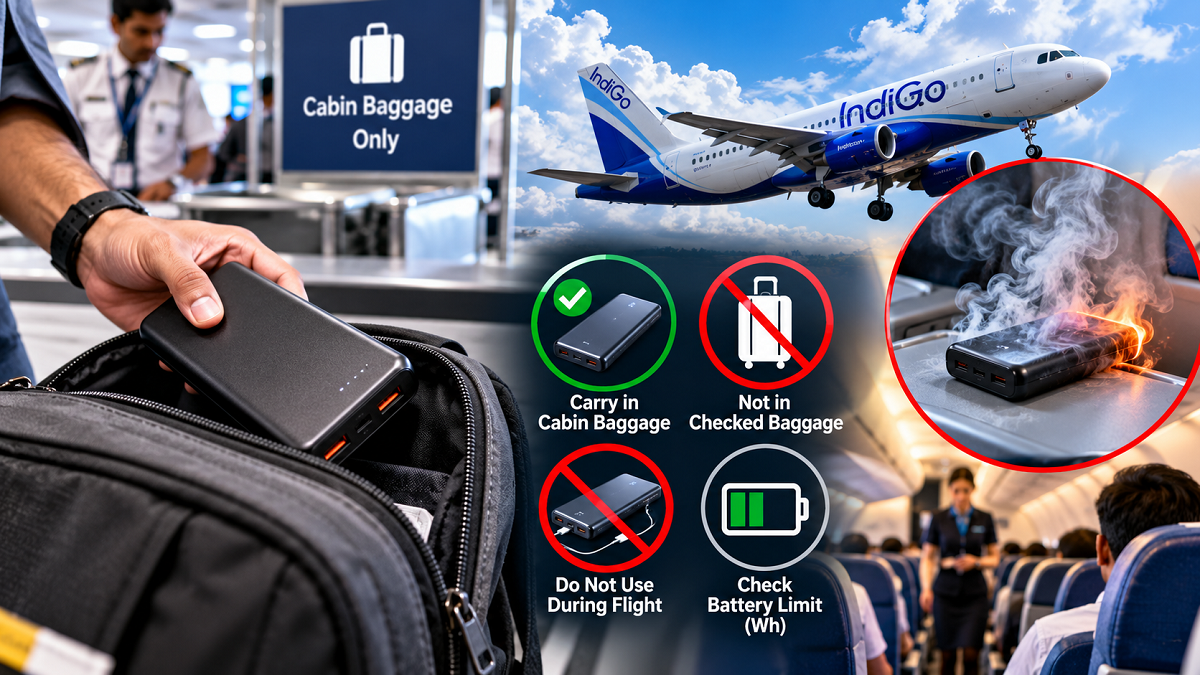
Flight Power Bank Rules 2026: Carrying a power bank while travelling by air may seem harmless, but passengers need to follow specific aviation safety regulations. Portable chargers have become essential travel accessories, particularly for people who rely on smartphones, tablets and other electronic devices throughout their journeys.
However, power banks contain lithium batteries that can pose a fire hazard if damaged, overheated or improperly handled. This is why airlines impose restrictions on where passengers can carry these devices, their battery capacity and whether they can be used during flights.
A reported incident involving an IndiGo flight travelling from Delhi to Chennai has brought renewed attention to electronic-device safety. Flight 6E 6115 was reportedly diverted to Hyderabad after smoke was noticed coming from a passenger's electronic device.
Importantly, the airline had not confirmed that the device involved was a power bank. Therefore, the incident should not be described as a confirmed power bank fire.
For passengers planning domestic or international flights, understanding the applicable rules can help prevent problems during airport security checks and reduce safety risks onboard.
Why Are Power Banks Considered a Safety Risk on Aircraft?
Most portable charging devices use lithium-ion or lithium-polymer batteries because they can store considerable energy in a compact design.
Although these batteries are generally safe when manufactured and used correctly, problems can occur if they are physically damaged, exposed to excessive heat or affected by an internal short circuit.
One of the most serious potential hazards is a process known as thermal runaway.
During thermal runaway, the battery's temperature rises rapidly due to an uncontrolled internal reaction. This can generate significant heat, smoke, flammable gases and, in some circumstances, fire.
Such incidents require immediate attention inside an aircraft because smoke and fire present serious aviation safety concerns.
Airlines therefore regulate the transportation of spare lithium batteries and power banks.
1. Power Banks Must Be Carried in Cabin Baggage
One of the most important rules for air passengers concerns where portable chargers should be packed.
Power banks are generally prohibited in checked baggage and must be carried in the passenger cabin, subject to the applicable airline restrictions.
This requirement exists because cabin crew can identify and respond more quickly if a lithium battery begins overheating or producing smoke.
A battery-related incident inside the cargo hold may be more difficult to access directly.
Passengers should follow these precautions:
- Keep permitted power banks in hand baggage rather than checked suitcases.
- Protect the battery terminals against accidental short circuits.
- Follow the airline's instructions regarding storage during the journey.
- Remove power banks before handing over a cabin bag that must be placed in the aircraft's cargo hold.
Travellers should remember that being permitted to carry a power bank does not necessarily mean they are allowed to use it during the flight.
2. Can You Use a Power Bank During a Flight?
Rules governing power bank usage can differ between airlines.
Some carriers restrict or prohibit using portable chargers to charge phones, tablets and other devices during the flight.
The supplied report states that IndiGo has introduced restrictions concerning onboard power bank usage.
Passengers flying with IndiGo or another carrier should check the latest published policy before travelling.
Where onboard power bank use is prohibited, passengers must not connect their portable charger to a smartphone or another electronic device.
Similarly, charging a power bank through an aircraft's USB port or electrical outlet may be restricted.
Passengers should follow cabin crew instructions even when a particular activity appears technically possible.
3. Check Your Power Bank for Damage Before Travelling
A damaged portable charger can create a significant safety hazard.
Before packing, passengers should inspect the device for visible damage or unusual behaviour.
Warning signs include:
- A swollen or distorted battery casing.
- Cracks caused by falls or physical impact.
- Excessive heating during normal operation.
- Unusual chemical or burning smells.
- Hissing sounds or signs of leakage.
- Damaged charging ports or exposed internal components.
If any of these symptoms appear, the device should not be used or taken onboard.
Passengers should replace unsafe power banks rather than attempting to repair damaged lithium batteries themselves.
Using a charger from a reputable manufacturer and following the product's operating instructions can also help reduce risks.
4. How Many mAh Are Allowed on Flights?
Battery capacity is another important factor determining whether a portable charger can be carried onboard.
Airlines generally assess lithium battery energy capacity in watt-hours, abbreviated as Wh.
The commonly referenced aviation thresholds are:
| Power Bank Capacity | General Aviation Rule |
|---|---|
| Up to 100 Wh | Generally permitted in cabin baggage, subject to airline conditions |
| Above 100 Wh and up to 160 Wh | May require airline approval, where permitted |
| Above 160 Wh | Generally prohibited on ordinary passenger aircraft |
These are general thresholds, not a guarantee that every airline will accept every power bank.
Some airlines impose stricter capacity limits, quantity restrictions or additional conditions for portable chargers.
In particular, the allowance for batteries above 100 Wh should not be assumed to apply automatically to all power banks.
Passengers should obtain confirmation from their airline before carrying a high-capacity device.
Is a 20,000mAh Power Bank Allowed on a Plane?
Many travellers own power banks rated at 10,000mAh or 20,000mAh and wonder whether they can carry them during air travel.
The answer depends on the battery's watt-hour rating and the airline's specific rules.
For example, a 20,000mAh power bank using a nominal battery voltage of 3.7V has an approximate energy capacity of:
20,000 × 3.7 ÷ 1,000 = 74 Wh
This falls below the commonly referenced 100 Wh threshold.
However, the calculation depends on the battery's actual rated voltage and specifications.
Passengers should not assume that every 20,000mAh charger has exactly the same watt-hour capacity.
Checking the manufacturer's printed battery rating is the safest approach.
5. What Should You Do if a Power Bank Starts Overheating?
If a portable charger, smartphone or laptop becomes unusually hot during a flight, passengers should immediately notify the cabin crew.
The same applies if a device begins producing smoke, strange noises or a burning smell.
Passengers should avoid trying to open, dismantle or repair the device.
They should also avoid touching or moving a smoking or burning battery without crew instructions.
If an electronic device becomes trapped inside an aircraft seat, passengers should not operate the seat adjustment mechanism in an attempt to retrieve it.
Doing so could crush or damage the battery.
Instead, they should alert the cabin crew and allow trained personnel to handle the situation using the aircraft's established safety procedures.
Early reporting can help prevent a minor battery problem from developing into a more serious incident.
Important Tips Before Carrying a Power Bank on Your Next Flight
Travellers should check the capacity and condition of their portable chargers well before reaching the airport.
It is also advisable to review the airline's baggage policy, particularly when travelling internationally or using multiple airlines on a connecting journey.
Passengers should ensure that battery terminals are protected and that devices cannot be accidentally activated or short-circuited inside their bags.
If the capacity marking is unclear or missing, the airline may require additional information or decline to accept the device.
Carrying a power bank within the general aviation capacity threshold does not override stricter rules imposed by individual carriers.
Final Thoughts
Power banks remain useful travel accessories, but their lithium batteries require careful handling during air journeys.
Passengers should keep permitted portable chargers in cabin baggage, inspect them for damage and verify their watt-hour capacity before travelling.
They should also remember that carrying a power bank and using one onboard are two different matters. Airline-specific restrictions must be followed throughout the flight.
The reported diversion of IndiGo flight 6E 6115 highlights the importance of responding promptly to smoke or overheating from electronic devices, although the type of device involved was not confirmed as a power bank.
Important Advisory: Battery capacity limits, quantity allowances and onboard charging restrictions can vary by airline and route. Passengers should confirm the latest applicable requirements with their airline before departure rather than relying solely on general aviation guidelines.