NEWS
NFSA Ration Rule Change Proposed: Free Wheat and Rice Allocation May Be Revised for AAY Families
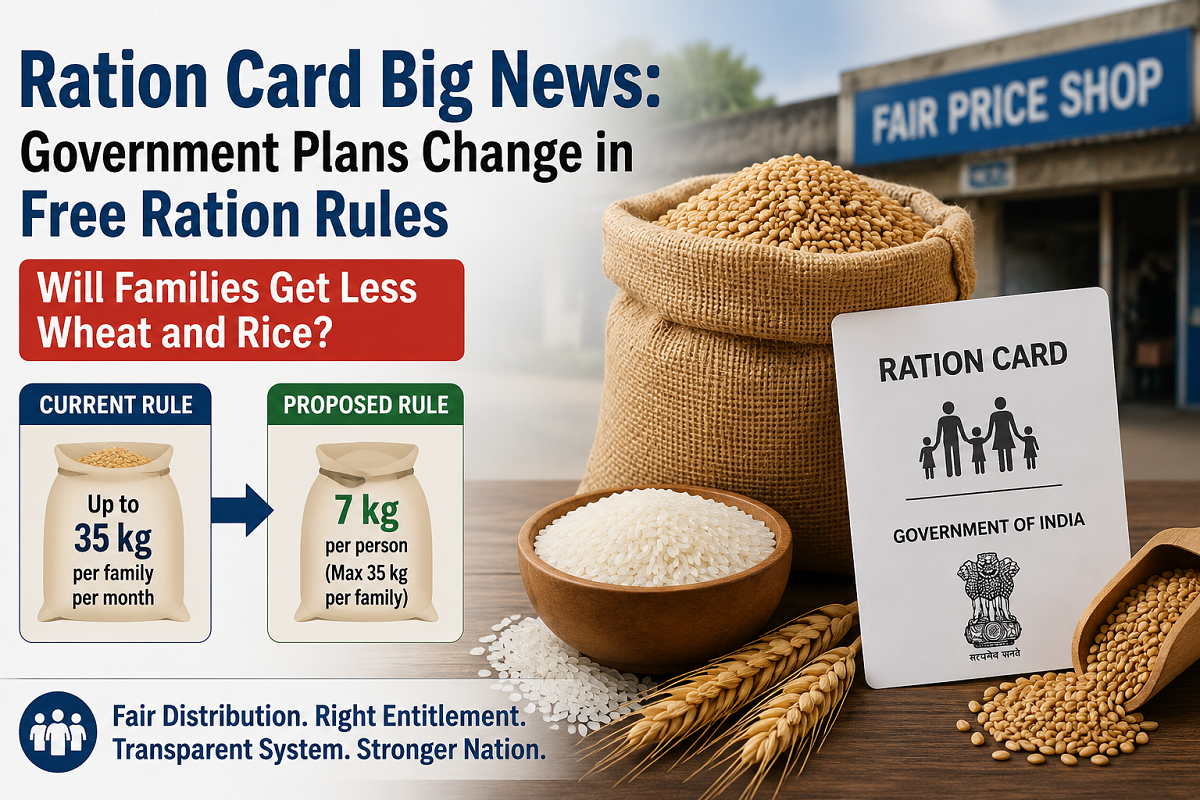
The Central Government has proposed significant changes to the distribution of free food grains under the National Food Security Act (NFSA), a move that could alter the quantity of wheat and rice received by families covered under the Antyodaya Anna Yojana (AAY). If implemented, the proposal will shift the ration allocation from a fixed family-based system to a per-person distribution model while retaining the existing maximum limit of 35 kilograms per household.
The proposed amendment is aimed at making the public distribution system more equitable, transparent, and need-based. It is also expected to help reduce the misuse of subsidized food grains and improve the efficiency of one of India's largest welfare schemes.
What Change Has the Government Proposed?
At present, every eligible Antyodaya Anna Yojana (AAY) household receives up to 35 kilograms of free food grains every month, regardless of the number of family members.
Under the new proposal, the allocation would instead be calculated at 7 kilograms per eligible individual, while continuing to cap the total entitlement at 35 kilograms per family.
This means the quantity of free ration a household receives would depend on the number of eligible members listed on the ration card, rather than being automatically fixed at 35 kilograms for every family.
How Will Families Be Affected?
The proposed rule could have different outcomes depending on household size.
A family with five members would continue receiving 35 kilograms of free ration, as 7 kilograms per person equals the current maximum allocation.
However, households with three or four members could receive less food grain than they currently receive because their entitlement would be calculated strictly on the basis of the number of beneficiaries.
For example:
- A three-member family would be entitled to 21 kilograms of free ration.
- A four-member household would receive 28 kilograms.
- A five-member family would continue to get 35 kilograms.
Larger families, however, would not receive additional grain beyond the existing cap. Even if a household has more than five eligible members, the maximum allocation would remain 35 kilograms.
Why Is the Government Considering This Move?
According to the proposal, the primary objective is to ensure that subsidized food grains reach beneficiaries based on actual household requirements.
Officials believe that allocating ration according to the number of eligible family members will help minimize excess distribution and discourage misuse. In some instances, authorities have reported complaints that surplus food grains supplied under welfare schemes were being diverted or sold in the open market instead of being used for household consumption.
By introducing a person-based allocation formula, the government aims to improve accountability and make the distribution process more efficient.
Focus on Transparency and Better Targeting
The government has been working to strengthen the Public Distribution System (PDS) by identifying ineligible or duplicate beneficiaries and ensuring that subsidies are directed to those who genuinely qualify.
The proposed changes are part of a broader effort to make welfare schemes more transparent through better beneficiary verification and more accurate allocation of food grains.
Authorities believe that a revised distribution model could help optimize the use of food grain stocks while ensuring that deserving families continue to receive support under the National Food Security Act.
NFSA Continues to Support Millions of Indians
The National Food Security Act remains one of India's largest social welfare initiatives. More than 80 crore people benefit from subsidized or free food grains through the scheme, with the government spending substantial public funds each year to ensure food security for economically weaker sections.
Any modification to the allocation formula is therefore expected to have a significant impact on millions of beneficiaries across the country.
Proposal Yet to Be Implemented
The revised ration allocation model has been proposed but is yet to be implemented. If approved, eligible families may see changes in the quantity of wheat and rice they receive based on the number of members registered on their ration cards.
Beneficiaries are advised to keep their ration card details updated and follow official government announcements for any final notification regarding the implementation of the revised rules. Until a formal decision is issued, the existing ration distribution system will continue to remain in effect.