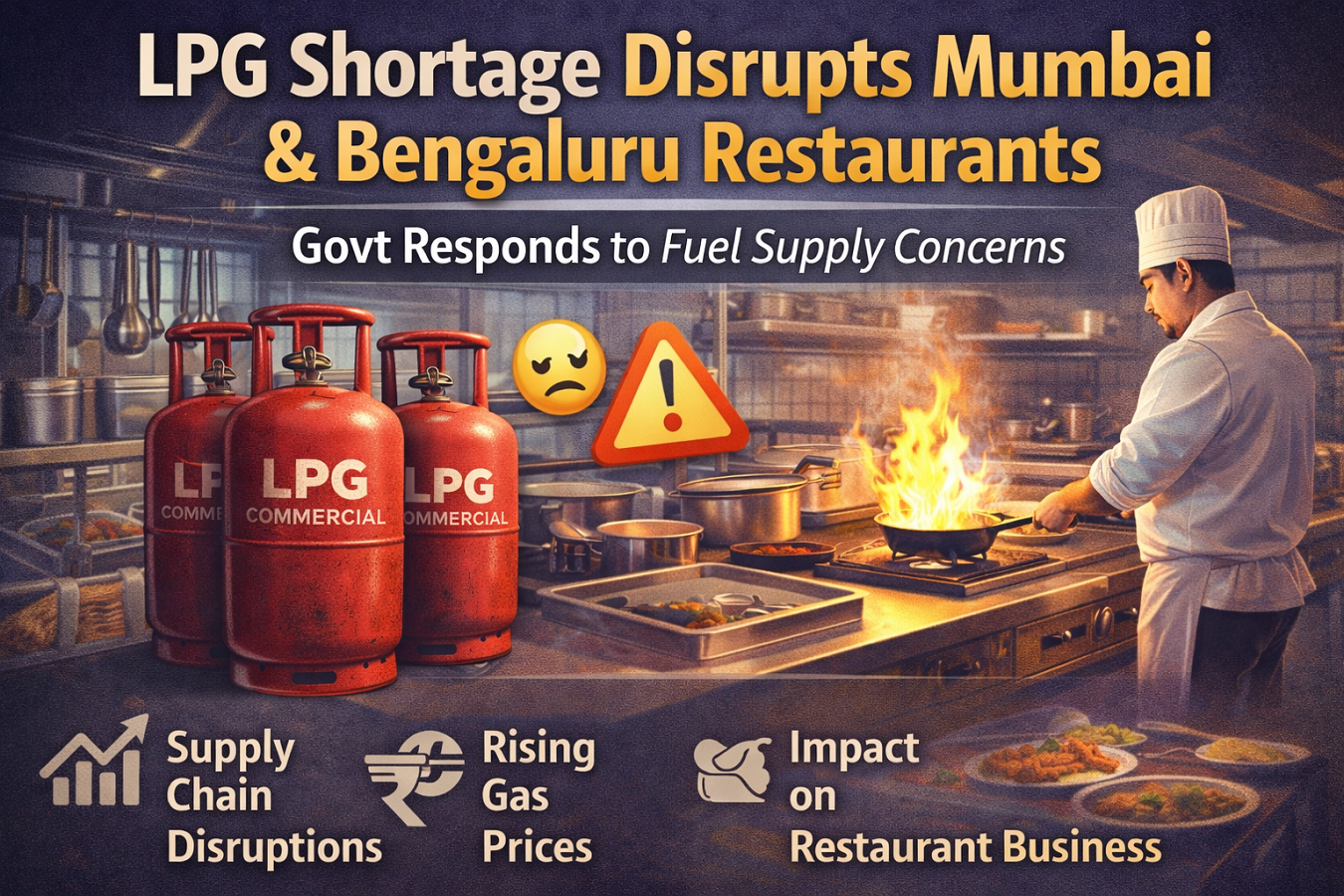
Dining out on weekends or ordering food during office lunch breaks has become a regular part of urban life in India. However, restaurants and food businesses in major cities like Mumbai and Bengaluru are currently facing a serious challenge. A shortage of commercial LPG cylinders has created uncertainty for restaurants, cafés, and small food establishments that rely heavily on gas for daily cooking operations.
Restaurant owners in parts of Maharashtra and Karnataka have reported difficulties in obtaining commercial gas cylinders, raising concerns about possible disruptions in food services. Industry groups have urged authorities to intervene quickly to stabilize supply and avoid further impact on businesses.
Why the LPG Supply Crisis Has Emerged
Experts say the issue is not limited to local distribution problems but is partly linked to global energy supply disruptions. Changes in international supply chains have affected the import of LPG into India, leading to fluctuations in availability.
Several factors have contributed to the situation, including:
- Global supply chain disruptions
- Fluctuations in crude oil and gas production
- Transportation and logistics challenges
Because India imports a significant portion of its LPG requirements, any disruption in international supply can influence domestic availability. Large commercial centers such as Maharashtra and Karnataka, where restaurants and hospitality businesses operate in large numbers, are among the most affected regions.
Restaurant Owners Voice Growing Concerns
For restaurants, commercial LPG cylinders are essential for daily operations. Without a steady supply of gas, kitchen activities can come to a halt.
Many small and medium restaurant owners say they are facing long delays after booking cylinders. According to some operators, waiting periods for deliveries have extended to several days or even weeks in certain areas.
Distribution centers are reportedly experiencing heavy demand, while available stocks remain limited. Restaurant associations warn that if the shortage continues, smaller establishments could be forced to reduce operations or temporarily close.
For businesses that operate on thin profit margins, disruptions in gas supply can create serious financial pressure.
Possible Impact on Food Prices
Whenever supply decreases while demand remains steady, prices tend to rise. The same principle could apply to commercial LPG cylinders.
Restaurant owners say that higher gas prices or limited availability may increase operating costs. In some cases, businesses may also encounter black-market pricing, which further affects profitability.
To manage rising expenses, restaurants might eventually pass some of the additional costs on to customers. This could lead to higher menu prices for everyday food items, potentially affecting consumers who regularly dine out or order meals online.
Calls for Government Intervention
Business associations and restaurant groups have urged the government to address the issue quickly. Industry representatives have requested measures such as:
- Improving supply chain coordination
- Increasing distribution of commercial LPG cylinders
- Prioritizing supply to restaurants and food businesses
Officials have acknowledged the concerns and indicated that efforts are being made to stabilize the LPG supply network. Authorities are also monitoring the situation to ensure that distribution remains fair and efficient.
Exploring Alternative Energy Options
Some experts suggest that restaurants may need to consider alternative cooking solutions to reduce dependence on LPG in the long term.
Possible alternatives include:
- Electric cooking appliances
- Induction-based commercial stoves
- Biogas systems
However, switching to new technologies requires investment and infrastructure changes. For many small food vendors, street food stalls, and roadside eateries, making such transitions quickly may not be practical.
Concerns About Employment in the Hospitality Sector
The restaurant industry supports thousands of workers, including chefs, kitchen staff, delivery workers, and service employees. Industry groups warn that prolonged supply issues could affect employment across the hospitality sector.
If restaurants are forced to reduce operations due to fuel shortages, many workers may face reduced working hours or job losses. This makes the issue not only a business concern but also a livelihood challenge for people employed in the food service industry.
Hope for Supply Stabilization
Despite the current challenges, industry experts remain hopeful that conditions will improve soon. If global supply chains stabilize and domestic distribution becomes more efficient, the availability of commercial LPG cylinders is expected to return to normal levels.
Restaurant owners and consumers alike are hoping that supply systems recover quickly so that the food industry in cities like Mumbai and Bengaluru can continue operating smoothly without disruption.