NEWS
LIC Jeevan Umang Policy 2026: Get 8% Annual Survival Benefit, Life Cover Up to Age 100 and Tax Benefits
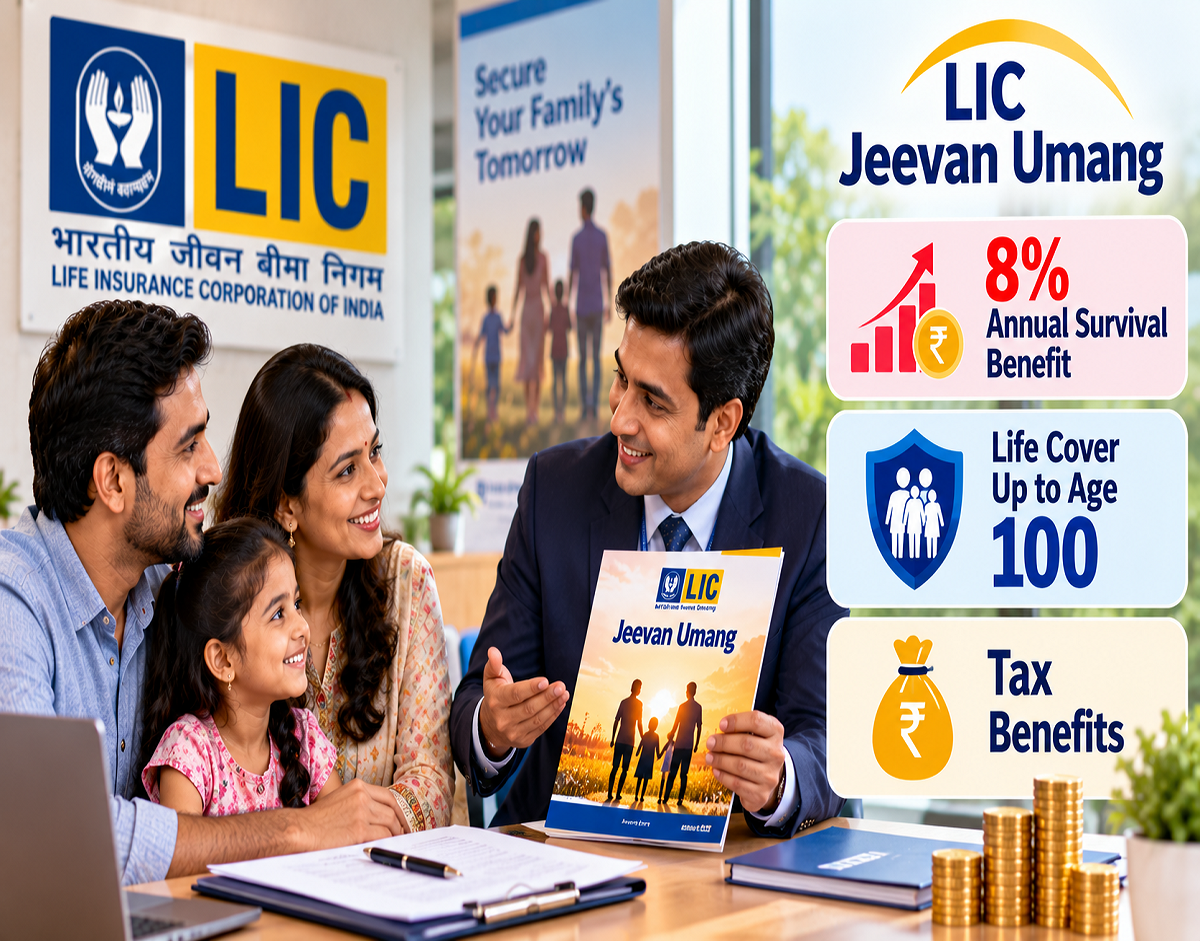
LIC Jeevan Umang Policy 2026: Life Insurance Corporation of India's Jeevan Umang policy is designed to combine long-term life insurance protection with regular survival benefits. Under the policy structure described in the October 2026 report, eligible policyholders can receive an annual survival benefit equal to 8% of the Basic Sum Assured after completing the premium-paying term. The policy also provides life insurance protection and a maturity benefit at age 100, subject to its terms and conditions.
However, policyholders should understand that the 8% annual payout is calculated on the Basic Sum Assured, not on the total premiums paid or the amount invested. Tax benefits also depend on applicable income tax provisions.
What Is LIC Jeevan Umang Policy?
LIC Jeevan Umang is a traditional whole-life insurance product designed to provide financial protection and long-term savings benefits.
The policy is described as a non-linked, participating life insurance plan.
Being non-linked means its benefits are not directly tied to the daily performance of stock market investments.
A participating policy may also receive bonuses declared by LIC, subject to the product's terms.
The October 14 report refers specifically to LIC Jeevan Umang Plan Number 945.
This is an important distinction because LIC has introduced different product versions over time. Plan number 945 is an older version, and customers should verify which Jeevan Umang version, if any, is currently available for new purchases.
Existing policyholders should refer to the terms of their own policy rather than assuming that every version has identical conditions.
How Does the 8% Annual Survival Benefit Work?
The most widely discussed feature of Jeevan Umang is its annual survival benefit.
Under the policy structure described in the report, the policyholder becomes eligible for annual payments after completing the selected premium-paying term.
The annual amount is calculated as 8% of the Basic Sum Assured.
For example, if a policyholder has a Basic Sum Assured of ₹10 lakh, the annual survival benefit would be:
₹10,00,000 × 8% = ₹80,000 per year
Similarly, a Basic Sum Assured of ₹5 lakh would provide an annual survival benefit of ₹40,000 under the stated benefit structure.
These payouts can help support household expenses, particularly during later working years or retirement.
However, the annual benefit should not be described as an 8% investment return.
The actual return on premiums depends on how much the policyholder pays, when premiums are paid, the duration of the policy and other benefits received.
LIC Jeevan Umang: Annual Income Calculation
The following table illustrates the annual survival benefit at different Basic Sum Assured amounts.
| Basic Sum Assured | Annual Survival Benefit at 8% | Monthly Equivalent |
|---|---|---|
| ₹2,00,000 | ₹16,000 | ₹1,333 |
| ₹5,00,000 | ₹40,000 | ₹3,333 |
| ₹10,00,000 | ₹80,000 | ₹6,667 |
| ₹15,00,000 | ₹1,20,000 | ₹10,000 |
| ₹20,00,000 | ₹1,60,000 | ₹13,333 |
| ₹25,00,000 | ₹2,00,000 | ₹16,667 |
The monthly equivalents are provided only for comparison.
The policy described in the report pays survival benefits annually, not as a guaranteed monthly pension.
Actual eligibility and payment timing depend on the policy contract.
Choose From Four Premium-Paying Terms
According to the reported terms of Plan 945, policyholders could select from four premium-paying periods:
- 15 years
- 20 years
- 25 years
- 30 years
The premium-paying term determines how long the policyholder must pay premiums.
Once that period ends, eligible annual survival benefits begin according to the policy schedule.
For example, someone purchasing a policy at age 30 with a 20-year premium-paying term would generally complete premium payments around age 50.
Under the described structure, annual survival benefits would then become payable at the specified policy anniversaries.
However, the exact premium amount would depend on the insured person's age, Basic Sum Assured, selected term and applicable underwriting conditions.
Does LIC Jeevan Umang Provide Life Cover Until Age 100?
The Jeevan Umang structure described in the report provides long-term life insurance protection extending to the policy's maturity age of 100.
If the insured person dies during the policy term, the eligible death benefit is payable according to the contract.
The death benefit may include the applicable sum assured on death, vested bonuses and any final additional bonus, where payable.
However, the amount received by the nominee is not necessarily equal to the Basic Sum Assured alone.
The death benefit formula and applicable conditions must be checked in the official policy document.
Additionally, life insurance protection should not be interpreted as a guarantee that every financial need of the family will be covered.
The adequacy of insurance depends on the selected coverage amount and the family's financial responsibilities.
What Happens When the Policyholder Turns 100?
Under the described Jeevan Umang policy structure, maturity occurs when the insured person reaches the specified maturity age of 100.
The maturity benefit generally includes the Basic Sum Assured along with applicable vested bonuses and any final additional bonus payable under the policy.
For example, a policyholder with a Basic Sum Assured of ₹10 lakh may receive that amount along with eligible bonus additions at maturity.
However, the total maturity amount cannot be calculated accurately without knowing the bonus declarations and policy-specific conditions.
Future bonuses should not be treated as guaranteed unless expressly provided in the contract.
The maturity benefit is separate from the annual survival benefits received during the eligible period.
Is the LIC Jeevan Umang 8% Benefit Guaranteed?
Under the reported Plan 945 structure, the annual survival benefit is specified as 8% of the Basic Sum Assured.
This makes the payment formula predictable, provided the policy remains eligible for the benefit.
However, the distinction between a guaranteed survival benefit and a guaranteed investment return is essential.
Suppose a customer pays substantial premiums over 20 years to obtain a particular Basic Sum Assured.
The annual survival benefit is still calculated on the Basic Sum Assured, not on the cumulative premium payments.
Therefore, the effective annualized return on the customer's investment may be significantly different from 8%.
A complete financial assessment should consider all premiums, annual payouts, death or maturity benefits and the timing of cash flows.
LIC Jeevan Umang Tax Benefits Under Section 80C
The report highlights potential tax benefits on premiums paid toward the policy.
Under applicable income tax provisions, eligible life insurance premiums may qualify for deductions under Section 80C.
However, Section 80C deductions are generally available under the old tax regime, subject to statutory limits and conditions.
Taxpayers using the new tax regime generally cannot claim the same Section 80C deduction.
Eligibility also depends on conditions relating to the insurance policy and the relationship between premiums and the sum assured.
Therefore, not every premium payment automatically qualifies for the maximum deduction.
Policyholders should evaluate the tax benefit according to their individual circumstances.
Are Annual Survival Benefits Tax-Free Under Section 10(10D)?
The October 2026 report states that annual survival benefits are tax-free under Section 10(10D).
However, the tax treatment of life insurance proceeds is subject to statutory conditions.
Section 10(10D) provides exemptions for qualifying life insurance receipts, but certain policies may be excluded because of premium-related limits or other applicable provisions.
For example, tax rules introduced for certain non-ULIP life insurance policies issued on or after April 1, 2023, can affect the exemption where the relevant annual premium thresholds are exceeded.
Older policies may be subject to different conditions.
As a result, the tax treatment of survival benefits and maturity proceeds should be evaluated using the policy's issue date, premium structure and applicable tax law.
It would be misleading to assume that every Jeevan Umang payout is automatically tax-free in all circumstances.
Policyholders should seek professional tax guidance where necessary.
Can You Take a Loan Against LIC Jeevan Umang?
Traditional life insurance policies may offer loan facilities after acquiring the required surrender value.
The report states that policyholders may be eligible to seek a loan after paying premiums for two years.
However, actual loan eligibility depends on the specific version of Jeevan Umang and its contractual conditions.
The loan amount is generally linked to the eligible surrender value rather than the full Basic Sum Assured.
Interest is charged according to the applicable loan terms.
If the policyholder does not repay the outstanding amount, the loan and accrued interest may affect the benefits payable.
Customers should therefore compare policy loan costs with other borrowing options before using this facility.
What Happens if You Surrender the Policy Early?
A policyholder may consider surrendering the insurance contract if financial circumstances change.
However, early surrender can have financial consequences.
The amount payable on surrender is determined by the applicable policy conditions and may be lower than the premiums paid.
Surrendering the policy also generally ends the future benefits associated with the contract.
Before taking this decision, customers should check whether paid-up benefits, policy loans or other contractual options are available.
The most suitable choice depends on the policy's status and the policyholder's financial needs.
LIC Jeevan Umang Eligibility and Minimum Sum Assured
The supplied report provides the following details for Plan 945.
| Feature | Reported Details |
|---|---|
| Policy Name | LIC Jeevan Umang |
| Referenced Plan Number | 945 |
| Policy Type | Non-Linked, Participating Whole-Life Insurance |
| Minimum Entry Age | 90 Days |
| Maximum Entry Age | Up to 55 Years, Subject to Term Conditions |
| Minimum Basic Sum Assured | ₹2,00,000 |
| Premium-Paying Terms | 15, 20, 25 or 30 Years |
| Annual Survival Benefit | 8% of Basic Sum Assured |
| Maturity Age | 100 Years |
| Policy Loan | Subject to Eligibility and Policy Terms |
These details relate to the version described in the report and should not be assumed to apply to every current LIC product.
Is LIC Jeevan Umang Suitable for Retirement Planning?
Jeevan Umang may appeal to people who want a combination of long-term insurance protection and predictable annual cash benefits.
However, it should not be confused with a conventional pension product.
A pension or annuity plan may be designed specifically to provide retirement income, whereas Jeevan Umang combines insurance and savings benefits under its own structure.
The annual survival benefit may support retirement expenses, but it is not necessarily sufficient to cover all living costs.
Inflation is another important consideration.
A fixed annual payout of ₹80,000 may have less purchasing power after several decades.
Investors should therefore evaluate whether the expected benefits align with their retirement needs and other sources of income.
LIC Jeevan Umang Policy 2026: Important Points Before Investing
Before purchasing any LIC policy, customers should verify the current product name and plan number.
They should also review the official premium illustration, guaranteed benefits, non-guaranteed bonus assumptions and surrender conditions.
For Jeevan Umang, understanding the difference between the Basic Sum Assured and the total premium paid is especially important.
The advertised 8% survival benefit does not mean that the policy delivers an 8% annualized return on invested money.
Existing Plan 945 policyholders should follow the conditions stated in their issued contracts.
New customers should check LIC's currently available product lineup rather than relying on an older plan number.
Conclusion
LIC Jeevan Umang is structured to provide life insurance protection along with annual survival benefits after the premium-paying period.
Under the reported Plan 945 terms, eligible policyholders receive annual payments equal to 8% of the Basic Sum Assured, with maturity scheduled at age 100.
The policy may also provide bonus-related benefits, subject to applicable conditions.
However, investors should carefully evaluate premiums, effective returns, taxation and liquidity before choosing this type of insurance.
The key takeaway is that an 8% survival benefit is not the same as an 8% return on investment. Understanding this distinction can help customers make better long-term financial decisions.
Disclaimer: This article discusses the Jeevan Umang Plan 945 structure described in the supplied report. Plan 945 is an older product version, and its current availability for new purchases has not been verified. Eligibility, benefits, tax treatment and loan provisions depend on the official policy contract and applicable law.