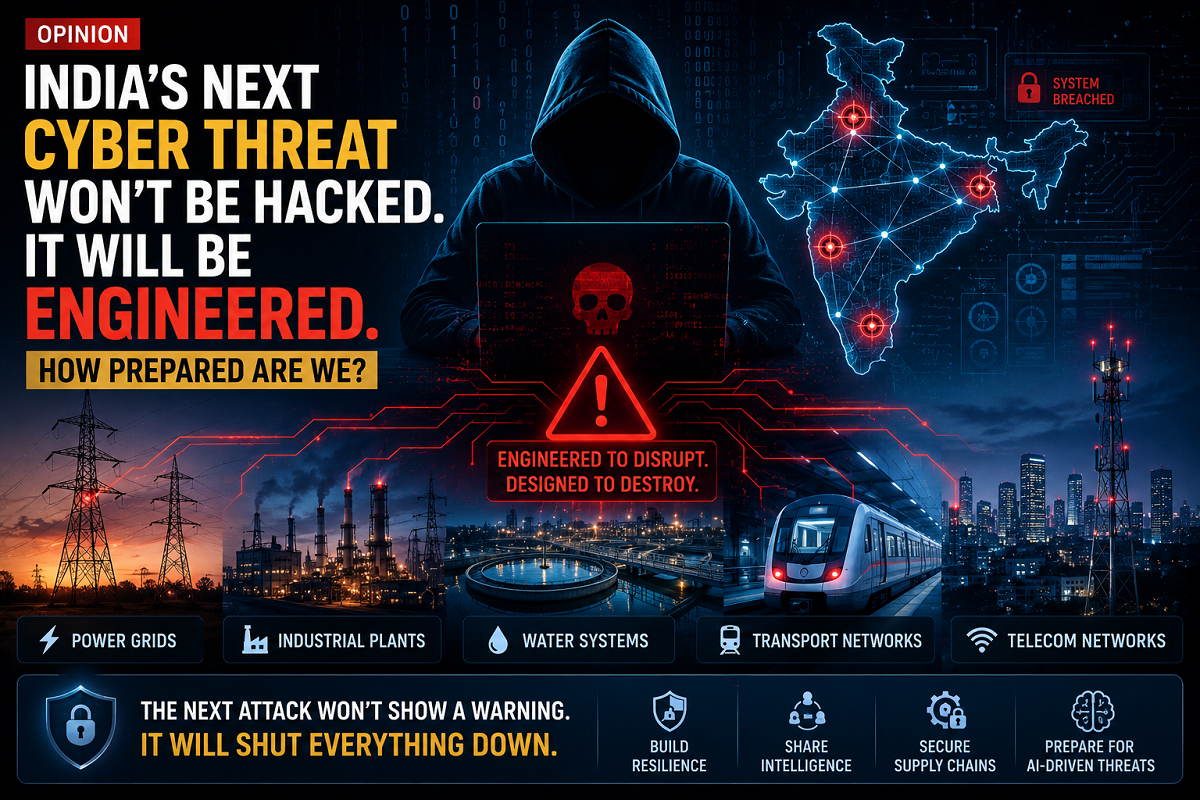
India’s cybersecurity landscape is entering a far more dangerous phase, where the biggest threat may no longer come from ordinary hackers or ransomware gangs. Experts are now warning that future cyberattacks could be designed to quietly infiltrate and manipulate the systems that power the country’s critical infrastructure — from electricity grids and transport networks to water systems and industrial operations.
Unlike traditional cybercrime, these next-generation threats may not announce themselves with ransom demands or stolen databases. Instead, they could remain hidden for months or even years before triggering disruptions capable of damaging essential public services and national infrastructure.
Cybersecurity Threats Are Evolving Rapidly
For years, India’s cyber defense discussions largely revolved around phishing scams, ransomware attacks, financial fraud, and data leaks. While these threats continue to exist, experts believe the nature of cyber warfare is now changing dramatically.
The emerging danger lies in what security professionals describe as “engineered disruption” — attacks specifically designed to manipulate operational systems rather than simply steal data.
This means attackers may attempt to quietly embed malicious elements inside:
- Industrial control systems
- Firmware and hardware components
- Smart city infrastructure
- Telecom networks
- Supply chains
- AI-driven monitoring systems
The goal is no longer limited to financial gain. Instead, the objective could be large-scale operational disruption.
How Engineered Cyberattacks Work
Traditional cyberattacks typically exploit a vulnerability, immediately reveal their presence, and demand money or data access. Engineered attacks operate very differently.
Security analysts say these threats can remain hidden deep inside systems for long periods, waiting for the right moment to activate. There may be:
- No warning signs
- No visible hacking attempts
- No ransom notes
- No immediate detection
By the time the damage becomes visible, the compromised systems may already be deeply affected.
Experts warn that critical infrastructure sectors are particularly vulnerable because modern digital systems are now heavily interconnected.
India’s Rapid Digital Expansion Increasing Risks
India’s fast-growing digital infrastructure has improved connectivity and efficiency across industries, but it has also expanded the potential attack surface.
Over the last decade, the country has rapidly adopted:
- Smart city technologies
- 5G connectivity
- IoT-enabled systems
- Automated factories
- Digital governance platforms
- AI-based infrastructure monitoring
While these systems improve operational efficiency, many were not originally designed to withstand highly sophisticated long-term cyber sabotage attempts.
Experts believe this creates a serious security challenge.
Industrial Systems No Longer Isolated
One major concern highlighted by cybersecurity professionals is the growing integration between operational technology (OT) and information technology (IT).
Previously, industrial systems like power plants, substations, and factory control units operated separately from public internet-connected networks. Today, many of these systems are integrated into centralized digital ecosystems.
As a result, a software vulnerability inside an IT network could potentially allow attackers to reach physical infrastructure systems such as:
- Power grids
- Pipelines
- Transportation systems
- Water treatment facilities
Security experts note that similar attack pathways have already been demonstrated internationally.
Artificial Intelligence Creating New Cyber Risks
Experts say Artificial Intelligence is changing cyber warfare in ways that are still not fully understood.
AI tools can reportedly help attackers:
- Automate reconnaissance
- Create highly convincing scams
- Adapt attacks dynamically
- Analyze defense systems faster
- Generate personalized phishing attempts
This makes traditional security systems less effective because many existing defenses rely on predictable attack patterns.
However, experts warn that AI itself may also become a target.
For example, AI systems used in industrial monitoring or predictive maintenance could potentially be manipulated with false data inputs. In such scenarios, systems may continue showing “normal” conditions while real-world equipment moves closer to failure.
Supply Chain Security Emerging as a Major Weakness
Cybersecurity specialists believe supply chain security is one of the most overlooked vulnerabilities in India’s digital ecosystem.
If malicious code or compromised hardware enters infrastructure before installation, later software updates may not fully remove the threat.
This raises serious concerns about:
- Imported hardware
- Firmware integrity
- Third-party vendors
- Embedded system security
- Procurement oversight
Experts argue that security checks must begin long before systems are activated.
India Needs Resilience, Not Just Reaction
Cybersecurity experts believe India’s current approach often remains reactive rather than preventive.
Typically:
- A cyberattack occurs
- Public concern rises
- Investigations begin
- Investments follow afterward
But for engineered cyber threats, experts warn this strategy may no longer work effectively because the damage could already be deeply embedded long before detection.
Instead, specialists recommend building infrastructure capable of surviving disruptions through:
- Strong redundancy systems
- Operational continuity planning
- Faster recovery frameworks
- Cybersecurity-focused procurement rules
- Real-time intelligence sharing
Shortage of Specialized Cybersecurity Talent
Another major concern is the shortage of professionals trained in advanced operational technology and AI-focused cybersecurity.
Experts say India currently has limited large-scale expertise in areas such as:
- Industrial cybersecurity
- AI system protection
- SCADA security
- Infrastructure resilience
- OT-IT integration defense
Many organizations also focus more on passing compliance audits rather than building genuine long-term cyber resilience.
The Future Threat May Be Invisible
Security analysts believe the most dangerous future cyberattacks may not look like traditional hacking at all.
Instead of dramatic breaches, future threats could quietly manipulate systems behind the scenes until essential services fail unexpectedly.
As India continues building large-scale digital infrastructure, experts stress that cybersecurity can no longer be treated as an optional layer added later. It must become a core part of infrastructure design from the very beginning.
Disclaimer: This article is based on expert opinions and cybersecurity analysis. Threat assessments and security strategies may evolve as technologies and attack methods continue to change globally.