NEWS
EPFO PF Withdrawal Rules 2026: Is Form 121 Required Before 5 Years? Check TDS Rules and Eligibility
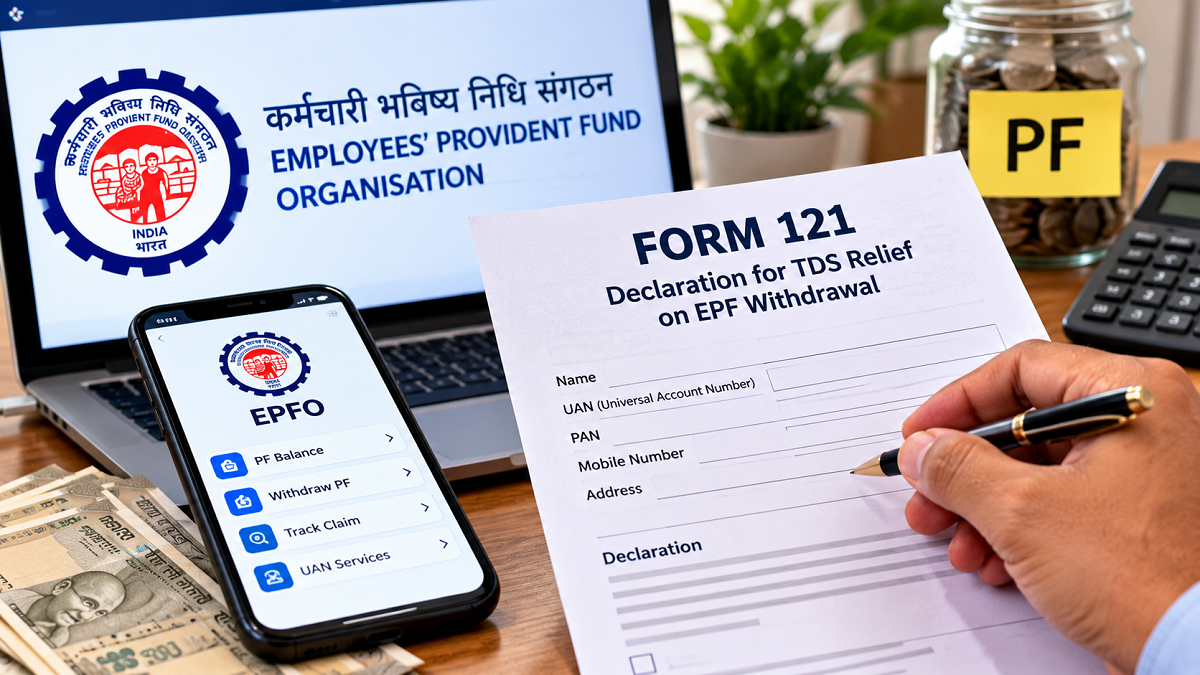
EPFO PF Withdrawal Rules 2026: Employees planning to withdraw money from their Employees' Provident Fund (EPF) accounts before completing five years of service should pay close attention to the applicable income tax rules. An early PF withdrawal may attract Tax Deducted at Source (TDS), depending on the withdrawal amount, service period and other eligibility conditions.
A significant change being discussed for the financial year 2026–27 concerns Form 121, a self-declaration intended to replace Forms 15G and 15H under the new income tax framework for eligible taxpayers seeking relief from TDS.
However, employees should understand that Form 121 is not a mandatory document for every PF withdrawal. Its purpose is to help eligible individuals claim non-deduction of TDS where the law permits.
Submitting the declaration also does not automatically make an otherwise taxable PF withdrawal tax-free.
Here is a detailed explanation of the five-year PF withdrawal rule, the ₹50,000 TDS threshold, Form 121 eligibility and the precautions employees should take before withdrawing their retirement savings.
What Is the New Form 121 for PF Withdrawal?
Form 121 is a proposed replacement under the new income tax framework for the self-declarations traditionally submitted through Forms 15G and 15H.
These declarations are used by eligible taxpayers to request that tax should not be deducted at source on specified income or payments when the applicable legal conditions are satisfied.
In the context of PF withdrawals, the declaration may become relevant when an employee withdraws an EPF balance before completing the required period of continuous service.
The key condition is that the individual must qualify to make the declaration under the applicable tax provisions.
Generally, such declarations involve confirming that the taxpayer's estimated tax liability for the relevant tax year is nil, subject to other statutory restrictions.
Employees should check the officially notified form and its implementation requirements before submitting a PF withdrawal claim.
Is Form 121 Mandatory for Withdrawing PF Before Five Years?
No. Employees should not assume that every withdrawal made before completing five years of service requires Form 121.
The declaration is relevant only when a taxpayer seeks relief from TDS and meets the prescribed eligibility requirements.
For example, an employee who has completed five years of qualifying continuous service may generally be eligible for tax-exempt EPF withdrawal under the applicable conditions.
In such a case, a declaration seeking relief from TDS on an otherwise exempt withdrawal may not be necessary.
Similarly, if the amount withdrawn does not cross the applicable TDS threshold, tax may not be deducted at source even without such a declaration.
However, whether the withdrawal itself is taxable is a separate question.
The important distinction is that Form 121 concerns TDS relief, not permission to withdraw PF money.
What Is the Five-Year Rule for EPF Withdrawals?
Under the applicable income tax framework, withdrawing accumulated EPF funds before completing five years of continuous service can result in tax consequences.
The five-year period is important because qualifying withdrawals after completing the required service period are generally eligible for favourable tax treatment.
However, employees should understand that the calculation of continuous service may include service with previous employers when the PF balance has been transferred correctly.
For example, suppose an employee works for one organisation for three years and then joins another company.
If the employee transfers the previous PF balance to the new employer's eligible provident fund account and continues working for another two years, the combined qualifying service may be considered when applying the five-year rule.
Therefore, employees should not assume that changing jobs automatically resets the service period for tax purposes.
The treatment depends on the applicable transfer and continuity requirements.
When Is TDS Deducted on PF Withdrawal?
TDS may apply when an employee withdraws an eligible accumulated PF balance before completing five years of continuous service.
Under the commonly applicable provisions of Section 192A of the Income-tax Act, 1961, TDS is generally considered when the taxable accumulated balance payable is ₹50,000 or more, subject to the relevant legal conditions and exceptions.
Where valid PAN details are provided, the commonly applicable TDS rate under the earlier framework has been 10%.
However, employees making withdrawals during FY 2026–27 should verify the corresponding provisions, thresholds and rates under the tax framework applicable to that year.
Example of PF Withdrawal and TDS
Consider an employee who has completed only three years of qualifying service and plans to withdraw ₹80,000 from the EPF account.
If the withdrawal is taxable and the applicable TDS rate is 10%, the deduction could be calculated as follows:
| Particulars | Amount |
|---|---|
| PF Withdrawal Amount | ₹80,000 |
| Illustrative TDS Rate | 10% |
| Illustrative TDS Deduction | ₹8,000 |
| Amount Received After TDS | ₹72,000 |
This example is for illustration only and assumes the entire payment is subject to TDS at the stated rate.
The actual deduction may differ depending on the applicable rules, PAN status and other conditions.
What Happens If PAN Is Not Provided?
PAN details can play an important role in determining the TDS applicable to a PF withdrawal.
Where PAN is not furnished or is invalid, higher deduction provisions may apply under the relevant income tax rules.
Employees should therefore ensure that their PAN information is correctly recorded in their EPFO account.
They should also check whether their personal details match across PAN, Aadhaar and EPFO records.
Incorrect or incomplete KYC information can lead to difficulties in processing certain claims.
However, the precise TDS rate and documentation requirements should be verified against the provisions applicable at the time of withdrawal.
Who Can Submit Form 121?
Form 121 is intended for individuals who satisfy the eligibility requirements for declaring that tax should not be deducted on specified payments.
The conditions generally relate to the taxpayer's estimated income and tax liability for the relevant financial year.
An employee should not submit a declaration simply because the PF withdrawal amount is below the basic income tax exemption limit.
The eligibility assessment may involve total estimated income, applicable deductions, tax liability and other statutory restrictions.
Submitting an incorrect declaration can create tax compliance problems.
Employees who are uncertain about their eligibility should review the official instructions or consult a qualified tax professional.
Does Submitting Form 121 Make PF Withdrawal Tax-Free?
This is one of the most important questions for employees considering an early withdrawal.
No. A declaration for non-deduction of TDS does not automatically make the underlying PF withdrawal exempt from income tax.
TDS and final income tax liability are different concepts.
TDS is a mechanism through which tax is collected when certain payments are made.
Final tax liability is determined according to the applicable income tax provisions and the taxpayer's overall financial circumstances.
For example, an employee may qualify for non-deduction of TDS but still need to disclose relevant income in the income tax return, depending on the legal requirements.
Similarly, where TDS has already been deducted, the taxpayer may be able to claim eligible credit or refund through the income tax return process.
The final outcome depends on the individual's tax position.
Are There Exceptions to the Five-Year PF Withdrawal Rule?
Certain circumstances may receive different tax treatment under the applicable provident fund provisions.
For example, qualifying transfers of PF balances between recognised provident fund accounts can preserve service continuity.
Additionally, specific circumstances involving termination of employment for reasons beyond the employee's control may be covered by statutory exceptions.
These can include certain situations involving ill health, discontinuation of the employer's business or other qualifying circumstances recognised under the law.
However, employees should not assume that every resignation, job loss or personal emergency automatically qualifies for an exemption.
The precise reason for leaving employment and the relevant statutory conditions matter.
What Should Employees Check Before Applying for PF Withdrawal?
Before submitting a claim, employees should review their EPFO account details and confirm whether the withdrawal is permitted under the applicable scheme rules.
They should also verify their qualifying service period, PAN details, bank account information and whether any previous PF balances have been transferred correctly.
If the withdrawal may attract TDS, employees should determine whether they qualify for a valid non-deduction declaration.
The following checklist can help:
| Important Check | Why It Matters |
|---|---|
| Continuous Service Period | Determines whether the five-year tax rule may apply |
| PF Withdrawal Amount | Helps assess the applicable TDS threshold |
| PAN Details | May affect the rate of tax deduction |
| Previous PF Transfers | May preserve qualifying service continuity |
| Estimated Annual Tax Liability | Relevant for declaration eligibility |
| Applicable Tax Rules | Determines the correct form and deduction requirements |
Employees should also remember that withdrawal eligibility and tax treatment are separate issues.
Even when a withdrawal would be taxable, the employee must still satisfy the relevant EPFO scheme conditions to receive the money.
EPFO PF Withdrawal Rules 2026: What Employees Should Remember
The introduction of Form 121 under the new income tax framework is relevant to employees who may need to claim relief from TDS on certain payments, including eligible PF withdrawals.
However, the declaration should not be misunderstood as a compulsory form for every employee withdrawing PF before completing five years of service.
The five-year service requirement remains an important factor in determining the tax treatment of an EPF withdrawal.
Employees should also consider the applicable TDS threshold, PAN requirements, service continuity rules and any statutory exceptions.
Most importantly, avoiding TDS through an eligible declaration does not automatically mean the PF withdrawal is exempt from income tax.
Before withdrawing retirement savings, employees should verify the rules applicable to FY 2026–27 and ensure that the correct declaration and supporting details are submitted wherever required.
Disclaimer: This article provides general information about EPF withdrawals and income tax compliance. The implementation and applicability of Form 121, TDS rates and eligibility requirements should be confirmed through officially notified tax rules and EPFO instructions. Tax treatment depends on individual circumstances.