NEWS
ChatGPT Update 2026: AI Agents Can Handle Multiple Tasks Together, Know How the New Technology Works
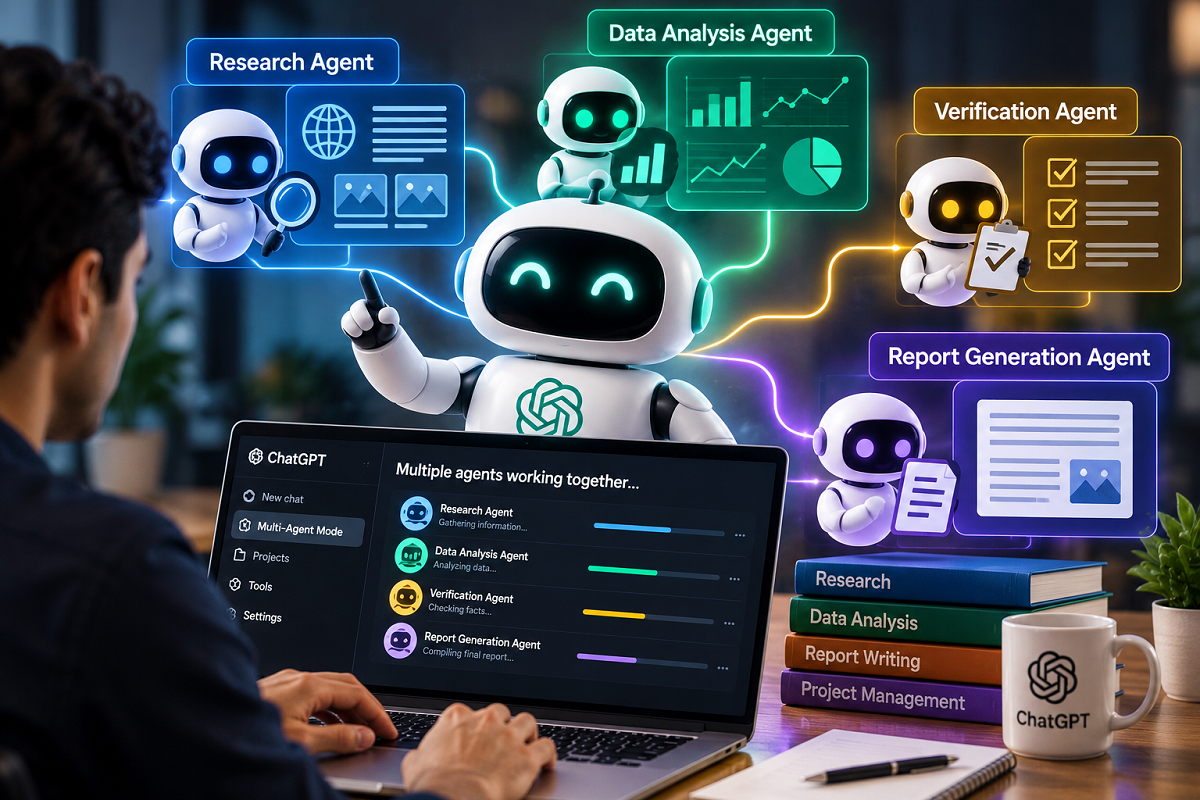
ChatGPT Multi-Agent Update 2026: Artificial intelligence is moving beyond answering questions and writing short messages. Advanced AI systems can now assist with complicated projects involving research, document analysis, coding, data processing and report preparation.
OpenAI has been expanding its agent-based technology to support longer and more demanding workflows. These capabilities are particularly useful for professionals, researchers, developers and businesses that regularly manage several interconnected tasks.
One of the most interesting developments is multi-agent technology, which allows an AI system to divide a complex assignment into smaller activities and delegate suitable parts to specialised AI agents.
Instead of requiring every step to be completed sequentially, independent tasks can potentially run in parallel, helping users manage complicated projects more efficiently.
OpenAI also offers advanced GPT-6 Astra-powered capabilities for eligible users, although access to particular models and agent features depends on the product, subscription and workspace settings.
What Is ChatGPT's Multi-Agent Technology?
Multi-agent technology involves a coordinating AI agent working with several smaller agents, sometimes called subagents.
Each subagent receives a specific responsibility within a larger assignment.
For example, imagine a company preparing a detailed business report. One agent might analyse financial information, another could examine customer trends, while a third reviews relevant documents.
The coordinating agent can then bring the findings together into a structured final report.
This approach is particularly valuable when tasks are sufficiently independent to be completed simultaneously.
However, not every assignment benefits from parallel processing. Tasks that depend on the results of earlier steps may still need to be completed in sequence.
How Can Multiple AI Agents Work on One Project?
A multi-agent workflow generally begins with a user describing the overall objective.
The coordinating system then identifies smaller activities that could contribute to completing the assignment.
For instance, a market research project might involve gathering industry information, examining competitors, organising numerical data and preparing a written summary.
Different agents can work on separate parts of the assignment where supported.
Once those activities are completed, the coordinating system reviews and combines the results.
The objective is to reduce unnecessary repetition and make better use of available computing resources.
Importantly, users should still review the final output, especially when it involves financial information, legal documents, medical subjects or other decisions requiring high accuracy.
1. Multiple Tasks Can Run at the Same Time
Parallel task execution is one of the major advantages of multi-agent systems.
Traditional workflows often involve completing one activity before starting the next.
With multi-agent orchestration, independent activities can proceed simultaneously.
For example, separate agents could examine different sections of a large document collection or investigate distinct technical problems.
This may reduce the time required to complete certain complex projects.
However, the actual speed improvement depends on the workload, system configuration and number of tasks that can genuinely run independently.
Using more agents does not automatically guarantee faster or more accurate results.
2. Better Coordination for Complex Projects
Another benefit of agent-based workflows is the ability to coordinate several activities toward one objective.
Instead of manually managing every individual step, users can describe the result they want and allow a supported AI workflow to organise parts of the process.
ChatGPT Work, for example, is designed for longer, multi-step assignments involving research, analysis and the creation of finished deliverables.
This can be useful for preparing reports, presentations, spreadsheets and other professional materials.
The exact interface and level of control available to users depend on the product and their account access.
Not every ChatGPT conversation automatically launches multiple independent agents.
3. Reusing Information Can Improve Efficiency
Advanced AI workflows may also benefit from mechanisms that reduce unnecessary repeated processing.
Caching and related techniques can allow systems to reuse certain previously processed information instead of performing identical operations again.
For lengthy tasks, this can improve efficiency and reduce computational overhead.
However, caching should not be confused with permanent memory or a guarantee that information remains current.
Previously processed information may still need to be checked again when the underlying facts, files or requirements have changed.
For example, a financial report using yesterday's market prices may require fresh data before publication.
Efficiency improvements are most useful when combined with appropriate verification.
4. Integration With External Tools and Applications
Modern AI agents can become more useful when they have authorised access to relevant tools.
Depending on the available integrations and user permissions, an agent-based workflow may work with documents, spreadsheets, development environments and connected business applications.
For example, a team could use AI assistance to review information from approved company resources and prepare a summary for internal use.
Developers may use coding agents to inspect software projects, identify problems and help implement changes.
OpenAI's Codex tools also support workflows involving multiple agents working on different development tasks.
However, tool access is controlled by product capabilities, account permissions and security settings.
Users should not assume that ChatGPT can access every application or private file automatically.
Can AI Complete a Detailed Audit in 25 Minutes?
The supplied report describes an example in which three AI agents allegedly completed a complicated audit in approximately 25 minutes.
Such an example illustrates the potential appeal of parallel AI workflows, but the specific result should not be treated as a verified performance benchmark without supporting evidence.
The time required to complete an audit depends on the volume of records, complexity of the analysis, quality of available information and required level of verification.
AI can help organise documents, identify inconsistencies and prepare preliminary findings.
However, professional audits may require human judgment, independent checks and formal approval.
AI-generated results should therefore be reviewed before they are used for important business or regulatory decisions.
What Is GPT-6 Astra and Who Can Use It?
GPT-6 Astra is part of OpenAI's advanced model offerings for demanding tasks.
Astra powers the GPT-6 Pro option in ChatGPT for eligible plans and is also available through supported Work and Codex experiences.
These products serve somewhat different purposes.
ChatGPT is commonly used for conversational assistance, explanations, writing and everyday questions.
ChatGPT Work focuses on completing longer assignments that may involve several steps, files and tools.
Codex is designed primarily for software development and coding workflows.
Model availability, usage allowances and access to advanced capabilities vary according to the user's subscription and organisational permissions.
It is also important to distinguish between an advanced AI model and a multi-agent workflow. A powerful model does not necessarily mean that every task automatically uses several agents.
How Could Students and Office Workers Benefit?
AI-assisted workflows can support several everyday activities.
Students may use AI to organise study material, compare concepts and prepare revision notes.
Researchers can use supported tools to examine documents, identify relevant themes and structure preliminary findings.
Office professionals may benefit from assistance with report preparation, spreadsheet analysis and document organisation.
Businesses can explore repeatable agent workflows for tasks such as internal reporting and knowledge management.
However, users remain responsible for checking accuracy, protecting confidential information and complying with relevant workplace or academic rules.
Will Multi-Agent AI Replace Human Workers?
Multi-agent systems are designed to automate or assist with certain activities, but they do not eliminate the need for human oversight.
Complex projects often require contextual understanding, professional responsibility and decisions that cannot be delegated entirely to automated systems.
AI-generated information can contain mistakes, overlook important details or rely on incomplete data.
For that reason, users should verify important conclusions and review any actions affecting sensitive information or external systems.
The most practical approach is to use AI as a tool for improving productivity while maintaining appropriate human control.
Final Thoughts
OpenAI's growing investment in advanced models, agent-based workflows and connected tools is changing how people approach complicated digital tasks.
Multi-agent technology can divide suitable projects into smaller activities and allow independent work to proceed in parallel.
For researchers, businesses and developers, this could make certain workflows more efficient and easier to manage.
However, performance varies, and access to specific features depends on the product and subscription.
The key takeaway: ChatGPT's advanced work capabilities and multi-agent technology can help users manage complex assignments, but they should not be mistaken for a guarantee that every task will run simultaneously or finish without human review.