Business
ATM Cash Withdrawal Failed but Money Deducted? Know RBI's 5-Day Refund Rule and ₹100 Daily Compensation
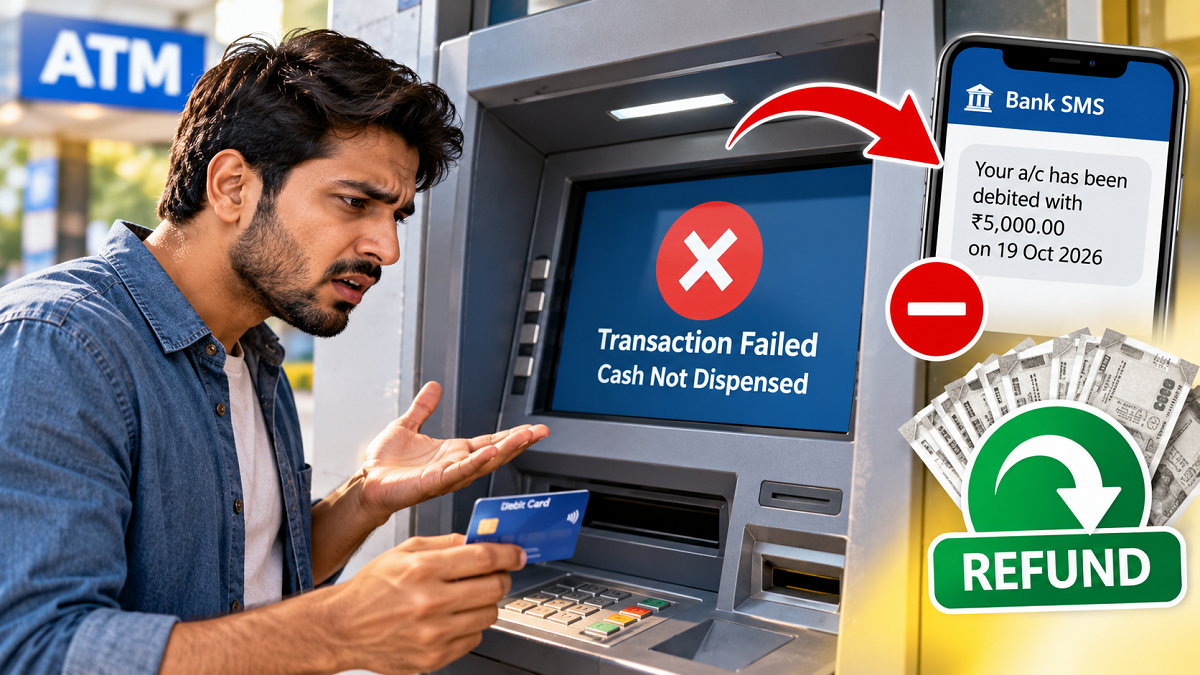
ATM Failed Transaction Rules 2026: Imagine visiting an ATM to withdraw cash, completing the transaction and receiving a message that money has been deducted from your bank account. However, the machine does not dispense any cash. Such situations can be stressful, especially when the money is needed urgently.
Although digital payments have become increasingly popular in India, millions of people continue to depend on ATMs for everyday cash requirements.
Technical errors, network interruptions and ATM malfunctions can occasionally result in failed withdrawals where the customer's account is debited despite no cash being delivered.
Fortunately, the Reserve Bank of India (RBI) has established rules to protect customers in such cases.
Under the applicable framework, banks must reverse eligible failed ATM transactions within a specified period. Delays beyond that deadline can also attract compensation.
Here is everything bank customers should know about failed ATM withdrawals, refund timelines, compensation and complaint procedures.
ATM Did Not Dispense Cash but Money Was Deducted: What Should You Do?
If an ATM transaction fails but the amount is deducted from your account, avoid panicking.
The first step is to confirm the debit through your bank's official SMS alert, mobile banking application or account statement.
Sometimes, an unsuccessful withdrawal is automatically reversed after the banking system identifies the failed transaction.
However, customers should not assume that the money has already been refunded without checking their account balance or transaction history.
It is also advisable to avoid repeatedly attempting the same withdrawal at a malfunctioning ATM, as this could create additional transaction records and confusion.
Step 1: Save All Details of the Failed ATM Transaction
Maintaining a record of the transaction can make the complaint process easier.
Customers should preserve the following information:
- Date and approximate time of the withdrawal attempt.
- Amount deducted from the bank account.
- ATM location and identification number, if available.
- Transaction reference number.
- ATM receipt, if the machine generated one.
- Bank SMS alert or account statement showing the debit.
These details can help the bank identify the unsuccessful withdrawal and investigate the transaction.
Customers should not share their ATM PIN, CVV, passwords or OTPs while reporting the problem.
Step 2: Register a Complaint With Your Bank
If cash was not dispensed, contact the bank that issued your ATM or debit card.
Even if the transaction took place at another bank's ATM, the card-issuing bank is generally the appropriate first point of contact.
Customers can usually submit complaints through their bank's customer care number, mobile banking application, internet banking service or nearest branch.
Clearly explain that the withdrawal amount was debited but the ATM did not dispense the cash.
After registering the complaint, obtain a complaint reference number.
This number is important for tracking the issue, requesting updates and escalating the matter if the refund is delayed.
RBI ATM Refund Rules: How Many Days Does the Bank Have?
Under RBI's framework for failed ATM transactions, where a customer's account is debited but cash is not dispensed, the transaction must be reversed within T+5 calendar days.
Here, T refers to the date of the failed transaction.
The five-day period is measured in calendar days, not working days.
This means weekends and holidays are included in the calculation.
The reversal is expected to be processed automatically within the prescribed timeline.
RBI failed ATM transaction rules
T+5 days
Maximum reversal timeline
₹100/day
Compensation for delay beyond the deadline
These provisions apply to eligible failed ATM transactions where the account is debited but cash is not dispensed.
Can You Receive ₹100 Per Day if the Bank Delays the Refund?
Yes. Under the applicable RBI rules, if the bank fails to reverse an eligible failed ATM transaction within T+5 calendar days, compensation of ₹100 per day is payable for the delay beyond the prescribed period.
The compensation is separate from the original amount deducted from the customer's account.
For example, suppose a customer attempts to withdraw ₹5,000, but the ATM does not dispense cash.
If the bank reverses the amount three days after the permitted deadline, the applicable compensation would be ₹300.
The customer would therefore be entitled to the original ₹5,000 reversal along with ₹300 in compensation, assuming the transaction falls within the relevant RBI rules.
The compensation should be credited automatically under the regulatory framework rather than requiring the customer to make a separate claim.
Failed ATM Transaction Compensation: Example Calculation
| Delay Beyond RBI Deadline | Applicable Compensation |
|---|---|
| 1 day | ₹100 |
| 2 days | ₹200 |
| 3 days | ₹300 |
| 5 days | ₹500 |
| 7 days | ₹700 |
| 10 days | ₹1,000 |
The table illustrates compensation for delays occurring after the T+5 calendar-day deadline, not from the original transaction date.
Actual entitlement depends on the circumstances of the failed transaction and the applicable regulatory provisions.
What if the Bank Does Not Refund Your Money?
If the deducted amount does not return within the prescribed period, customers should follow up with their bank using the original complaint reference number.
Ask the bank to provide an update on the reversal and explain why the transaction remains unresolved.
If the customer care team does not resolve the issue, the complaint can be escalated to the bank's grievance redressal department or designated nodal officer.
Customers should retain copies of complaint acknowledgements, emails, messages and relevant account statements.
These records may be useful if the dispute needs to be taken to a higher authority.
How to File an RBI Ombudsman Complaint Online
If the bank rejects the complaint, provides an unsatisfactory resolution, or fails to respond within 30 days of receiving the complaint, the customer may be eligible to approach the RBI Ombudsman under the Reserve Bank – Integrated Ombudsman Scheme, 2021.
The RBI provides an online Complaint Management System for eligible complaints against regulated financial institutions.
Customers can access the official portal at cms.rbi.org.in.
The general process involves selecting the relevant financial institution, entering the complaint details, describing the unresolved issue and submitting supporting documents.
The complaint should explain that the ATM did not dispense cash despite the amount being debited.
It should also mention the transaction date, disputed amount, complaint reference number and the bank's response, if any.
Customers should generally complain to their bank first before approaching the RBI Ombudsman.
Does the Refund Rule Apply to Other Banks' ATMs?
The RBI's failed ATM transaction framework covers eligible transactions involving ATM withdrawals, including situations where customers use an ATM operated by a bank other than their own.
For example, a customer holding an account with one bank may use another bank's ATM to withdraw cash.
If the account is debited but no money is dispensed, the customer should report the failed transaction to the card-issuing bank.
The banks and payment system participants can then investigate the transaction through the applicable settlement and dispute-resolution process.
Customers do not ordinarily need to visit the physical ATM location to begin the complaint process.
Important Safety Tips When an ATM Withdrawal Fails
A failed cash withdrawal can sometimes make customers vulnerable to fraudsters offering assistance.
Never share your ATM PIN or banking OTP with anyone claiming they can speed up the refund.
Avoid calling customer service numbers found on unverified websites or social media posts.
Instead, use the official contact details provided by your bank.
Customers should also monitor their bank statements to confirm that the correct amount has been credited.
If an unfamiliar transaction appears or there are signs of unauthorised account access, the matter should be reported immediately as a potential fraud incident rather than treated only as a technical ATM failure.
ATM Failed Transaction Rules 2026: Key Takeaway
An unsuccessful ATM withdrawal does not necessarily mean the customer has permanently lost the deducted money.
RBI rules provide a defined mechanism for reversing eligible failed ATM transactions.
Banks are required to complete the reversal within T+5 calendar days when the account has been debited but cash was not dispensed.
If the reversal is delayed beyond that period, compensation of ₹100 per day is applicable under the regulatory framework.
Customers should preserve transaction records, report the issue to their card-issuing bank and track the refund. If the complaint remains unresolved, they can escalate it through the bank's grievance mechanism and, where eligible, approach the RBI Ombudsman.
Note: The five-day reversal timeline and compensation provisions relate specifically to eligible failed ATM cash withdrawal transactions. Other types of payment failures may have different RBI-prescribed resolution timelines.