
India's digital payment ecosystem has transformed the way people pay for entertainment, utilities, memberships, and online services. From OTT platforms and music streaming apps to cloud storage and mobile services, millions of users now rely on UPI AutoPay to automate recurring payments.
While the feature offers unmatched convenience, it has also created a new financial challenge. Many consumers continue paying for services they no longer use simply because they forgot about active AutoPay mandates linked to their bank accounts.
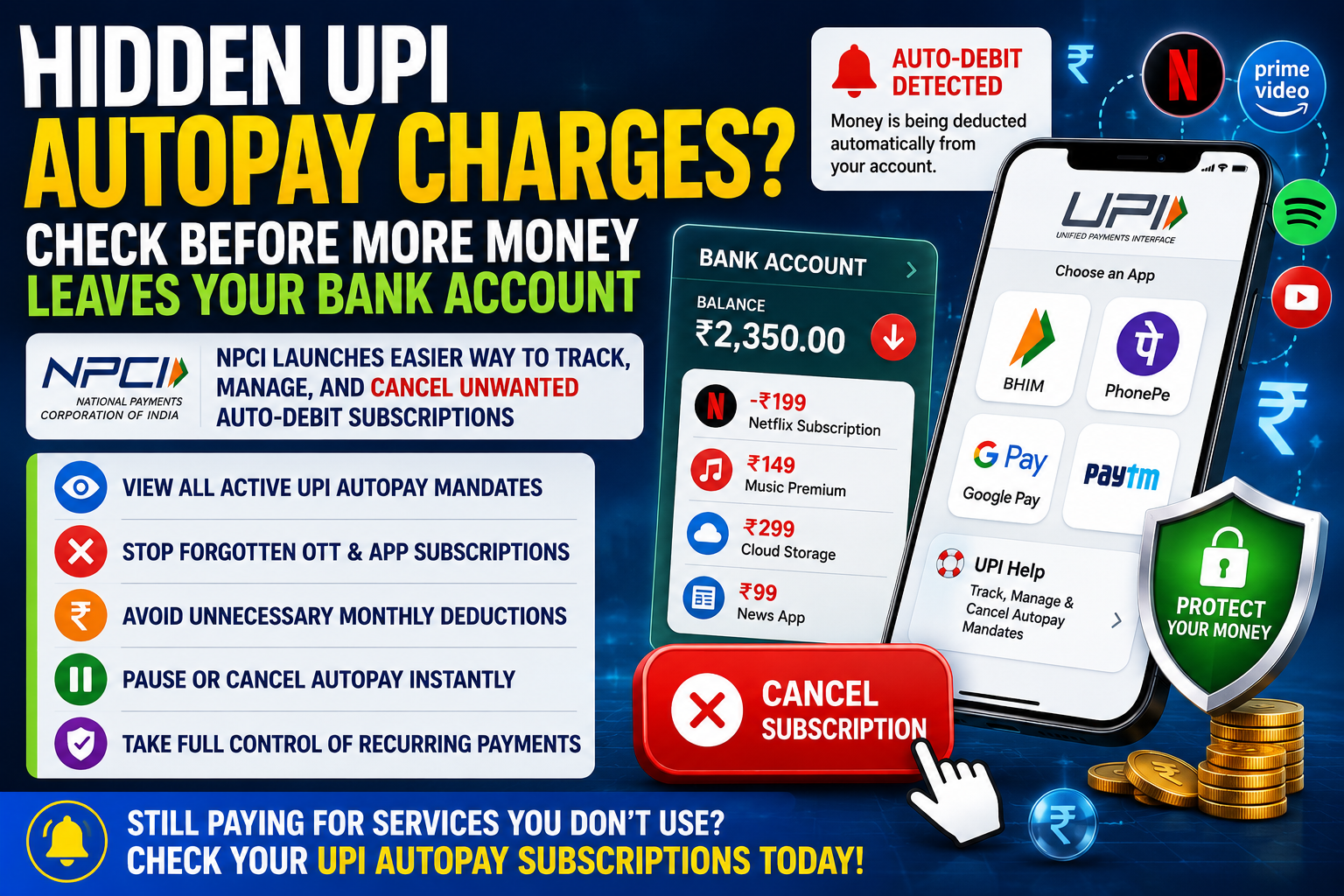
To address this growing issue, the National Payments Corporation of India (NPCI) has introduced a centralized solution that allows users to track, manage, pause, and cancel unwanted UPI AutoPay subscriptions more easily than before.
Why Forgotten AutoPay Subscriptions Are Becoming a Major Problem
In recent years, subscription-based services have exploded across India. Consumers frequently sign up for free trials, discounted plans, video streaming services, productivity tools, gaming memberships, and digital platforms.
However, after the initial excitement fades, many users stop using these services but fail to disable the associated AutoPay mandate.
As a result, money continues to be automatically deducted from their bank accounts every month without attracting much attention.
Industry observers say this "subscription leakage" has become one of the most common reasons for unnecessary recurring expenses among digital payment users.
What Exactly Is UPI AutoPay?
UPI AutoPay is a feature that enables automatic recurring payments directly from a user's bank account.
Once a mandate is approved, payments are processed automatically on the scheduled date without requiring manual authorization each month.
The feature is commonly used for:
- OTT subscriptions
- Video streaming platforms
- Music services
- Mobile applications
- Utility bill payments
- Insurance premiums
- Education subscriptions
- Cloud storage services
- Gym memberships
- Digital news and content platforms
The convenience of automated payments has made UPI AutoPay one of the fastest-growing digital payment features in the country.
India's Recurring Payment Market Is Growing Rapidly
Over the last few years, recurring payments through UPI have witnessed massive growth.
Today, a significant share of subscription payments in India is processed through UPI AutoPay. From low-cost subscriptions worth a few rupees to premium services costing hundreds or thousands of rupees every month, consumers increasingly prefer automated payments over manual transactions.
However, the rapid adoption has also exposed a major gap—many users are unaware of how many active mandates are linked to their accounts.
NPCI's New Initiative to Help Consumers
Recognizing the issue, NPCI has developed a unified platform that gives customers better visibility over their recurring payment commitments.
The initiative enables users to:
- View active UPI AutoPay mandates
- Check subscription details
- Monitor recurring deductions
- Pause active mandates
- Permanently cancel unwanted subscriptions
According to early estimates, the platform is already processing nearly one million AutoPay cancellations every month.
This suggests that a large number of users are discovering and discontinuing subscriptions they no longer need.
Why Many Users Lose Track of Their Subscriptions
One of the biggest challenges is that AutoPay mandates are often scattered across multiple UPI applications.
For example:
- A user may activate a subscription through PhonePe.
- Another mandate could be created through Google Pay.
- A third service may be linked through Paytm.
Over time, users forget which platform was used to authorize each payment.
Because mandates remain active in the background, deductions continue silently, resulting in avoidable financial outflows.
UPI Help: A Single Place to Manage AutoPay Mandates
To simplify subscription management, NPCI launched a feature called UPI Help.
The platform allows customers to access information about their recurring payment instructions in one place.
Users can review existing mandates and take action if they no longer wish to continue a subscription.
This reduces dependence on individual apps and makes it easier to monitor recurring expenses.
How to Check Active UPI AutoPay Subscriptions
The process may vary slightly depending on the application being used.
In the BHIM app, the UPI Help feature is prominently available on the home screen, making it easy for users to review active mandates.
In several other UPI applications, similar options may be located under:
- Settings
- Profile Section
- Payment Management
- AutoPay Mandates
- Subscription Controls
Users are encouraged to periodically review these sections to identify unnecessary recurring payments.
Steps to Avoid Unwanted Auto-Debits
Financial experts recommend the following practices:
Review Mandates Regularly
Check your active AutoPay subscriptions every few months.
Cancel Unused Services Immediately
If you are no longer using a service, disable the mandate instead of waiting.
Monitor Bank Statements
Recurring deductions can often be identified quickly through monthly statement reviews.
Avoid Multiple Free Trials
Many forgotten subscriptions originate from free trial offers that automatically convert into paid plans.
Use UPI Help
Make it a habit to review active mandates through NPCI's centralized platform.
The Bottom Line
UPI AutoPay has made digital payments smoother and more convenient, but it has also increased the risk of unnoticed recurring deductions. As subscription-based services continue to grow, keeping track of active mandates is becoming an essential part of personal finance management.
NPCI's new UPI Help platform gives consumers greater control over their recurring payments, helping them identify hidden subscriptions and prevent unnecessary spending. A quick review of your active AutoPay mandates today could save you hundreds—or even thousands—of rupees over the course of a year.