NEWS
Rajasthan Government Schemes 2026: State Highlights Farmer Support, Solar Power and Water Projects
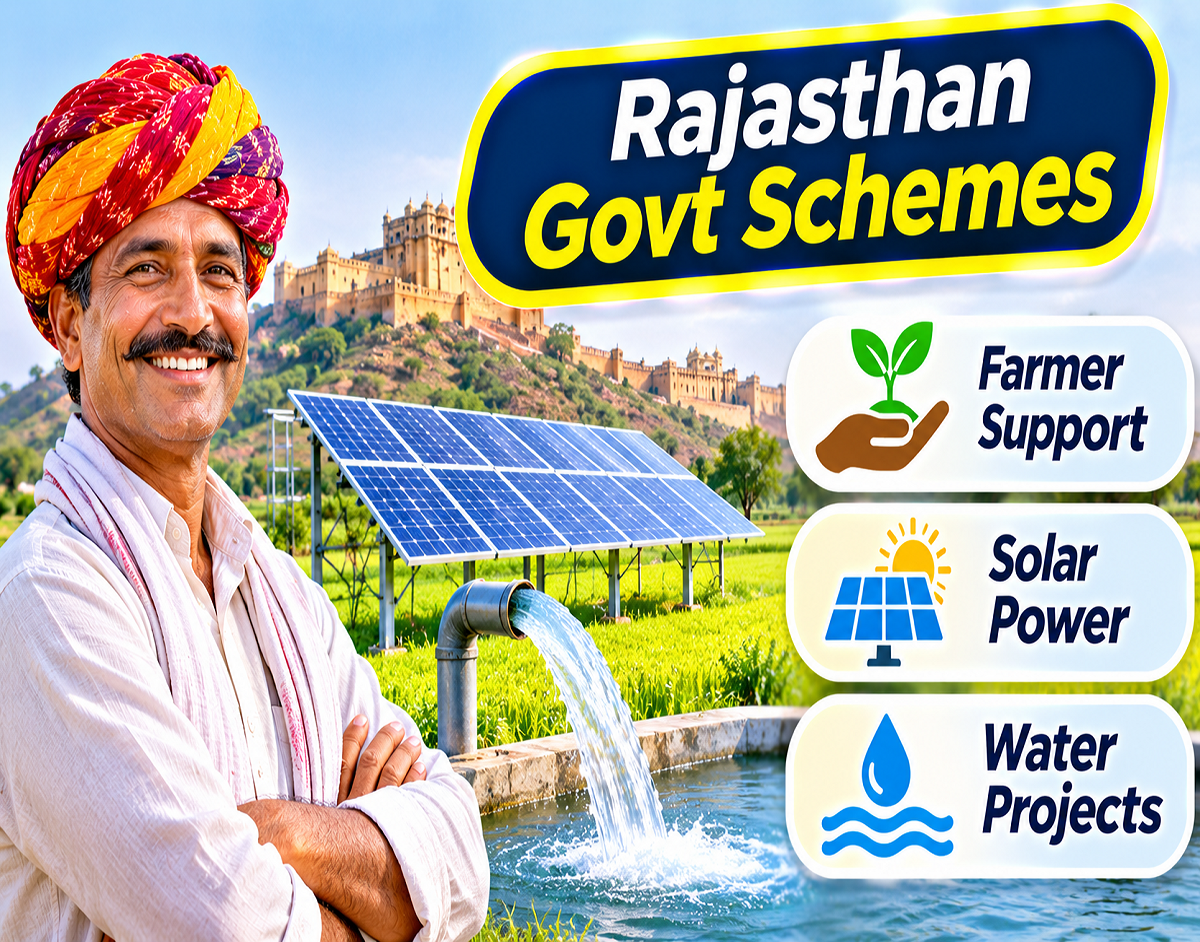
Rajasthan Government Schemes 2026: Rajasthan has highlighted its progress in implementing central government schemes, expanding financial assistance to farmers, developing solar energy infrastructure and addressing long-pending water projects.
According to a recent government development update, Rajasthan has secured the top position nationally in 12 schemes and programmes. The update also states that approximately 76 lakh farmers are receiving ₹9,000 annually through combined farmer assistance arrangements.
The state has additionally highlighted the installation of around 2,300 solar power plants under the PM-KUSUM initiative, with a reported combined capacity exceeding 5,000 megawatts.
The government has linked these developments to its broader objectives of improving agricultural incomes, expanding renewable energy and strengthening long-term water security.
The figures are presented as claims from the supplied government update; the underlying programme-wise ranking, beneficiary records and solar capacity data require independent confirmation.
Rajasthan Government Schemes 2026: Key Highlights
| Sector | Figures highlighted in the update |
|---|---|
| National Schemes | First-place performance claimed in 12 schemes and programmes |
| Farmer Financial Assistance | ₹9,000 annually |
| Farmer Beneficiaries | Approximately 76 lakh |
| PM-KUSUM Solar Plants | Around 2,300 |
| Reported Solar Capacity | More than 5,000 MW |
| Water Infrastructure | Progress claimed on long-pending projects |
| Main Development Priorities | Agriculture, renewable energy and water security |
Rajasthan Claims Leading Performance in 12 Government Schemes
The development update states that Rajasthan has achieved the first position in the country in 12 national schemes and programmes.
The announcement presents this as an indication of progress in implementing government initiatives.
However, the statement does not identify all 12 schemes, their assessment periods or the performance indicators used to determine the rankings.
Such details are important because government programmes may be assessed using different measures, including beneficiary coverage, project completion, fund utilisation and service delivery.
A complete evaluation would require the relevant programme-wise data and official rankings.
Farmers to Receive ₹9,000 Annually Under Assistance Arrangements
One of the main highlights concerns financial assistance for farmers.
According to the supplied update, approximately 76 lakh farmers in Rajasthan are covered by arrangements providing ₹9,000 annually.
The central government's Pradhan Mantri Kisan Samman Nidhi (PM-KISAN) scheme provides eligible farmer families with ₹6,000 annually, ordinarily distributed in three instalments of ₹2,000.
The Rajasthan announcement indicates a combined annual assistance amount of ₹9,000, reflecting additional state-level support.
Eligible farmers should check the current rules governing the state contribution and central PM-KISAN benefits.
Why Is Farmer Financial Assistance Important?
Direct financial assistance can help agricultural households meet recurring expenses such as seeds, fertilisers, irrigation and other farming requirements.
Payments transferred through authorised banking channels can also reduce dependence on intermediaries.
However, the benefit depends on eligibility, verification and compliance with the relevant scheme requirements.
Farmers can check central PM-KISAN information through the official PM-KISAN portal.
Rajasthan's PM-KUSUM Programme Expands Solar Power Capacity
Rajasthan has also reported substantial progress under the Pradhan Mantri Kisan Urja Suraksha evam Utthaan Mahabhiyan (PM-KUSUM).
The supplied update states that approximately 2,300 solar power plants have been installed, with their combined capacity exceeding 5,000 MW.
A September 14, 2026 report quoted Rajasthan Energy Department Secretary Aarti Dogra as saying that approximately 5.20 gigawatts of capacity had been installed under PM-KUSUM Components A and C. This supports the broad capacity figure, although it does not independently establish the exact number of plants mentioned in the update.
How PM-KUSUM Helps Farmers
The scheme is designed to promote renewable energy in agriculture, reduce dependence on diesel and provide opportunities for farmers to participate in solar electricity generation.
Its main components cover decentralised solar power plants, standalone agricultural solar pumps and solarisation of existing agricultural pumps or feeders.
Under Component A, eligible participants can establish grid-connected solar plants and sell electricity to distribution companies under applicable arrangements.
This creates the possibility of additional income from electricity generation while supporting cleaner agricultural energy use.
From Food Producers to Energy Producers
The government has described the expansion of solar infrastructure as a step towards enabling farmers to become energy producers as well as food producers.
Rajasthan's extensive sunshine and available land make solar energy an important part of its agricultural and electricity planning.
Solar-powered irrigation can reduce reliance on conventional electricity supplies or diesel pumps, depending on the installation and local conditions.
Farmers participating in eligible solar generation arrangements may also benefit from electricity sales or land-related income.
However, the financial benefits depend on the specific PM-KUSUM component, project ownership, approved tariffs and contractual terms.
Rajasthan Focuses on Long-Pending Water Projects
Water security remains another major priority highlighted by the state government.
Chief Minister Bhajan Lal Sharma has linked progress on long-pending water infrastructure arrangements to cooperation between the central and state governments.
In a September 23, 2026 statement, the Chief Minister referred to agreements involving the Ramjal Setu project, Yamuna water arrangements, the Narmada agreement and the Kishau Multipurpose Dam project. He said these initiatives were intended to help meet Rajasthan's water requirements.
Why Water Projects Matter for Rajasthan
Large parts of Rajasthan experience limited rainfall and depend on groundwater, reservoirs, canals and inter-state water arrangements.
Improved water infrastructure could support drinking water supplies, irrigation and long-term regional development.
However, signing agreements or resolving administrative obstacles does not necessarily mean that every project has been completed.
The actual benefits will depend on construction progress, funding, water availability and operational implementation.
Rajasthan's Performance Across Other National Programmes
A November 2, 2026 report cited Chief Minister Bhajan Lal Sharma's announcement that Rajasthan held first position in 12 central schemes and programmes, second position in 10 and third position in eight.
The reported achievements included performance under crop insurance, PM-KUSUM, sanitation initiatives, tribal welfare programmes and public participation campaigns.
For example, the report cited approximately 2.2 crore crop insurance policies during Kharif 2025 and 1.7 crore during Rabi 2025–26 under Pradhan Mantri Fasal Bima Yojana. These figures refer to policies issued, not necessarily unique farmers covered.
These rankings relate to particular schemes and performance indicators; they should not be interpreted as a single overall ranking of state development.
What These Initiatives Mean for Rajasthan Residents
The programmes highlighted in the update address several important areas of the state's economy.
Farmer assistance can provide eligible agricultural households with recurring financial support.
Solar energy projects can help diversify energy supplies and create new opportunities for agricultural communities.
Water infrastructure projects could improve access to water where completed and effectively operated.
Meanwhile, implementation of central welfare programmes can influence access to services in agriculture, health, housing and rural development.
The ultimate impact of these initiatives will depend on the number of people receiving benefits, the quality of implementation and the completion of infrastructure projects.
Conclusion
Rajasthan's latest development update highlights progress in central government scheme implementation, farmer financial assistance, solar energy expansion and long-term water planning.
The state government reports first-place performance in 12 national schemes and programmes, annual farmer assistance of ₹9,000 for approximately 76 lakh beneficiaries, and PM-KUSUM solar installations exceeding 5,000 MW.
Published reporting supports the broad claims concerning scheme rankings and solar capacity, while the precise number of solar plants and current farmer beneficiaries should be assessed against the latest official programme records.
For Rajasthan's farmers and rural communities, the most important measures of progress will be reliable benefit payments, affordable energy, improved water availability and the completion of announced projects.
Source Credit: Rajasthan government development update; Chief Minister's Office, Rajasthan; Ministry of New and Renewable Energy; and published reports on Rajasthan's central scheme performance and PM-KUSUM implementation. Official references: Rajasthan Chief Minister's Office, PM-KISAN and PM-KUSUM National Portal.