
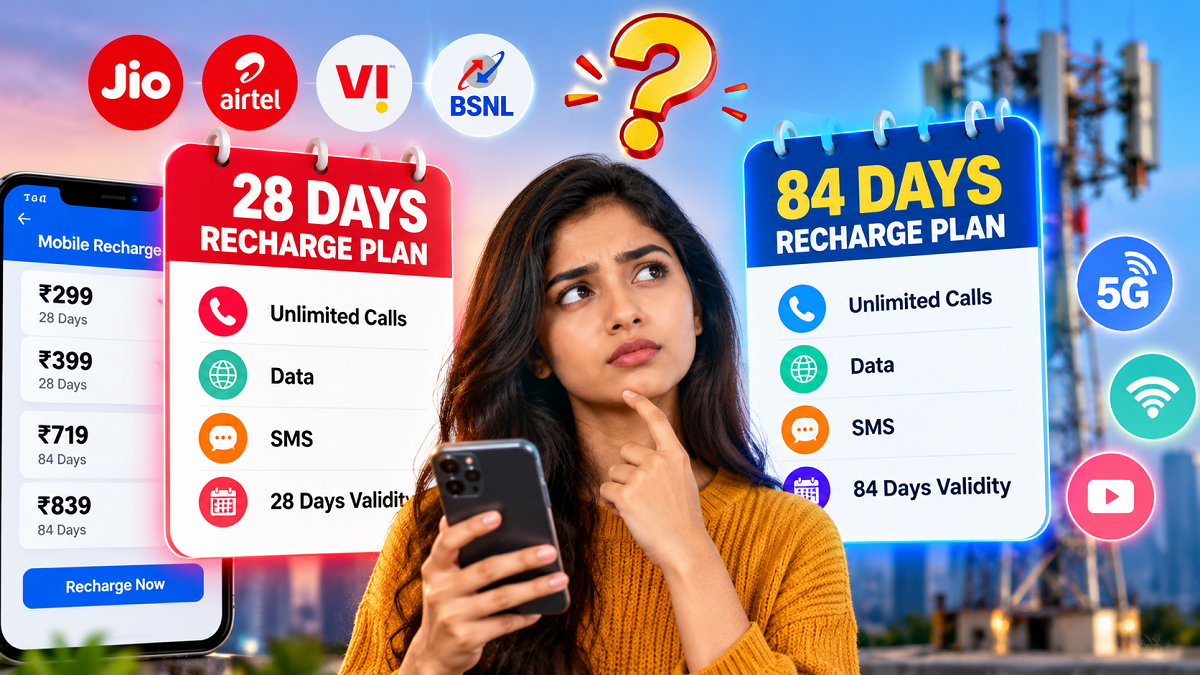
Mobile Recharge Plan 2026: Choosing the right mobile recharge plan can make a noticeable difference to your monthly expenses. Whether you use Jio, Airtel, Vi or BSNL, selecting a plan that matches your calling and internet requirements is important for managing your mobile budget.
Telecom operators offer different validity periods, but 28-day and 84-day prepaid recharge plans remain popular choices among Indian customers.
While a 28-day recharge usually requires a smaller upfront payment, an 84-day plan provides longer validity and may offer better value in certain cases.
However, a longer validity period does not automatically mean greater savings.
Before making your next recharge, it is worth understanding the benefits, limitations and cost differences between these two options.
28-Day Recharge Plan: Best for Users Who Prefer Smaller Payments
A 28-day prepaid recharge plan can be suitable for customers who want to avoid spending a large amount of money at once.
These plans are often preferred by students, occasional internet users and people who manage their expenses through smaller, regular payments.
The biggest advantage is the lower initial cost compared with a longer-duration plan offering similar daily benefits.
For example, a person who receives a limited monthly allowance may find it easier to purchase a 28-day recharge than pay for nearly three months of service together.
Another advantage is flexibility.
Once the recharge expires, users can review their requirements and select a different plan.
Someone who initially needs substantial daily data may later decide to switch to a lower-data option.
Shorter plans allow customers to make such changes more frequently without waiting for a longer validity period to end.
However, the main disadvantage is that a 28-day plan lasts exactly four weeks, not a full calendar month.
As a result, customers who want uninterrupted service throughout the year generally need approximately 13 recharges.
84-Day Recharge Plan: Convenient for Long-Term Mobile Users
An 84-day recharge plan provides approximately 12 weeks of validity.
This makes it attractive for people who prefer uninterrupted calling and internet services without frequently checking their recharge expiry dates.
One of its biggest advantages is convenience.
Instead of recharging every four weeks, customers can purchase a plan that lasts three times as long as a 28-day package.
For users who depend on their mobile numbers for office communication, online banking alerts and everyday calls, longer validity can reduce the inconvenience of frequent renewals.
Some 84-day plans may also offer additional benefits, depending on the operator and recharge category.
These could include higher data allowances, eligible entertainment subscriptions or other bundled services.
However, customers should carefully examine whether they actually need these additional features.
The biggest limitation is the higher upfront payment.
An 84-day recharge may not suit users who prefer to keep more money available for other immediate expenses.
28 Days vs 84 Days: Key Differences
| Feature | 28-Day Recharge | 84-Day Recharge |
|---|---|---|
| Validity | 28 days | 84 days |
| Upfront payment | Usually lower | Usually higher |
| Recharge frequency | More frequent | Less frequent |
| Flexibility to change plans | Greater | Lower during validity |
| Potential savings | Depends on price and benefits | May offer better daily value |
| Suitable for | Budget-conscious and flexible users | Regular users seeking convenience |
| Extra benefits | Plan-dependent | Plan-dependent |
The best choice depends on the actual price and benefits offered by the telecom operator.
Which Recharge Plan Is Cheaper? Understand the Calculation
Many customers assume that purchasing an 84-day recharge automatically saves money.
However, this is not always true.
The correct way to compare plans is to calculate the cost per day and consider whether the benefits are equivalent.
Suppose a telecom company offers the following hypothetical plans:
- A 28-day plan costing ₹299.
- An 84-day plan costing ₹799.
These are illustrative prices, not verified current recharge offers.
If you recharge with the ₹299 plan three times, the total expense for 84 days will be:
₹299 × 3 = ₹897
Meanwhile, the 84-day plan costs ₹799.
The difference is:
₹897 − ₹799 = ₹98
In this example, the longer-duration plan saves ₹98 over 84 days.
Daily Recharge Cost Comparison
| Recharge Plan | Total Cost | Validity | Approx. Cost Per Day |
|---|---|---|---|
| 28-day plan | ₹299 | 28 days | ₹10.68 |
| 84-day plan | ₹799 | 84 days | ₹9.51 |
The 84-day plan is cheaper in this example because its daily cost is lower.
However, the comparison is meaningful only if both plans provide similar calling, data and other essential benefits.
How Many Times Do You Need to Recharge in One Year?
Recharge frequency is another important factor.
A 28-day plan covers four weeks, so a customer maintaining continuous service for a full year will generally need around 13 recharge cycles, with exact coverage depending on the starting date.
An 84-day plan lasts 12 weeks.
Four such plans provide 336 days of validity, which is less than a full year.
Therefore, customers relying only on 84-day plans will generally need to begin a fifth recharge cycle to maintain uninterrupted service throughout the year.
This does not mean five complete 84-day periods are consumed within one calendar year, but it is important when planning annual recharge spending.
Users should calculate costs based on the total number of days they want covered rather than assuming that an 84-day plan is equivalent to three calendar months.
Who Should Choose a 28-Day Mobile Recharge?
A 28-day recharge can be a practical choice for people who prefer smaller payments.
Students and users with limited disposable income may find the lower initial expense easier to manage.
It can also be useful for people whose data requirements change regularly.
For example, someone who travels occasionally may want a higher-data plan during one period and a more basic recharge later.
Shorter validity can provide flexibility to adjust spending as needs change.
A 28-day plan may also suit customers who are testing a telecom operator's network quality before committing to a longer recharge.
However, users must remember to renew their plans on time to avoid service interruptions.
Who Should Choose an 84-Day Recharge?
An 84-day plan may be more suitable for customers who use the same mobile number and similar data benefits consistently.
Working professionals, business owners and regular internet users may appreciate the convenience of longer validity.
It can also be a good option for people who frequently forget recharge expiry dates.
If the 84-day plan has a lower daily cost than three comparable 28-day plans, it may provide financial savings.
However, customers should avoid paying extra for bundled services they do not use.
For example, an expensive recharge that includes entertainment subscriptions may not be worthwhile for someone who only needs calling and limited mobile data.
Check These Five Things Before Recharging
1. Total Recharge Price
Compare the full amount payable rather than focusing only on advertised discounts or bonus benefits.
2. Daily Data Allowance
Check whether the plan offers enough high-speed data for your normal usage.
Some plans provide a fixed daily allowance, while others include a total data quota for the entire validity period.
3. Calling and SMS Benefits
Confirm the calling and SMS provisions, particularly if you regularly use your number for work or banking-related communication.
4. Network Coverage
A cheaper recharge is not useful if the operator's network performs poorly in your home, workplace or frequently visited locations.
5. Additional Services
Review the terms of any bundled OTT subscription, 5G data benefit or other promotional offer.
Such benefits may be subject to device compatibility, network availability or separate eligibility conditions.
Does a Longer Recharge Always Offer Better Value?
Not necessarily.
Telecom operators regularly revise their plans, prices and bundled benefits.
An 84-day recharge may offer a lower daily cost in one pricing category but not in another.
For instance, a low-data 28-day plan could be more economical for someone who rarely uses mobile internet than a costly 84-day package offering more data than necessary.
Similarly, a user who needs substantial daily data should compare plans with equivalent allowances rather than choosing solely on validity.
The best recharge is the one that provides the services you actually need at the lowest suitable overall cost.
How to Find the Best Jio, Airtel, Vi or BSNL Recharge
Before purchasing a recharge, open your telecom operator's official application or website.
Review the currently available prepaid plans and compare their validity, data allowances, calling benefits and total prices.
Calculate the cost per day by dividing the recharge price by the number of validity days.
For an 84-day comparison, multiply the price of a 28-day plan by three.
Then compare the resulting cost with the price of an 84-day plan offering similar benefits.
This simple calculation can help you identify whether the longer recharge provides genuine savings.
Final Takeaway
Both 28-day and 84-day mobile recharge plans have their advantages.
A 28-day plan is generally better for users who prefer lower upfront payments and greater flexibility. An 84-day plan may be more suitable for those who want longer validity, fewer recharges and potentially lower daily costs.
However, the right decision depends on your mobile usage, budget and the actual offers available from your telecom operator.
Before recharging, compare prices, validity, daily data and calling benefits to ensure you are getting the best value for your money.
Disclaimer: Recharge prices and benefits vary by telecom operator and may change. The numerical examples in this article are hypothetical and are intended only to explain how to compare recharge costs.