Business
Kisan Vikas Patra 2026: How Long Will ₹1 Lakh Take to Become ₹2 Lakh? Check Interest Rate and Rules
For investors who prefer predictable returns and do not want their savings directly exposed to stock-market fluctuations, Kisan Vikas Patra (KVP) is one of the government-backed small savings options available through Post Offices. The scheme is particularly known for a simple proposition: an investment made under the prevailing terms grows to twice its original amount after the prescribed maturity period.
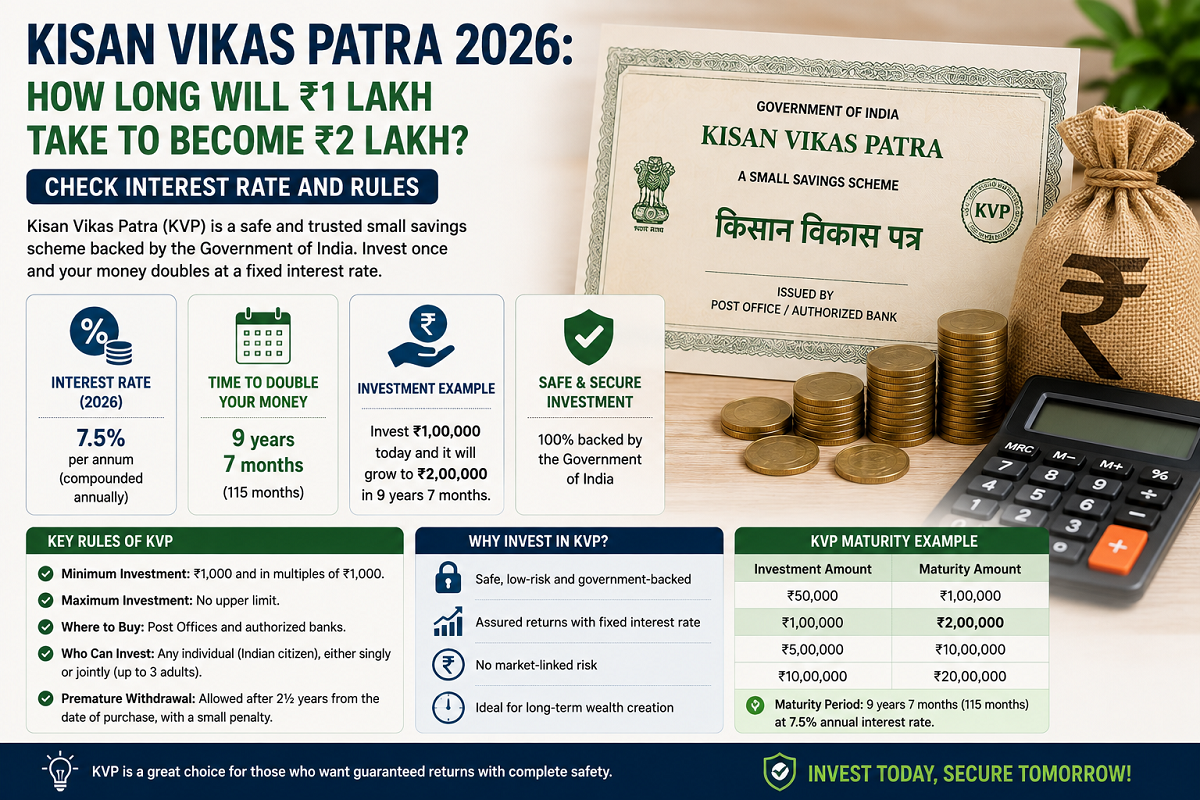
For the July-September quarter of financial year 2026-27, the interest rate cited for KVP is 7.5% per annum, compounded annually. At this rate, the prescribed maturity period is 115 months, or 9 years and 7 months.
That means an investment of ₹1 lakh made under these terms would mature at ₹2 lakh after 115 months, subject to the applicable KVP rules.
However, the doubling feature is only one part of the scheme. Before investing, it is equally important to understand eligibility, minimum investment, premature closure and taxation.
How Long Does KVP Take to Double Your Money?
At the applicable 7.5% annual interest rate, KVP has a maturity period of 115 months.
That works out to:
115 months = 9 years and 7 months
Therefore, if an investor puts ₹1 lakh into KVP in August 2026 under the current applicable terms, the investment would reach its prescribed maturity value of ₹2 lakh after 9 years and 7 months.
That would place the maturity around March 2036.
Similarly, ₹2 lakh would become ₹4 lakh and ₹5 lakh would mature at ₹10 lakh under the same terms.
The actual maturity conditions are determined by the interest rate applicable when the account is opened.
Kisan Vikas Patra 2026: Key Details
| Feature | Details |
|---|---|
| Interest rate | 7.5% per annum |
| Compounding | Annual |
| Maturity period | 115 months |
| Time to double | 9 years and 7 months |
| Minimum investment | ₹1,000 |
| Additional deposits | In multiples of ₹100 |
| Maximum investment | No prescribed upper limit |
| Section 80C deduction | Not available |
| Premature closure | Allowed under specified conditions |
KVP can therefore be useful for investors who are comfortable locking away money for several years and want a predetermined maturity amount.
How Much Can You Invest in KVP?
The entry requirement is relatively low.
An account can be opened with a minimum investment of ₹1,000, after which the amount can be invested in multiples of ₹100.
There is no prescribed maximum investment limit under the scheme.
For example, an investor could invest ₹10,000, ₹50,000, ₹1 lakh or a larger amount depending on their financial capacity and applicable compliance requirements.
However, the absence of an upper limit does not mean that investors should put all their savings into KVP.
Liquidity requirements, taxation, emergency reserves and diversification should also be considered.
Who Can Open a Kisan Vikas Patra Account?
KVP is available to eligible resident individuals under the scheme rules.
An adult can open an account individually or jointly with up to two other adults.
A guardian can also open an account on behalf of a minor or an eligible person requiring guardianship under the applicable rules.
A minor who has attained the prescribed age can also operate an account in their own name subject to the scheme's conditions.
Investors should check the latest Post Office documentation and KYC requirements before opening the account.
Can You Withdraw KVP Before Maturity?
KVP is designed as a long-term savings instrument, but premature closure is possible under specified circumstances.
Under normal conditions, premature closure can generally be considered after 2 years and 6 months from the date of deposit, subject to the applicable scheme rules.
There are also certain exceptional situations where closure may be permitted earlier.
These can include the death of the account holder or, in the case of a joint account, applicable circumstances involving the account holders, as well as closure ordered by a court or other conditions recognised under the scheme.
The amount payable on premature closure can depend on when the account is closed and the rules applicable at that time.
Investors should therefore avoid treating KVP like a savings account from which money can be withdrawn freely whenever needed.
Don't Put Emergency Money Into KVP
The premature withdrawal restrictions make financial planning particularly important.
Suppose someone has ₹3 lakh in total savings and invests the entire amount in KVP simply because they want a guaranteed maturity value.
If an emergency arises six months later, accessing that money may not be straightforward.
An emergency fund should ideally be maintained separately in an appropriately liquid instrument before committing surplus savings to a long-term product such as KVP.
This can help prevent financial stress if unexpected expenses arise.
Can KVP Be Used as Security for a Loan?
Kisan Vikas Patra can also have utility beyond simply earning interest.
Subject to applicable rules, KVP can be pledged or transferred as security to specified authorities and eligible financial institutions.
This may include scheduled banks and certain other institutions permitted under the scheme.
If the certificate or account is pledged, the required process and documentation must be completed according to the applicable Post Office rules.
The lender will also have its own eligibility and credit-assessment requirements, so owning a KVP does not automatically guarantee loan approval.
Can a KVP Account Be Transferred?
KVP also provides transfer facilities under prescribed conditions.
Ownership may be transferred from one eligible person to another in circumstances allowed by the scheme.
Similarly, transfer-related procedures may apply in cases such as pledging the investment to an eligible institution.
Because such transfers are governed by specific conditions, account holders should complete them through authorised channels rather than relying on informal arrangements.
Does KVP Provide a Section 80C Tax Deduction?
This is an important distinction between KVP and certain other small savings products.
Investment in Kisan Vikas Patra does not qualify for a deduction under Section 80C merely because money has been invested in the scheme.
This makes KVP different from products such as PPF and certain qualifying tax-saving investments.
Therefore, someone investing ₹1.5 lakh in KVP should not assume that the investment automatically reduces taxable income under Section 80C.
Is KVP Interest Tax-Free?
No. The interest earned through KVP does not enjoy the same tax-free treatment associated with PPF.
KVP interest is taxable according to the applicable income-tax provisions and the investor's circumstances.
This means the headline 7.5% interest rate should not automatically be treated as the investor's effective post-tax return.
For someone subject to income tax, taxation can reduce the effective return generated by the investment.
Investors should consult a tax professional if they are unsure about how accrued KVP interest needs to be reported in their income-tax return.
KVP vs PPF: They Serve Different Purposes
Both KVP and PPF are government-backed savings products, but they should not be treated as interchangeable.
PPF is designed as a long-term savings product with specific tax advantages and a longer initial tenure. KVP focuses on providing a predetermined maturity value over its notified maturity period.
KVP interest is taxable and investment does not qualify for the Section 80C deduction, while PPF enjoys more favourable tax treatment under applicable rules.
The right choice therefore depends on whether the investor prioritises tax efficiency, maturity structure, liquidity or another financial objective.
Who Could Consider Kisan Vikas Patra?
KVP may appeal to conservative investors who:
- Prefer a government-backed savings product
- Want a predetermined maturity value
- Do not want direct equity-market exposure
- Can leave the money invested for several years
- Do not require frequent withdrawals
- Understand that the interest is taxable
It may be less suitable for someone who needs high liquidity or is primarily looking for a tax-saving investment.
₹1 Lakh to ₹2 Lakh: What Investors Should Remember
The attraction of Kisan Vikas Patra lies in its simplicity. At the current 7.5% annual rate and 115-month maturity period cited for the July-September 2026 quarter, ₹1 lakh invested under those terms is designed to mature at ₹2 lakh after 9 years and 7 months.
But "money doubling" should not be the only criterion for choosing an investment.
Investors should also consider inflation. If prices rise substantially over the next decade, ₹2 lakh in 2036 will not have the same purchasing power as ₹2 lakh today.
Taxation further affects the effective return.
Therefore, KVP can form part of a conservative savings strategy, but the decision should be based on the investor's financial goal, investment horizon, liquidity requirements and overall asset allocation—not simply on the promise that the nominal investment amount will double.
Disclaimer: This article is intended for general informational purposes only and does not constitute personalised investment or tax advice. Small savings interest rates, tax provisions and scheme rules can change. Investors should verify the latest terms through official channels and consult a qualified professional where necessary.