Business
ITR Filing 2026: Received a Section 143(1) Notice After Filing Your Tax Return? Here's What It Means
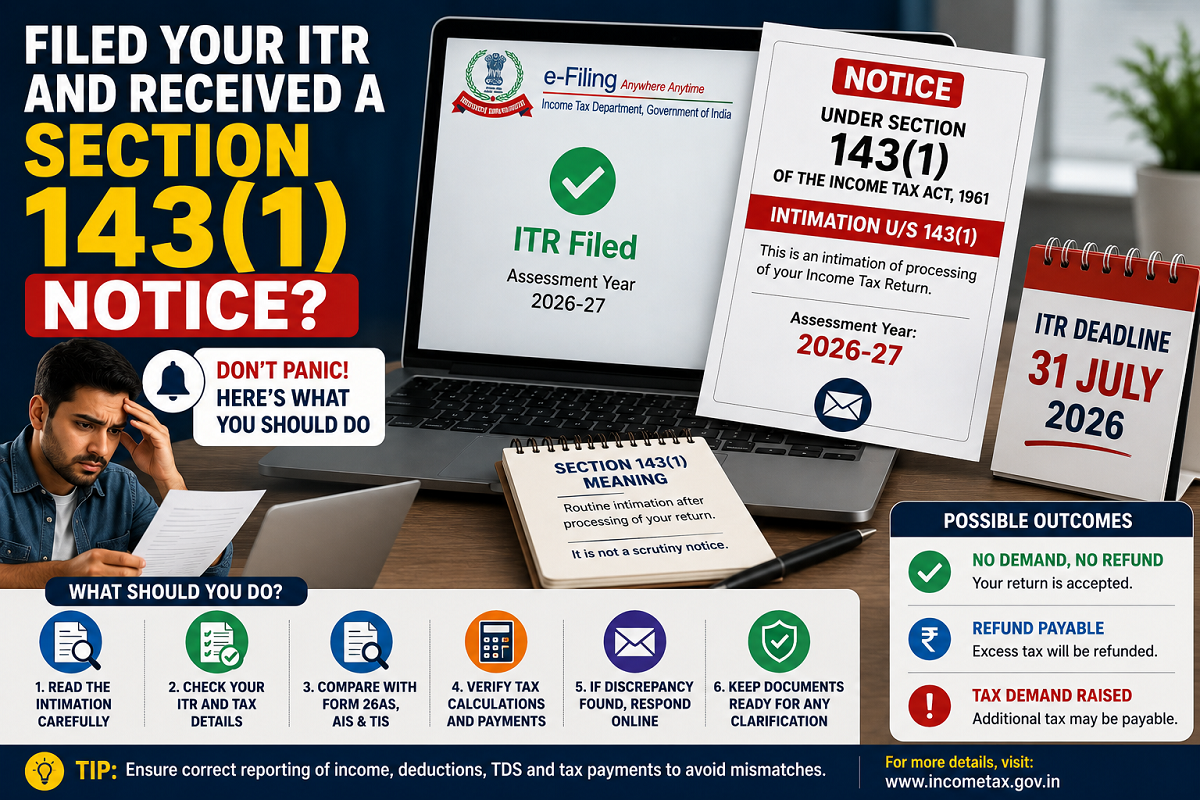
Income Tax Return 2026: Receiving a notice under Section 143(1) of the Income Tax Act after filing your Income Tax Return (ITR) may seem alarming, but in most cases, it is a routine communication from the Income Tax Department. Here's what the notice means, why you received it, and what action—if any—you need to take.
More Than 3 Crore ITRs Already Filed
With the deadline for filing Income Tax Returns for Assessment Year (AY) 2026-27 approaching, the Income Tax Department has urged taxpayers to complete the filing process on time.
In a recent post on its official X account, the department stated that more than 3 crore Income Tax Returns have already been filed and encouraged remaining taxpayers to submit their returns before the due date to avoid last-minute issues.
As return processing gathers pace, many taxpayers are beginning to receive communications under Section 143(1). Although the word "notice" often creates concern, this communication is generally part of the normal return processing procedure.
What Is a Section 143(1) Notice?
A notice issued under Section 143(1) is an Income Tax Return Intimation generated after the Income Tax Department processes your return electronically.
The notice compares the information reported in your ITR with the data available in the department's records, including:
- Tax deducted at source (TDS)
- Tax collected at source (TCS)
- Advance tax paid
- Self-assessment tax
- Income reported by employers and financial institutions
- Other information available with the department
The purpose is to verify whether the figures declared by the taxpayer match the department's records.
Why Did You Receive This Notice?
Receiving a Section 143(1) intimation does not automatically mean that something is wrong with your return.
The communication may simply inform you that:
- Your return has been successfully processed.
- No discrepancies were found.
- Your tax calculation matches the department's records.
In some cases, the intimation may also highlight differences between the taxpayer's calculations and those made by the department.
Possible Outcomes of a Section 143(1) Intimation
After processing your return, the Income Tax Department may issue one of the following outcomes.
1. No Demand and No Refund
This means the return has been accepted exactly as filed.
No further action is generally required from the taxpayer.
2. Refund Payable
If excess tax has been paid during the financial year through TDS, advance tax or self-assessment tax, the department may process the refund.
The intimation will mention the refund amount, which is credited after completion of the refund process.
3. Tax Demand Raised
If the department calculates additional tax liability because of mismatched income, deductions, exemptions or tax credits, the intimation may show an outstanding demand.
Taxpayers should carefully review the calculations before taking any action.
Common Reasons for a Tax Demand
A demand under Section 143(1) may arise due to several reasons, including:
- Mismatch in TDS claimed.
- Incorrect income reported.
- Mathematical errors in the return.
- Excess deduction claimed.
- Tax credit not appearing in government records.
- Differences between Form 26AS, AIS, TIS and the filed return.
Checking these documents carefully can help identify the source of the mismatch.
What Should You Do After Receiving the Notice?
The first step is not to panic.
Read the intimation carefully and compare it with:
- Your filed ITR.
- Form 26AS.
- Annual Information Statement (AIS).
- Taxpayer Information Summary (TIS).
- Salary Form 16 or other income documents.
- Tax payment challans.
If everything matches, no further action may be required.
If a discrepancy exists, review the reason before responding through the Income Tax e-filing portal.
Can You Disagree With the Demand?
Yes.
If you believe the demand has been raised due to an incorrect calculation or mismatch, you may submit an online response through the Income Tax Department's e-filing portal.
Supporting documents should be kept ready to justify your claim if required.
How Long Does the Department Take to Process an ITR?
The processing time varies depending on factors such as:
- Volume of returns filed.
- Accuracy of information.
- Verification status.
- Matching of tax credits.
- Complexity of the return.
Some returns are processed within a few days, while others may take several weeks.
How to Avoid Receiving a Demand
Before filing your return, taxpayers should ensure that:
- All sources of income have been reported.
- TDS details match Form 26AS.
- AIS and TIS have been reviewed.
- Bank interest and other taxable income have been included.
- Deductions and exemptions have been claimed correctly.
- Personal details and bank account information are accurate.
Careful verification before submission can reduce the chances of receiving a demand later.
A Section 143(1) Notice Is Usually Part of Routine Processing
A Section 143(1) intimation is one of the most common communications issued by the Income Tax Department after an ITR is processed. In many cases, it simply confirms that the return has been accepted or informs the taxpayer about a refund.
Even if a tax demand is raised, taxpayers should first compare the department's calculations with their own records before taking any action. Understanding the reason behind the intimation is the key to resolving the matter smoothly.
Disclaimer: This article is intended for informational purposes only and should not be considered legal or tax advice. Taxpayers should verify details through the official Income Tax Department portal or consult a qualified tax professional before responding to any tax notice.