
NEWS
EPFO Wage Limit Raised to ₹25,000: How the New PF Rule Could Affect Salary, Pension and Benefits
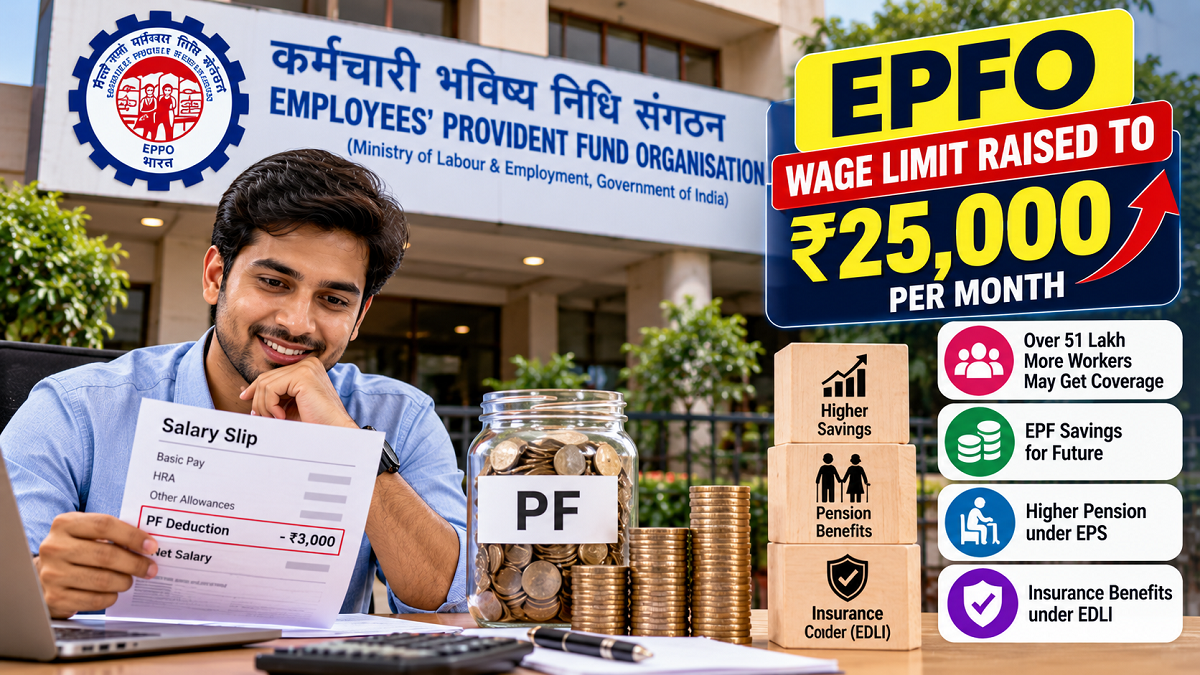
A major change in the Employees' Provident Fund Organisation (EPFO) framework could bring millions of additional salaried workers within the mandatory provident fund system. The wage ceiling for mandatory EPF coverage has been raised from ₹15,000 to ₹25,000 per month, expanding the social security net for employees in the affected salary range.
The change is particularly significant for workers earning between ₹15,000 and ₹25,000 per month who may previously have remained outside mandatory EPF coverage when joining eligible establishments, depending on the applicable rules and their membership status.
With the higher wage ceiling, more eligible employees can come within the EPFO framework and receive benefits linked to Employees' Provident Fund (EPF), Employees' Pension Scheme (EPS) and Employees' Deposit Linked Insurance (EDLI).
The change could strengthen long-term retirement protection, although newly covered employees may also notice an impact on their monthly take-home salary because of PF deductions.
More Than 51 Lakh Workers Could Come Under EPFO Coverage
According to the estimates cited with the change, more than 51 lakh additional workers could potentially come within mandatory EPFO coverage.
This expands access to a broader social security framework rather than simply introducing another deduction from salary.
Eligible employees covered by EPFO can build a retirement corpus through regular EPF contributions. They may also receive pension-related benefits under EPS and insurance protection under EDLI, subject to the respective scheme rules.
For workers who previously did not have structured retirement savings through their employer, the change could therefore have a meaningful long-term impact.
What Has Changed With the ₹25,000 Wage Ceiling?
The key change concerns the wage ceiling used for mandatory EPF coverage.
Previously, the commonly applicable ceiling was ₹15,000 per month. Under the revised framework, the limit has been increased to ₹25,000 per month.
This means eligible employees within the expanded wage band can now fall within mandatory EPFO coverage under the applicable conditions.
However, employees should remember that EPF membership rules can depend on factors including existing membership status and the provisions applicable to their employment. The ₹25,000 figure should therefore not be interpreted simply as a blanket rule that PF will be deducted in exactly the same way from every employee earning up to that amount.
How Could the New PF Rule Affect Take-Home Salary?
For employees newly brought into mandatory PF coverage, one of the most immediate changes could be visible in their salary slip.
A portion of eligible wages is contributed towards provident fund benefits. The standard employee contribution is generally 12% of eligible wages, subject to the applicable EPF rules.
For example, if the contribution is calculated on ₹25,000, a 12% employee contribution would amount to:
₹25,000 × 12% = ₹3,000 per month
This amount would go towards the employee's provident fund savings rather than being paid as part of monthly take-home salary.
As a result, an employee newly brought under the EPF system could see lower cash-in-hand salary while simultaneously accumulating more money for retirement.
The actual deduction can depend on the employee's salary structure and the contribution basis followed under the applicable rules.
Employer Contribution Is Also Important
EPF is not funded solely through deductions from the employee's salary.
Employers also make the prescribed contribution under the EPFO framework. The employer's contribution is allocated according to the rules governing EPF and EPS.
This distinction is important because the entire employer contribution does not necessarily go directly into the employee's EPF balance.
A prescribed portion can be directed towards the Employees' Pension Scheme, while the remaining applicable amount goes towards EPF, subject to the prevailing scheme provisions.
Employees should therefore check their salary structure and EPFO passbook to understand how contributions are being allocated.
EPS Pension Contribution Could Also Increase
The higher wage ceiling could also have implications for pension contributions under the Employees' Pension Scheme (EPS).
Under the earlier ₹15,000 ceiling, an employer's EPS contribution calculated at 8.33% was capped at approximately ₹1,250 per month.
If the applicable pensionable wage ceiling becomes ₹25,000, an 8.33% calculation would work out to approximately:
₹25,000 × 8.33% = ₹2,082.50
That is roughly ₹2,083 per month.
This could increase the amount directed towards EPS for affected employees, although the eventual pension is determined according to EPS rules and the applicable pension formula. It would therefore be incorrect to assume that a higher monthly contribution translates into an identical percentage increase in the final pension.
EPF, EPS and EDLI: What Employees Could Gain
The expansion of EPFO coverage can provide workers with three important forms of social security.
EPF helps employees accumulate long-term retirement savings through regular employee and employer contributions.
EPS provides pension-related benefits to eligible members based on the scheme's conditions, including pensionable salary and qualifying service.
EDLI provides life insurance protection linked to EPF membership, subject to the scheme's eligibility requirements and limits.
Together, these benefits are designed to provide financial support during retirement and protection for an employee's family in certain circumstances.
Why Employees Should Check Their Salary Structure
Workers earning between ₹15,000 and ₹25,000 should pay close attention to their salary slips and employment terms following the change.
A PF deduction can reduce monthly take-home pay, but the deducted amount contributes towards long-term savings rather than disappearing as a normal expense.
Employees should check their basic pay and other eligible wage components, employee PF deduction, employer contribution, EPS allocation and overall cost-to-company structure.
This will provide a clearer picture of how EPFO coverage affects both immediate salary and long-term benefits.
Higher PF Coverage Could Strengthen Retirement Savings
The increase in the wage ceiling from ₹15,000 to ₹25,000 represents a significant expansion of the EPFO social security framework for eligible salaried workers.
While newly covered employees may see a reduction in their monthly take-home salary because of provident fund contributions, they could simultaneously gain access to structured retirement savings, pension benefits and insurance protection.
For someone contributing on ₹25,000 of eligible wages, a 12% employee PF contribution could amount to ₹3,000 per month, while the EPS component based on 8.33% of ₹25,000 would work out to approximately ₹2,083, subject to the final applicable EPFO rules.
Employees affected by the revised wage ceiling should therefore review their salary structure and EPFO contribution details carefully to understand both the short-term impact on take-home pay and the potential long-term benefits for retirement and financial security.