
NEWS
This temple in India houses the mysterious mummy of a 900-year-old Indian saint! Learn the shocking truth!

Guru Ramanujacharya: The body of the renowned saint and religious guru Ramanujacharya is still preserved in the Sri Ranganathaswamy Temple in South India. Learn the fascinating and mysterious story behind it.
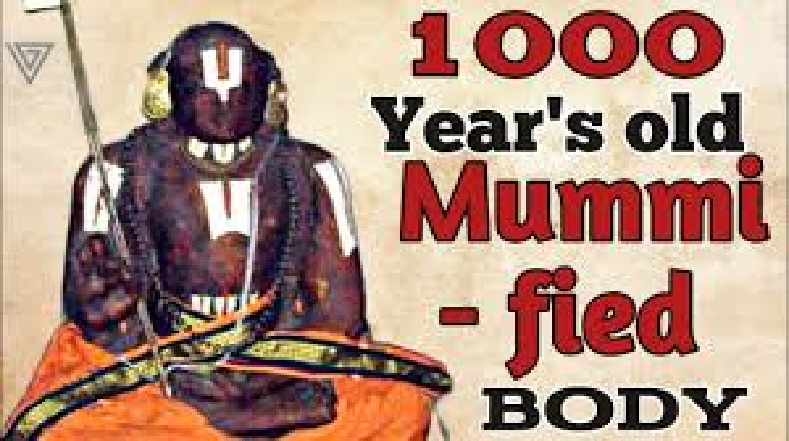
Mummies of Sri Ranganathaswamy Temple
Guru Ramanujacharya's 900-year-old mummy: Today, when we hear the word mummy, we think of Hollywood movies or dead bodies encased in ancient Egyptian coffins. But can a dead body really be preserved for thousands of years?
It's possible, as scientists have confirmed. Today, we're going to tell you about a 900-year-old mummy of an Indian saint, not from Egypt, but from India itself, about which very few people know.
Mummy of a 900-year-old saint at Sri Ranganathaswamy Temple
The body of the renowned saint and religious guru Ramanujacharya is still preserved at the Sri Ranganathaswamy Temple (Sriranga, Tiruchirappalli) in South India. His body is said to be approximately 900 years old, and people come from far and wide to visit.
Hinduism, one of the oldest religions in the world, believes that a person does not attain salvation only through death, but it is also important to free their soul; hence, cremation is performed after death.
In Christianity and Islam, bodies are buried. Egypt has an ancient tradition of preserving bodies as mummies. Following this tradition, the body of Guru Ramanujacharya has also been preserved.
Who was Ramanujacharya?
Guru Ramanujacharya was an Indian philosopher, scholar of Hindu theology, social reformer, and a member of the Vaishnavite sect. His philosophical ideas contributed to the influence of the Bhakti movement.
You may be surprised to know that a paste of sandalwood, turmeric, and saffron is applied to Guru Ramanujacharya's body to protect it from bacteria. Furthermore, a mixture of saffron and camphor is prepared and applied to the body twice a year.
The body appears saffron in colour due to the use of a coat of turmeric, sandalwood and camphor.
The Li Mausoleum in 1137 BC
Devotees can easily have darshan of Guru Ramanujacharya. His body is placed behind the statue. The fingernails can be used to determine if this is the real body.
The body of Sri Ramanujacharya is placed in the southwest corner of the fifth chakra inside the Srirangam temple. Temple priests say this was ordered by Lord Ranganatha himself.
According to legend, when Guru Ramanujacharya was about to leave this earth, he informed his disciples of this fate. He instructed them to remain with him for three more days.
He is believed to have breathed his last in 1137 BC.

