Business
PM Surya Ghar Gets New 60-Second Solar Tool: Check Rooftop Cost, Subsidy, Loan and Savings Online
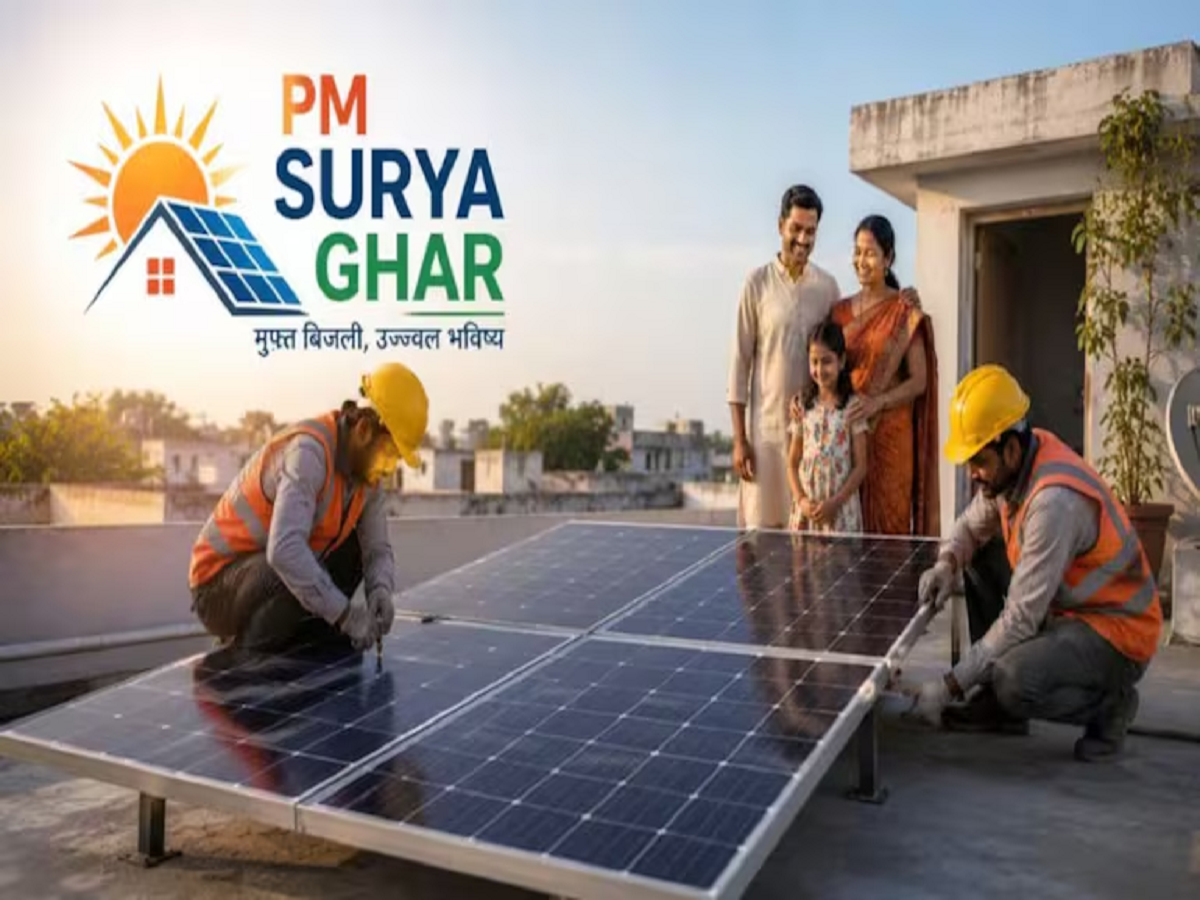
PM Surya Ghar Muft Bijli Yojana: Households planning to install rooftop solar can now get a quick estimate of the required system size, installation cost, government subsidy and financing options through a new digital facility introduced under the PM Surya Ghar scheme.
The Ministry of New and Renewable Energy (MNRE) has launched an interactive platform called “Get Solar in 60 Secs” to make the initial decision-making process easier for residential consumers. Instead of trying to calculate solar capacity, project cost and subsidy separately, users can enter a few basic details and receive a personalised estimate within about a minute.
The new facility comes as the PM Surya Ghar programme continues to expand rapidly. Government data released on August 4, 2026 showed that more than 50.06 lakh households had benefited from rooftop solar installations under the programme. Nearly 19 lakh households were reporting zero electricity bills, while 14.8 GW of rooftop solar capacity had been commissioned.
What Is the ‘Get Solar in 60 Secs’ Tool?
The new digital tool is designed for people who are interested in installing rooftop solar but are unsure about the size of the system they need or how much the project could cost.
The platform takes basic information from the consumer and provides an indicative rooftop-solar calculation.
Users are asked to enter details such as their name, mobile number, state and district. They can then provide information about their recent electricity bill and sanctioned electricity load.
Based on these inputs, the tool can estimate a suitable rooftop solar capacity, expected installation cost, applicable subsidy, financing options and potential long-term savings.
It can therefore serve as a starting point before a household proceeds with the formal application and installation process.
How to Use the New Solar Calculator
Using the platform is designed to be straightforward.
First, the consumer provides basic personal and location details, including state and district. Next, information relating to electricity consumption or the latest electricity bill and sanctioned load is entered.
The platform then analyses these details to provide an indicative solar-system recommendation.
For example, a household consuming relatively little electricity may require a smaller rooftop system, while a family with higher consumption may be shown a larger solar capacity.
The estimate can also indicate how much central financial assistance may be available and how much of the remaining installation cost may have to be paid or financed by the consumer.
How Much Subsidy Is Available Under PM Surya Ghar?
The central subsidy under the PM Surya Ghar Muft Bijli Yojana depends on the capacity of the residential rooftop solar system.
Under the scheme structure, the central financial assistance is:
- ₹30,000 for a 1 kW system
- ₹60,000 for a 2 kW system
- ₹78,000 for a 3 kW system or higher
The central subsidy is capped at 3 kW for an individual residential household. The government provides support equivalent to 60% of the benchmark system cost for the first 2 kW and 40% of the additional benchmark cost between 2 kW and 3 kW.
Some states may offer additional support of their own, so the final financial benefit can vary depending on the consumer's location.
Can the Tool Also Show Solar Loan Options?
Yes. One of the useful features of the new platform is that it can provide information relating to financing options available for rooftop solar installations.
Households that do not want to pay the entire remaining cost upfront can explore eligible bank-loan options.
The government has also facilitated collateral-free financing for eligible residential rooftop systems. In July 2026, MNRE stated that nationalised banks were offering collateral-free loans for eligible systems at a concessional rate linked to the repo rate plus 50 basis points, which at that time worked out to 5.75% per annum, with a tenure of up to 10 years under the applicable arrangement.
Actual loan availability, interest rate, eligibility and repayment terms should be checked with the participating bank when applying, as these can change.
Consumers Can Find Registered Solar Vendors
Choosing an installer is another important part of rooftop-solar adoption.
The platform can help consumers identify vendors registered under the PM Surya Ghar programme. Users can then connect with an eligible vendor to discuss installation, technical requirements and other formalities.
Under the scheme, households apply through the National Portal and can select an empanelled vendor for rooftop solar installation. The portal also provides information designed to help consumers assess system size and vendors.
Consumers should preferably use authorised channels and verify vendor details before making payments or sharing sensitive information.
Government Has Also Introduced the ‘SUNtosh’ WhatsApp Chatbot
The solar calculator is not the only digital facility being used to make the programme easier to access.
On June 4, 2026, the government launched a WhatsApp-based chatbot named SUNtosh in connection with the PM Surya Ghar programme. The chatbot is intended to help users obtain information related to the scheme and navigate common questions surrounding rooftop solar.
Such digital tools are aimed at reducing the confusion consumers may face around subsidies, applications, vendors and the installation process.
Can Households Really Get Up to 300 Units of Free Electricity?
The PM Surya Ghar scheme was created with the objective of enabling households to generate rooftop solar electricity and potentially receive the benefit of up to 300 units of electricity per month, depending on system generation and consumption.
The programme has an approved financial outlay of ₹75,021 crore and aims to cover one crore households with rooftop solar.
However, the phrase “300 units free” should not be interpreted as an automatic fixed monthly credit for every beneficiary. The actual electricity-bill benefit depends on factors such as the size of the rooftop system, local sunlight conditions, electricity consumption, generation and the applicable net-metering arrangement.
More Than 50 Lakh Households Have Already Benefited
The programme has recorded a sharp increase in installations.
According to an MNRE update released through the Press Information Bureau on August 4, 2026, more than 50.06 lakh households had benefited from rooftop solar under PM Surya Ghar. The government said ₹28,024 crore in subsidies had already been released directly to beneficiaries, while nearly 19 lakh households were receiving zero electricity bills.
The government also reported that more than 12 lakh households had earned a combined ₹421 crore by supplying surplus power to the grid during FY 2024-25.
When Was PM Surya Ghar Launched?
The PM Surya Ghar Muft Bijli Yojana was launched by Prime Minister Narendra Modi on February 13, 2024. The Union Cabinet subsequently approved the scheme on February 29, 2024, with its ₹75,021 crore outlay.
This distinction is important because February 29 is sometimes incorrectly described as the scheme's launch date.
Rooftop Solar Could Also Deliver Long-Term Environmental Benefits
Apart from reducing household electricity expenditure, the scheme forms part of India's broader transition toward renewable energy.
Government estimates suggest that rooftop installations across one crore households could generate around 1,000 billion units of renewable electricity over their expected lifetime and reduce carbon dioxide-equivalent emissions by about 720 million tonnes over 25 years.
For households, however, the immediate benefit of the new “Get Solar in 60 Secs” tool is simpler: it provides a quick first look at whether rooftop solar makes financial sense for their electricity consumption.
Consumers can use the estimate to understand the likely system capacity, subsidy and financing requirement before moving ahead with a formal application. Since actual installation costs, loan rates and electricity savings can differ by location and vendor, the final figures should always be verified through the official PM Surya Ghar portal, the local DISCOM and an empanelled installer.