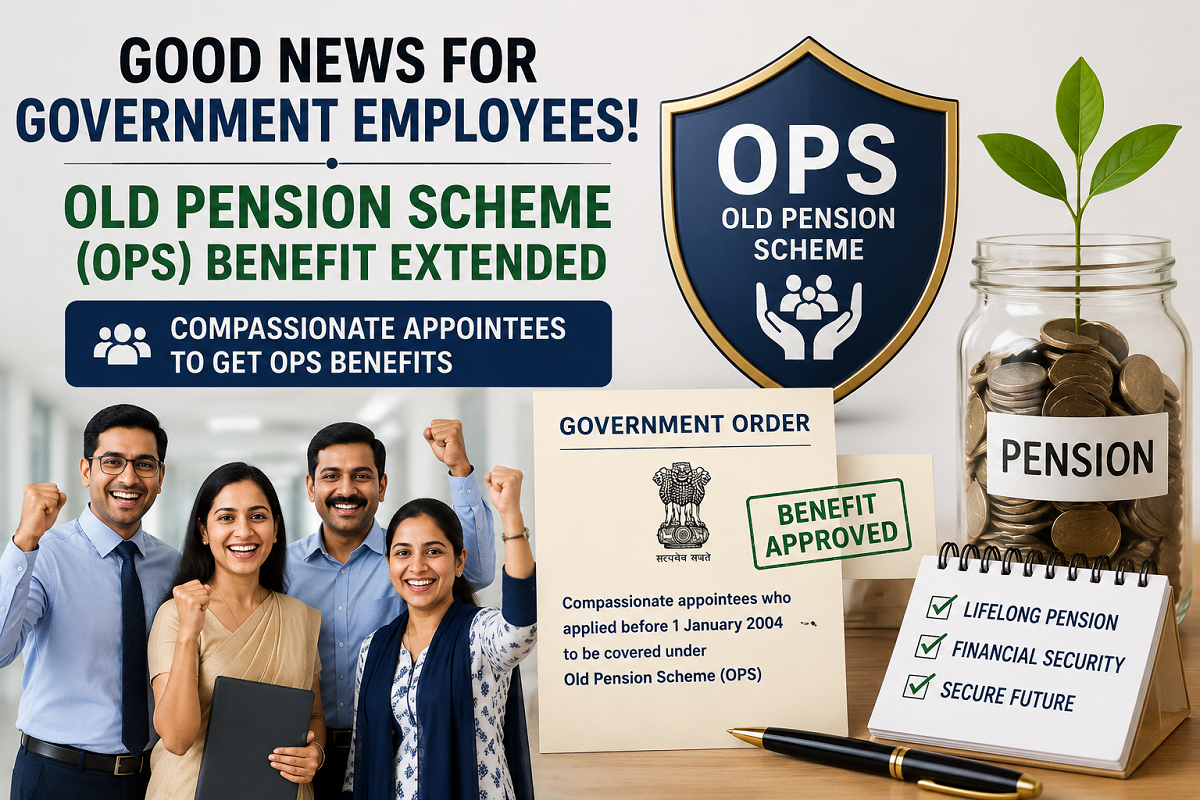
In a significant relief for a section of Central Government employees, the government has clarified that certain employees appointed on compassionate grounds will now be eligible for the Old Pension Scheme (OPS), even if their appointments were made after the introduction of the National Pension System (NPS).
The decision follows a fresh order issued by the Department of Pension and Pensioners' Welfare (DoPPW) on June 22, 2026, bringing clarity to a long-pending issue affecting thousands of families. The move is expected to benefit employees whose applications for compassionate appointment were submitted before the implementation of the National Pension System but whose actual appointments took place later due to administrative delays.
The announcement has been welcomed by many affected employees and has also revived discussions about the future of the Old Pension Scheme for other categories of government staff.
Who Will Be Eligible for OPS?
According to the latest government order, employees appointed on compassionate grounds will qualify for the Old Pension Scheme if the application for compassionate appointment was submitted before January 1, 2004, even if the final appointment letter was issued after that date.
Until now, many such employees had been placed under the National Pension System because their joining date fell after January 1, 2004—the date from which NPS became applicable to new Central Government recruits.
The revised clarification recognizes that delays in completing the appointment process should not deprive eligible families of the pension benefits that would have otherwise been available under the earlier pension rules.
Why Is This Decision Important?
Compassionate appointments are provided to eligible family members of deceased government employees to help them cope with financial hardship after the loss of the primary earning member.
In several cases, although applications were submitted before January 1, 2004, the recruitment process was completed only after the National Pension System came into force. As a result, many beneficiaries were enrolled under NPS instead of OPS.
The latest decision addresses this issue by allowing eligible employees to receive pension benefits under the Old Pension Scheme based on the date of their application rather than the date of appointment.
This is expected to provide long-term financial security to thousands of affected employees and their families.
Relief for Thousands of Employees
The government order is seen as a major relief for employees who had been seeking parity in pension benefits for several years.
Many affected individuals argued that delays caused by administrative procedures should not change the pension system applicable to them, especially when their compassionate appointment process had begun before the introduction of NPS.
The new clarification resolves this concern for eligible cases and provides greater certainty regarding retirement benefits.
Does This Mean OPS Is Returning for Everyone?
While the decision has generated optimism among some government employees, experts believe it should not be interpreted as a nationwide restoration of the Old Pension Scheme.
The latest order applies only to a specific category of compassionate appointees who satisfy the prescribed eligibility conditions. It does not extend OPS benefits to all employees currently covered under the National Pension System.
Over the past few years, several employee organizations have demanded the restoration of OPS for all government staff. However, the Central Government has repeatedly maintained that there is no proposal to replace NPS with OPS for all employees.
Why Is a Complete OPS Revival Considered Difficult?
Financial experts point out that restoring the Old Pension Scheme for all government employees would significantly increase the government's long-term pension liabilities.
Unlike the National Pension System, which is based on defined contributions from both the employee and the employer, the Old Pension Scheme guarantees a lifelong pension funded by the government.
Because of the substantial fiscal burden associated with OPS, the government has consistently stated in Parliament and other official forums that it does not intend to bring back the old pension system universally.
What This Means for Employees
Employees appointed on compassionate grounds should carefully review the eligibility conditions mentioned in the latest government notification. Those whose compassionate appointment applications were submitted before January 1, 2004, may now become eligible for the Old Pension Scheme, subject to the provisions laid down in the official order.
For employees covered under the National Pension System in other categories, the existing pension framework remains unchanged unless further policy decisions are announced.
Key Takeaway
The Central Government's latest clarification offers important relief to a specific group of compassionate appointees by extending the benefits of the Old Pension Scheme based on the date of their application rather than the date of appointment. While the move resolves a long-standing issue for eligible employees, it does not indicate a broader return of OPS for all government workers. The National Pension System continues to remain the primary retirement framework for employees who joined Central Government service after January 1, 2004, except in cases covered by the new eligibility criteria.