NEWS
EV Charging Cost Explained: How Much Does It Cost to Charge an Electric Car at Home vs Public Charging Stations?

Electric Car Charging Cost 2026: Electric vehicles (EVs) are gradually becoming a popular alternative to conventional petrol and diesel cars in India. Lower running expenses, reduced dependence on fossil fuels and expanding charging infrastructure are encouraging more consumers to consider electric mobility.
However, one of the biggest questions among prospective EV buyers is how much electricity an electric car consumes and whether charging at home is more economical than using a public charging station.
The actual charging expenditure depends on several factors, including battery capacity, electricity tariffs, charger specifications and energy losses during charging.
Understanding these expenses can help electric vehicle owners manage their monthly transportation budget and maximise savings.
How Much Does It Cost to Charge an Electric Car at Home?
Residential charging is generally considered one of the most economical ways to recharge an electric vehicle. This is because domestic electricity tariffs are often lower than the rates charged by commercial EV charging operators.
For example, suppose an electric car owner installs a 7.2 kW home charger and pays ₹5 per unit of electricity.
If the charger draws 7.2 kW continuously for one hour, it will consume approximately 7.2 units of electricity.
The estimated charging expenditure can be calculated as follows:
| Particulars | Estimated Details |
|---|---|
| Home charger capacity | 7.2 kW |
| Electricity consumption per hour | 7.2 units |
| Domestic electricity tariff | ₹5 per unit |
| Charging cost for one hour | ₹36 |
| Charging cost for five hours | ₹180 |
| Charging cost for eight hours | ₹288 |
These calculations assume that the charger operates continuously at its rated power. Actual consumption may vary depending on the vehicle's charging capability, battery level and charging efficiency.
How Much Does a Full Electric Car Battery Charge Cost?
Electric vehicles are available with different battery capacities. Smaller electric cars generally require less electricity for a complete recharge, while larger vehicles with extended driving ranges may require more energy.
Assuming a domestic electricity tariff of ₹5 per unit, the estimated full battery charging expenses would be:
| EV Battery Capacity | Estimated Charging Cost | Cost With 10% Charging Loss |
|---|---|---|
| 25 kWh | ₹125 | ₹139 |
| 30 kWh | ₹150 | ₹167 |
| 40 kWh | ₹200 | ₹222 |
| 50 kWh | ₹250 | ₹278 |
| 60 kWh | ₹300 | ₹333 |
| 75 kWh | ₹375 | ₹417 |
| 100 kWh | ₹500 | ₹556 |
The above figures represent illustrative charging costs from an empty to a full battery. Most EV owners do not regularly charge their vehicles from zero to 100%.
Electricity tariffs, applicable taxes and charging efficiency can influence the final amount.
How Much Does Public EV Charging Cost?
Public charging stations provide an important alternative for electric vehicle owners, particularly those travelling long distances or living in residential buildings without dedicated charging facilities.
Commercial charging operators may charge higher rates because their pricing can include infrastructure expenses, equipment maintenance, electricity costs and service charges.
A 50 kW DC fast charger can theoretically deliver up to 50 kWh of energy in one hour if the vehicle supports that charging speed and conditions remain favourable.
However, charging speeds generally fluctuate depending on battery temperature, charge level and vehicle specifications.
For illustration, consider a public charging station charging between ₹15 and ₹25 per unit.
| Electricity Delivered | At ₹15 per Unit | At ₹20 per Unit | At ₹25 per Unit |
|---|---|---|---|
| 20 kWh | ₹300 | ₹400 | ₹500 |
| 30 kWh | ₹450 | ₹600 | ₹750 |
| 40 kWh | ₹600 | ₹800 | ₹1,000 |
| 50 kWh | ₹750 | ₹1,000 | ₹1,250 |
| 60 kWh | ₹900 | ₹1,200 | ₹1,500 |
These are hypothetical tariff examples rather than confirmed nationwide charging rates. Actual prices vary across charging networks and locations.
Home Charging vs Public Charging: Which Offers Better Value?
Both charging methods serve different purposes. While residential charging is generally suitable for everyday commuting, public fast charging offers greater convenience during long-distance journeys.
| Comparison | Home Charging | Public Charging |
|---|---|---|
| Charging expenses | Generally lower | Generally higher |
| Charging speed | Usually slower | Fast charging options available |
| Convenience | Suitable for overnight charging | Useful while travelling |
| Availability | Requires suitable residential facilities | Depends on charging network coverage |
| Additional expenses | Installation and electrical upgrades | Possible service and parking charges |
| Best suited for | Daily commuting | Highway journeys and emergency charging |
Electric vehicle owners with access to private parking and an approved home charging installation may benefit from lower recurring charging expenses.
EV Running Cost Per Kilometre: How Much Can You Save?
Suppose an electric car has a 40 kWh usable battery capacity and delivers an actual driving range of approximately 300 kilometres.
At a domestic electricity tariff of ₹5 per unit, the theoretical cost of charging the battery would be ₹200, excluding energy losses.
If the same amount of energy costs ₹20 per unit at a public charging station, the charging expenditure would increase to ₹800.
| Particulars | Home Charging | Public Charging |
|---|---|---|
| Battery capacity | 40 kWh | 40 kWh |
| Assumed electricity rate | ₹5/unit | ₹20/unit |
| Estimated charging cost | ₹200 | ₹800 |
| Assumed driving range | 300 km | 300 km |
| Estimated energy cost per kilometre | ₹0.67 | ₹2.67 |
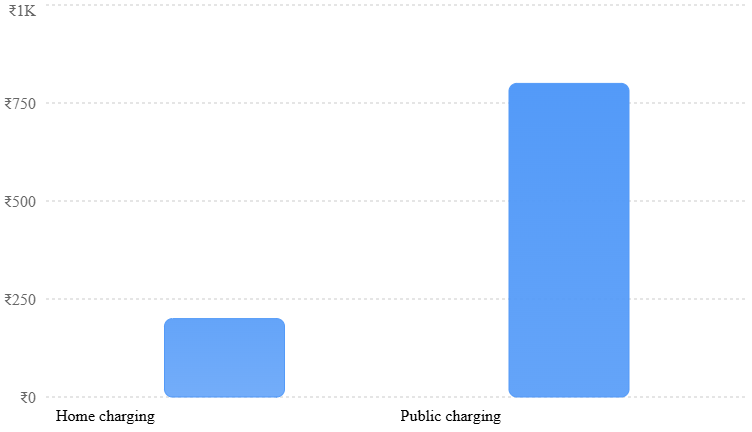
Illustrative comparison for 40 kWh of electricity, excluding charging losses and additional fees.
Actual driving expenses depend on road conditions, driving habits, vehicle efficiency, air-conditioning usage and battery performance.
Simple Ways to Reduce Electric Car Charging Expenses
EV owners can manage their electricity expenditure more effectively by following a few practical measures:
- Charge your vehicle at home whenever suitable facilities are available.
- Use off-peak electricity tariffs if offered by your electricity provider.
- Compare public charging prices before starting a charging session.
- Follow the manufacturer's recommended battery charging limits.
- Maintain appropriate tyre pressure to improve driving efficiency.
- Avoid unnecessary rapid acceleration and aggressive driving.
- Consider rooftop solar power for residential charging where financially and technically feasible.
- Use manufacturer-approved charging equipment and ensure professional electrical installation.
Is Installing a Home EV Charger Worth It?
For individuals who regularly use electric vehicles for office travel, shopping and daily transportation, installing a dedicated residential charger can provide considerable convenience.
However, buyers should also consider the initial installation cost, sanctioned electrical load, parking arrangements, earthing requirements and applicable housing society permissions.
Public charging stations remain essential for highway journeys and consumers who cannot install residential charging equipment.
A combination of regular home charging and occasional public fast charging can help EV owners balance affordability, convenience and travel flexibility.
Disclaimer: All charging expenses and per-kilometre calculations are illustrative estimates based on assumed electricity tariffs and battery capacities. Actual costs may differ depending on local electricity rates, charging losses, vehicle specifications and service provider charges.