NEWS
Diwali Lighting Tips 2026: Can You Run Decorative LED Lights on an Inverter? Know the Safety Rules
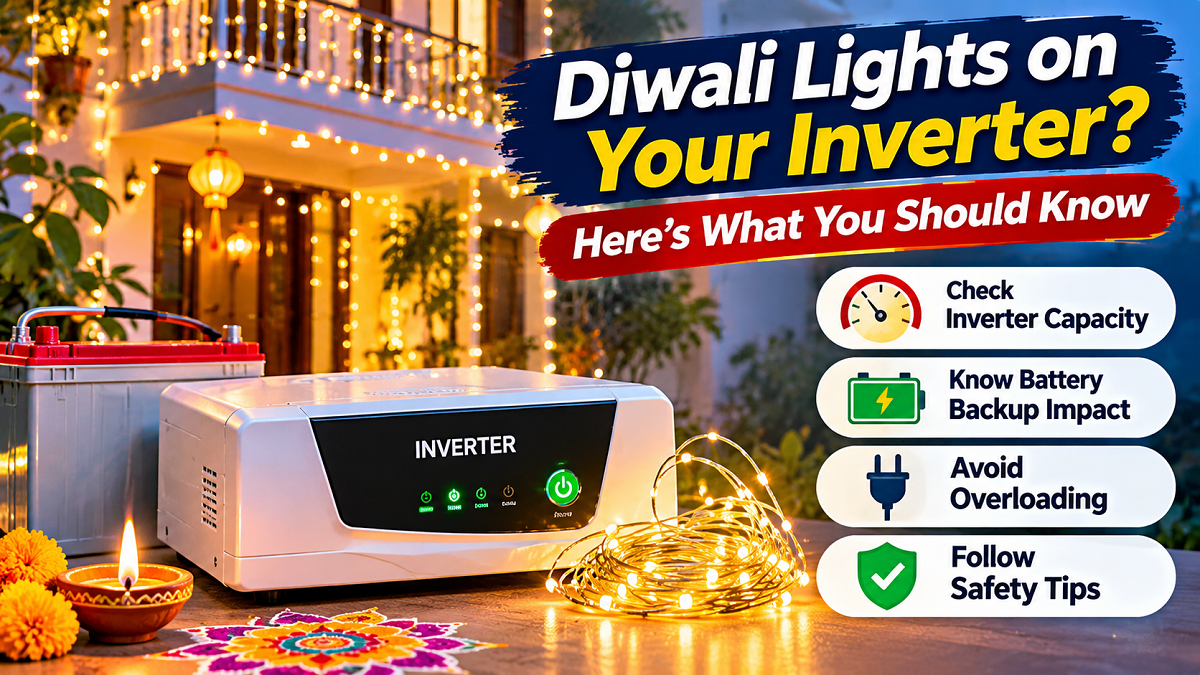
Diwali Inverter Guide 2026: As the festive season approaches, households across India are preparing to decorate their homes with colourful LED string lights, decorative lamps and sparkling lighting arrangements. Diwali celebrations often involve illuminating balconies, windows, entrances and outdoor spaces to create a festive atmosphere.
However, an unexpected power cut can interrupt these arrangements, particularly when decorative lighting depends entirely on the main electricity supply.
Many homeowners already have an inverter installed to provide backup electricity during outages. This raises an important question: Can Diwali decorative lights operate safely on a household inverter without damaging the battery or affecting essential appliances?
The answer is yes. Most modern LED decorative lights can run on an inverter, provided the system has sufficient spare capacity and the lighting setup follows proper electrical safety practices.
Before connecting additional lights, homeowners should understand how inverter capacity, battery backup and electricity consumption affect performance.
Can Diwali LED String Lights Work on a Home Inverter?
Modern LED decorations generally consume considerably less electricity than traditional incandescent decorative bulbs. This makes them suitable for many residential inverter systems.
A household inverter rated for a continuous output of around 700 watts may support several LED light strings, depending on their combined power requirements and the other appliances already connected.
However, an inverter's actual capacity must be checked before adding decorative lighting.
Some inverters are rated in volt-amperes (VA) rather than watts. Their usable wattage depends on the manufacturer's specifications and power factor.
For example, an inverter with a 700-watt continuous output cannot safely support appliances whose combined operating load exceeds that limit.
Homeowners should therefore calculate the total connected load instead of assuming that every decorative lighting arrangement will work automatically.
Check Your Inverter Capacity Before Connecting Extra Lights
One of the most important steps is identifying how much electricity the decorative lights will consume.
LED string lights are available in different lengths, brightness levels and power ratings. Their consumption can vary depending on the product.
Consider a simple example:
- Five LED light strings consuming 10 watts each require 50 watts.
- Ten similar strings require 100 watts.
- Twenty such strings would consume approximately 200 watts.
These are illustrative figures, and actual wattage should always be checked on the product label or adapter.
If the inverter is already operating fans, television sets or other household appliances, their power consumption must also be included.
The total running load should remain comfortably below the inverter's rated continuous output.
Will Diwali Decorations Reduce Inverter Battery Backup?
Although LED lights are energy-efficient, they still draw electricity from the inverter battery during a power cut.
The more electrical appliances connected to the inverter, the faster the stored battery energy will be consumed.
For example, suppose an inverter is operating two fans, a television and several decorative LED strings. Adding more lights will increase the total power requirement and reduce the available backup duration.
Battery backup depends on several factors, including:
- Battery voltage and ampere-hour (Ah) capacity.
- Battery age and condition.
- Total electricity consumption of connected appliances.
- Inverter conversion efficiency.
- Battery type and permissible depth of discharge.
A fully charged battery may support a small lighting arrangement for several hours, but the exact duration cannot be determined without knowing these details.
To preserve backup power, homeowners should switch off unnecessary appliances when decorative lights are running on the inverter.
How to Prevent Inverter Overloading During Diwali
Connecting too many lights or electrical appliances can overload an inverter.
When the connected load exceeds its rated capacity, the inverter may activate its protection system.
Common warning signs include repeated beeping, an overload indicator, unexpected shutdowns or interruptions in the power supply.
Ignoring these warnings can affect system performance and may create electrical safety risks.
To reduce the possibility of overloading, use only the required number of LED strings and check their combined wattage.
Avoid operating high-power appliances such as electric heaters, irons, kettles or other heavy electrical equipment on a small household inverter unless it is specifically designed to support them.
Homeowners should also follow the load limits recommended by the inverter manufacturer.
Can You Connect Diwali Lights Directly to an Inverter?
Decorative lights should normally be connected through properly installed sockets or circuits supplied by the inverter's backup output.
Users should not attempt to attach LED strings directly to inverter battery terminals or modify electrical connections.
Many decorative LED products operate through adapters or controllers that convert household AC electricity into the voltage required by the lights.
These components should be used according to the manufacturer's instructions.
If the existing decorative lighting circuit is not connected to inverter backup, a qualified electrician should assess whether a suitable connection can be installed safely.
Improvised wiring and overloaded extension boards should always be avoided.
Important Electrical Safety Tips for Diwali Decorations
Electrical safety becomes particularly important when decorative lights are installed on balconies, terraces, gates and outdoor walls.
Consumers should purchase quality lighting products from reliable sellers and inspect the wiring before installation.
Damaged cables, exposed conductors, loose connections and overheating adapters should never be ignored.
Outdoor decorative lights must be suitable for outdoor use, and electrical joints should be protected against rain and moisture.
Extension boards should not be overloaded or connected in unsafe chains.
Homeowners should also ensure that the inverter and battery are installed in a suitable, well-ventilated location, away from flammable materials and sources of excessive heat.
Appropriate electrical protection devices and proper earthing are essential for the household wiring system.
If any decorative light produces unusual heat, sparks or a burning smell, disconnect it immediately and have the problem inspected.
Simple Ways to Save Electricity While Decorating Your Home
Diwali lighting can remain attractive without consuming unnecessary electricity.
Energy-efficient LED strings are generally preferable to older incandescent decorative bulbs because they provide illumination using substantially less power.
Homeowners can also use timers or smart switches to turn decorative lights off automatically when they are no longer needed.
Instead of illuminating every area continuously, consider focusing on entrances, balconies, windows and other prominent locations.
Switching off decorative lights before going to sleep or leaving the house can reduce unnecessary consumption and improve safety.
These small steps can help maintain festive decorations while limiting the additional load on the household electrical system.
Final Verdict: Is Using an Inverter for Diwali Lighting a Good Idea?
Running Diwali LED decorations on a household inverter is generally practical, particularly when the lights have low power requirements.
However, the inverter's continuous output capacity, existing appliance load and battery condition must be considered before connecting additional lighting.
A small number of LED strings may have only a modest impact on electricity consumption, while an extensive decorative setup can significantly reduce battery backup.
The safest approach is to calculate the total wattage, avoid overloading the inverter and use properly installed electrical connections.
With careful planning and suitable LED lighting, homeowners can keep their festive decorations illuminated during a power outage without unnecessarily compromising their inverter's performance or household electrical safety.
Source: Based on a consumer technology article published by Journal India on November 2, 2026. Rewritten with additional practical explanations and electrical safety guidance.