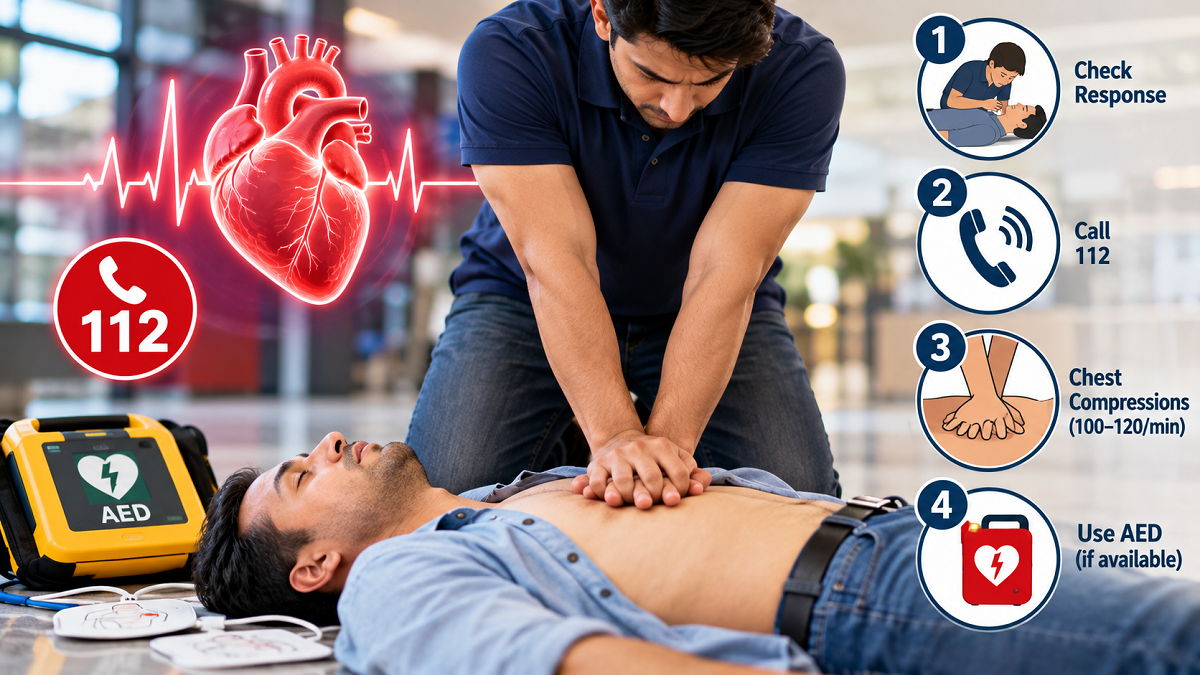
CPR Guide 2026: Cardiac arrest is a life-threatening medical emergency that can happen suddenly, sometimes without obvious warning signs. It occurs when the heart stops pumping blood effectively, preventing oxygen-rich blood from reaching the brain and other vital organs.
Without immediate action, a person experiencing cardiac arrest can lose their life within minutes. However, performing cardiopulmonary resuscitation (CPR) promptly can improve the chances of survival until professional medical assistance arrives.
CPR is an emergency procedure that helps maintain blood circulation through repeated chest compressions. Knowing when to start CPR, how to position your hands, and how fast to perform compressions can make a crucial difference.
Here is a step-by-step guide to performing CPR on an adult, recognising cardiac arrest, and understanding when chest compressions are necessary.
What Is Cardiac Arrest and Why Is CPR Important?
Cardiac arrest occurs when the heart suddenly stops pumping blood effectively. As a result, oxygen delivery to the brain and other organs is interrupted.
A person experiencing cardiac arrest usually collapses, becomes unresponsive, and stops breathing normally.
Sometimes, the person may make occasional gasping sounds. These abnormal breaths, known as agonal gasps, should not be mistaken for normal breathing.
CPR helps circulate blood while emergency medical services are on their way.
Although CPR does not always restart the heart, it can help maintain essential blood flow until advanced treatment, including defibrillation when appropriate, becomes available.
This is why immediate action by bystanders is so important.
When Should You Start CPR?
CPR should be started when an adult is unresponsive and is not breathing normally.
If someone suddenly collapses, take the following actions immediately:
- Check responsiveness: Gently tap the person's shoulders and shout to see whether they respond.
- Check breathing: Look for normal breathing for no more than 10 seconds. Occasional gasping does not count as normal breathing.
- Call emergency services: Dial 112 in India or ask someone nearby to contact emergency medical services.
- Request an AED: If an automated external defibrillator is available, ask another person to bring it.
- Begin CPR: Start chest compressions without waiting for an ambulance.
If you are alone, call emergency services using your phone's speaker mode and follow the operator's instructions while beginning CPR.
Do not waste valuable time repeatedly checking for a pulse if you are not a trained healthcare professional.
How to Perform CPR Correctly: Step-by-Step Guide
The following instructions describe adult CPR. CPR techniques for infants and children differ.
Step 1: Make Sure the Surrounding Area Is Safe
Before approaching the person, check whether the environment is safe.
Look for immediate hazards such as moving vehicles, electrical equipment, fire, or other dangerous conditions.
If the surroundings are safe, position the person on their back on a firm, flat surface whenever possible.
Kneel beside the person's chest so that you can perform compressions effectively.
Step 2: Place Your Hands in the Correct Position
Correct hand placement is essential for effective chest compressions.
Place the heel of one hand in the centre of the person's chest, over the lower half of the breastbone.
Position your other hand on top of the first and interlock your fingers.
Keep your arms straight and position your shoulders directly above your hands.
This posture allows you to use your upper-body weight to deliver effective compressions while reducing unnecessary strain on your arms.
Step 3: Push Hard and Fast on the Chest
Begin pressing down firmly and rhythmically.
For adults, recommended chest compression guidelines are:
| CPR Technique | Recommended Adult Guideline |
|---|---|
| Compression Rate | 100–120 compressions per minute |
| Compression Depth | Approximately 5–6 cm |
| Hand Placement | Centre of the chest, lower half of the breastbone |
| Arm Position | Straight arms, shoulders above hands |
| Chest Recoil | Allow the chest to return fully after each compression |
| Interruptions | Keep pauses as short as possible |
After every compression, allow the chest to return to its normal position before pressing again.
Avoid leaning continuously on the chest between compressions because this can interfere with blood returning to the heart.
Maintaining a steady rhythm is important.
Step 4: Continue CPR Until Help Arrives
Once CPR has started, continue chest compressions until trained emergency responders take over, the person begins showing clear signs of life such as normal breathing or purposeful movement, the environment becomes unsafe, or you are physically unable to continue.
If another person is available and capable of performing CPR, you can take turns to reduce fatigue.
Rescuers should ideally switch approximately every two minutes while keeping interruptions as brief as possible.
If you have not been trained to provide rescue breaths, hands-only CPR is an appropriate approach for an adult who suddenly collapses.
If you are trained and willing to provide rescue breaths, conventional CPR generally involves 30 chest compressions followed by two rescue breaths, with each breath delivered over approximately one second and enough to make the chest rise.
Follow emergency dispatcher instructions whenever available.
Step 5: Use an AED if One Is Available
An automated external defibrillator, commonly called an AED, is a device that analyses the heart's rhythm and determines whether an electric shock is appropriate.
AEDs are designed to provide spoken or visual instructions that can guide rescuers through their use.
If an AED is available:
- Turn on the device and follow its instructions.
- Expose the person's chest and attach the electrode pads as shown on the device.
- Make sure nobody touches the person while the AED analyses the heart rhythm.
- If the device advises a shock, ensure everyone is clear before delivering it.
- Resume CPR immediately when instructed by the AED.
Not every cardiac arrest requires a shock. The AED determines whether a shockable rhythm is present.
Using an AED promptly, alongside CPR, can improve survival chances in appropriate cases.
When Should CPR Not Be Performed?
CPR is intended for someone who is unresponsive and not breathing normally.
It is not necessary for every person who faints or becomes unconscious.
If the person is unconscious but breathing normally: Do not perform chest compressions. Call emergency services, keep monitoring their breathing, and place them in the recovery position if appropriate and there is no reason to avoid movement.
If the person is conscious: Do not start CPR. Assess the situation and seek medical assistance if necessary.
If the person is unresponsive and only gasping: Treat this as a possible cardiac arrest and begin CPR.
If a serious injury is suspected: Avoid unnecessary movement. However, if the person is unresponsive and not breathing normally, life-saving CPR should not be delayed solely because an injury may be present.
What Is the Difference Between Cardiac Arrest and a Heart Attack?
Many people use the terms heart attack and cardiac arrest interchangeably, but they describe different medical emergencies.
A heart attack generally occurs when blood flow to part of the heart muscle becomes blocked.
A person having a heart attack may remain conscious and continue breathing normally.
Symptoms can include chest discomfort, shortness of breath, sweating, nausea, or pain spreading to the arm, jaw, or back.
Cardiac arrest, by contrast, occurs when the heart suddenly stops pumping blood effectively.
A person experiencing cardiac arrest typically becomes unresponsive and stops breathing normally.
A heart attack can sometimes trigger cardiac arrest, but the two conditions are not the same.
Both require urgent medical attention.
Common CPR Mistakes to Avoid
During an emergency, incorrect techniques or unnecessary delays can reduce the effectiveness of CPR.
Some common mistakes include pressing too slowly, delivering shallow compressions, placing hands incorrectly, and stopping repeatedly to check whether the person has recovered.
Another dangerous mistake is assuming that occasional gasping means the person is breathing normally.
Bystanders should also avoid delaying CPR while searching for water, medicines, or other home remedies.
CPR and rapid access to emergency medical services are the priorities when cardiac arrest is suspected.
Can Someone Without Medical Training Perform CPR?
Yes. A person without formal medical training can perform hands-only CPR on an adult who is unresponsive and not breathing normally.
Hands-only CPR involves continuous chest compressions without rescue breaths.
Emergency dispatchers may provide telephone instructions to guide the rescuer.
However, practical CPR training is strongly recommended because it helps people learn correct compression depth, rhythm, hand placement, and AED use.
Schools, workplaces, community organisations, and healthcare institutions can play an important role in improving public awareness of these skills.
Why the First Few Minutes Matter
During cardiac arrest, the brain and other vital organs quickly become deprived of oxygen-rich blood.
The longer circulation remains interrupted, the greater the risk of serious injury or death.
Immediate CPR helps maintain some blood flow until advanced treatment becomes available.
Early recognition of cardiac arrest, rapid emergency response, high-quality CPR, and timely defibrillation are essential parts of improving survival.
Even when a bystander is unsure about their technique, following dispatcher instructions and starting appropriate chest compressions can be more helpful than doing nothing.
Final Thoughts
Cardiac arrest can occur unexpectedly, and the actions taken during the first few minutes can make a life-saving difference.
If an adult suddenly collapses, becomes unresponsive, and is not breathing normally, call emergency services immediately and begin CPR.
Remember the essential adult CPR guidelines: 100–120 chest compressions per minute, approximately 5–6 cm deep, with full chest recoil and minimal interruptions.
Use an AED as soon as one becomes available and follow its instructions.
Learning CPR through a recognised first-aid training programme can help you respond more confidently and effectively during a real emergency.
Medical Disclaimer: This article provides general adult CPR information and does not replace certified first-aid training or professional emergency guidance. In a suspected cardiac arrest in India, call 112 immediately and follow the emergency operator's instructions.