LIFESTYLE
Cancer Medicine Prices May Fall: 30% Trade Margin Cap Could Save Patients ₹2,500 Crore Annually
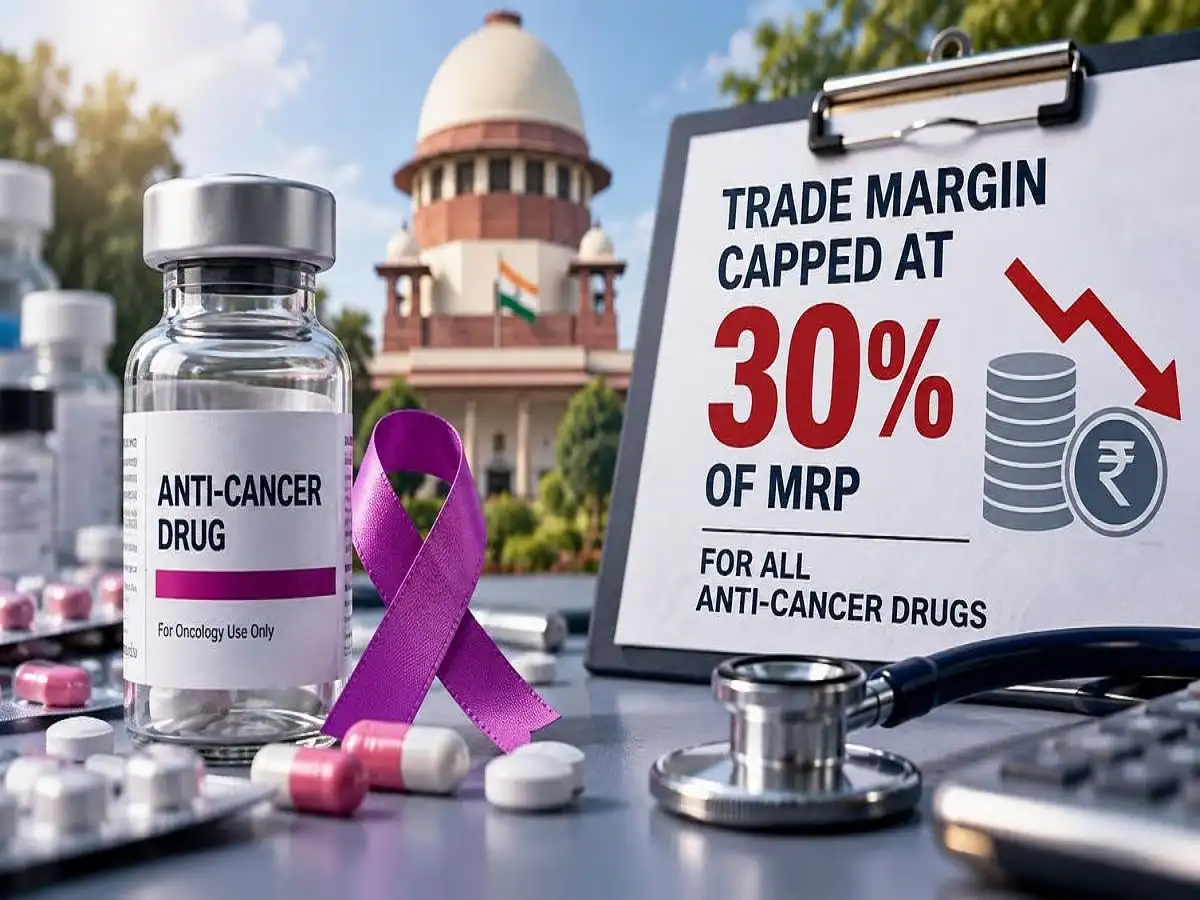
Cancer Drug Price Cut 2026: Cancer treatment can place a significant financial burden on patients and their families, particularly when expensive medicines are required for several months or years. In a move aimed at making treatment more affordable, the central government has reportedly decided to limit trade margins on non-scheduled anti-cancer medicines to 30%.
According to the October 12, 2026 report, the proposed pricing measure could help cancer patients across India save approximately ₹2,500 crore every year.
The initiative is expected to reduce excessive margins added during the distribution and sale of certain cancer medicines, potentially lowering the maximum retail price (MRP) paid by patients.
Some medicines could reportedly see price reductions of up to 70%, although the actual decrease would depend on their existing pricing structure.
The reported expansion of the pricing measure still requires confirmation through the applicable official notification and revised medicine price lists. Therefore, patients should not assume that all cancer medicines have already become cheaper.
Government Plans 30% Trade Margin Limit on Cancer Medicines
The proposed measure focuses on the trade margins charged on non-scheduled anti-cancer medicines.
Trade margins generally represent the difference between the price charged at an earlier stage of the supply chain and the price paid by the final consumer.
When these margins are unusually high, the retail price of a medicine can become significantly more expensive than its underlying procurement cost.
By restricting the permitted margin to 30% under the applicable pricing mechanism, authorities aim to make selected cancer medicines more affordable.
The policy is particularly relevant because many cancer treatments involve repeated medicine purchases.
Even a moderate reduction in the price of a regularly prescribed medicine could make a meaningful difference to a patient's treatment expenses over time.
However, the final impact will depend on the medicines covered, their existing margins, and the revised prices notified by the authorities.
Which Cancer Medicines Could Become Cheaper?
According to the supplied report, the proposed trade margin restriction could cover a broad range of non-scheduled anti-cancer medicines.
These may include:
- Branded medicines: Anti-cancer medicines sold under specific pharmaceutical brand names.
- Generic medicines: Medicines marketed using their generic names.
- Domestically manufactured medicines: Cancer medicines produced by pharmaceutical companies in India.
- Imported medicines: Anti-cancer medicines manufactured abroad and supplied to Indian patients.
- Patented medicines: Medicines protected by applicable intellectual property rights.
- Non-patented medicines: Medicines that are not subject to the same patent restrictions.
The purpose is to address excessive distribution margins across different categories of cancer medicines.
However, inclusion in a broad category does not automatically mean every medicine within that category will receive the same price reduction.
The exact scope must be established through the relevant government order and product-specific pricing details.
Cancer Patients Could Save ₹2,500 Crore Every Year
One of the most significant claims associated with the reported measure is the possibility of annual savings of approximately ₹2,500 crore for cancer patients.
Cancer treatment frequently involves multiple expenses, including diagnostic tests, surgery, chemotherapy, radiation therapy, hospital visits, and prescription medicines.
For some patients, medication represents a substantial portion of the overall treatment cost.
Patients requiring long-term drug therapy may be especially sensitive to changes in medicine prices.
A reduction in retail prices could help reduce out-of-pocket spending and improve the affordability of treatment.
However, the ₹2,500 crore figure is an estimated nationwide benefit, not a guaranteed saving for every patient.
Actual savings would depend on the prescribed medicine, the revised MRP, the quantity required, and the duration of treatment.
Will Cancer Medicine Prices Fall by 70%?
The report suggests that certain anti-cancer medicines could experience price reductions of up to 70% following implementation of the margin restriction.
This is a potential maximum reduction for some products, not a uniform discount across all cancer medicines.
For example, a medicine with an unusually high existing distribution margin may have more room for a substantial retail price reduction.
Another medicine that already has relatively low margins may see a much smaller change.
It is also important to understand that a 30% trade margin cap does not automatically mean a medicine's existing MRP will fall by 30%.
The final retail price depends on the applicable pricing formula, supply-chain costs, and the existing margin.
Patients should therefore check the revised price of their specific prescribed medicine rather than relying on general percentage estimates.
Government Introduced Similar Cancer Drug Price Controls in 2019
India has previously taken steps to reduce the cost of cancer medicines through trade margin regulation.
In February 2019, the National Pharmaceutical Pricing Authority (NPPA) introduced a 30% trade margin restriction for 42 selected non-scheduled anti-cancer medicines.
The measure was intended to reduce excessive retail margins and improve affordability.
According to the figures cited in the supplied report, the earlier intervention affected 526 medicine brands, with some products experiencing price reductions of up to 50%.
The reported 2026 proposal seeks to extend a similar approach to a wider range of non-scheduled anti-cancer medicines.
If implemented as described, it could bring additional medicines within the trade margin rationalisation framework.
Scheduled vs Non-Scheduled Medicines: What Is the Difference?
India regulates pharmaceutical prices through the Drugs (Prices Control) Order, 2013, commonly known as DPCO 2013.
The framework distinguishes between scheduled and non-scheduled formulations.
| Category | Scheduled Medicines | Non-Scheduled Medicines |
|---|---|---|
| Classification | Included in Schedule I of DPCO | Not included in Schedule I |
| Price Regulation | Subject to applicable notified ceiling prices | Subject to other pricing restrictions and monitoring |
| Pricing Authority | NPPA | NPPA monitors compliance with applicable rules |
| Price Increases | Governed by notified ceiling-price provisions | Generally restricted to a maximum 10% MRP increase over 12 months |
| Additional Measures | Ceiling-price controls | May be subject to trade margin rationalisation |
Scheduled Cancer Medicines
Scheduled medicines are included in Schedule I of the Drugs (Prices Control) Order.
The NPPA can determine and notify ceiling prices for these formulations according to the applicable rules.
Manufacturers generally cannot sell covered scheduled formulations above the notified ceiling price, subject to the relevant legal provisions.
According to the supplied report, ceiling prices had been fixed for 131 scheduled anti-cancer medicines by March 2026.
Non-Scheduled Cancer Medicines
Non-scheduled medicines are not included in Schedule I.
However, this does not mean their prices are entirely unrestricted.
Under the applicable DPCO framework, manufacturers generally cannot increase the MRP of a non-scheduled formulation by more than 10% during the preceding 12 months.
Trade margin rationalisation is an additional mechanism that can be used to address excessive margins in selected medicines.
How Can Patients Check the Revised Price of Cancer Medicines?
Patients and their families should verify the latest official pricing information before purchasing expensive medicines.
The NPPA publishes medicine price notifications and provides tools for checking applicable drug prices.
Patients can also compare the printed MRP on medicine packaging with the relevant official price information.
If a medicine's price has been revised, pharmacies and suppliers are expected to comply with the applicable pricing requirements.
However, patients should not change their prescribed medicines, dosage, or treatment schedules solely because another product is cheaper.
Cancer medicines can differ in formulation, strength, route of administration, and clinical suitability.
Any substitution should be discussed with the treating oncologist or another qualified medical professional.
Why Affordable Cancer Medicines Matter
The financial impact of cancer extends beyond the direct cost of medicines.
Patients may face repeated hospital visits, diagnostic procedures, travel expenses, and interruptions to employment.
For families already managing substantial treatment costs, expensive medicines can create additional financial pressure.
Policies aimed at reducing medicine prices can therefore play an important role in improving access to healthcare.
Lower medicine costs may help patients continue prescribed treatment and reduce some of the financial strain associated with long-term care.
Nevertheless, medicine price regulation is only one part of improving cancer care.
Timely diagnosis, access to hospitals, appropriate treatment, insurance coverage, and availability of essential medicines are also important.
What Happens Next?
The reported 30% trade margin restriction could represent an important expansion of India's efforts to make cancer medicines more affordable.
However, the final list of covered medicines, implementation date, revised MRPs, and enforcement arrangements need to be confirmed through official regulatory information.
Patients should watch for NPPA notifications and updated price lists rather than assuming that every anti-cancer medicine is immediately subject to a new lower price.
Pharmacies, hospitals, and pharmaceutical distributors will also need to follow the applicable pricing instructions once they take effect.
Final Thoughts
The reported move to restrict trade margins on non-scheduled anti-cancer medicines to 30% could provide financial relief to thousands of patients undergoing cancer treatment in India.
With estimated nationwide savings of approximately ₹2,500 crore annually and potentially substantial reductions for some medicines, the proposal highlights the importance of affordable access to essential treatment.
However, the actual benefit will vary between medicines, and claims of price reductions of up to 70% should not be interpreted as applying to every cancer drug.
Important Note: The reported 2026 expansion, estimated ₹2,500 crore savings, and possible 70% reductions are based on the supplied article and have not been independently verified against a new NPPA notification. Patients should consult official price lists and their treating doctors before making medicine-related decisions.