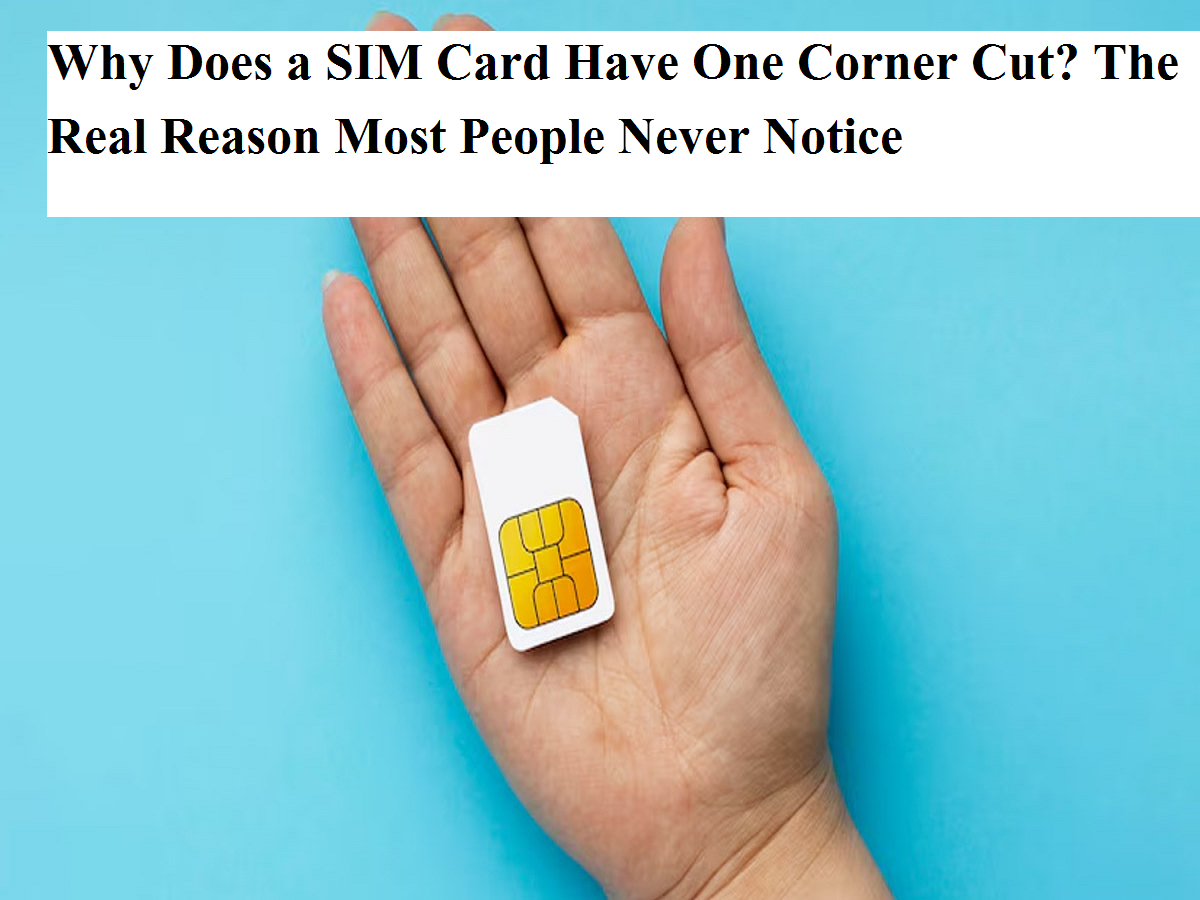
In today’s digital age, smartphones have become an inseparable part of daily life. From making calls and sending messages to online payments and social media, everything revolves around one tiny yet crucial component — the SIM card. While most of us have inserted or removed a SIM card countless times, very few people pause to notice one small but interesting detail: a SIM card always has one corner cut.
At first glance, this might look like a simple design choice. However, the truth is that this cut corner serves a very important purpose. In this article, we explain why SIM cards have a cut corner, how this design came into existence, and why it continues to be used even in modern nano SIMs.
The Evolution of SIM Card Design
When mobile phones were first introduced, SIM cards were not as small as they are today. Early SIM cards were almost the size of a credit card. Over time, as mobile phones became more compact, SIM cards also went through several size reductions — from full-size SIMs to mini, micro, and now nano SIMs.
Initially, SIM cards were completely rectangular in shape. While this seemed practical, it created a major usability issue for users. Many people found it confusing to figure out which direction the SIM card should be inserted into the phone’s slot.
The Problem Users Faced
Because early SIM cards had no distinct orientation mark, users often inserted them incorrectly. This led to several problems, such as:
- The phone failing to detect the network
- SIM cards getting stuck in the slot
- Damage to the SIM tray or internal connectors
- In some cases, permanent damage to the phone
These issues were common, especially when users tried to force the SIM card into the slot in the wrong direction.
The Simple Solution: A Cut Corner
To solve this problem, telecom companies and device designers came up with a smart and simple solution — cutting one corner of the SIM card. This small change made a big difference.
The cut corner acts as a directional guide, ensuring that the SIM card can be inserted only in the correct orientation. Phone manufacturers also designed SIM slots to match this shape, making incorrect insertion nearly impossible.
Why This Design Became a Global Standard
Once introduced, the cut-corner design proved to be extremely effective. Users could instantly understand how to place the SIM card correctly without needing instructions.
Because of its simplicity and efficiency, this design was quickly adopted worldwide and became an industry standard. Even today, regardless of the SIM size or phone brand, the cut corner remains a permanent feature.
Safety Is Another Key Reason
Apart from convenience, safety is another major reason behind the cut corner design. If a user tries to insert the SIM card incorrectly, the card simply won’t fit into the slot. This prevents accidental damage to both the SIM card and the phone’s internal hardware.
Even with modern smartphones using extremely small nano SIM cards, the cut corner is still present. This shows how effective and necessary this design choice continues to be.
Why the Design Still Matters Today
You might wonder why this design is still relevant when phones have advanced so much. The answer is simple — it works perfectly.
- It reduces user error
- It protects delicate phone components
- It ensures smooth SIM installation
- It avoids unnecessary repair costs
Sometimes, the smartest innovations are the simplest ones.
Final Thoughts
The cut corner on a SIM card is not just a design detail — it is a thoughtful solution to a real-world problem. Created to guide users, prevent damage, and improve safety, this tiny modification has played a big role in making mobile phones more user-friendly.
So, the next time you insert a SIM card into your phone, you’ll know that the small cut corner is there for a very important reason — and not just for looks.
If you found this article useful, don’t forget to share it. Stay connected for more such informative and interesting tech stories.