Business
UPI MDR Charges 2026: Will a ₹1 Lakh Payment Attract ₹300 Fee? Check the Proposed Rules and Calculation
UPI Transaction Charges 2026: Unified Payments Interface (UPI) has transformed digital payments in India, allowing millions of users to transfer money, pay merchants and complete transactions directly through their smartphones.
From purchasing groceries to making high-value payments, UPI has become an important part of everyday financial activity.
However, discussions surrounding a possible Merchant Discount Rate (MDR) on certain UPI transactions have raised questions among customers and business owners.
One important concern is whether transferring ₹1 lakh through UPI could attract additional charges. Another is whether dividing a large payment into several smaller transactions would reduce the potential fee.
A report published on October 23, 2026, discussed a proposed MDR structure involving a 0.4% charge on eligible merchant payments exceeding ₹2,000, subject to a maximum fee of ₹300 per transaction.
Importantly, these figures describe a reported proposal, not a verified charge currently applicable to all UPI transactions.
Here is how the suggested fee structure would work if officially introduced.
What Is MDR in UPI Transactions?
Merchant Discount Rate, commonly called MDR, is a fee associated with processing payments received by merchants.
In payment systems where MDR applies, the fee is generally charged to the merchant or deducted through the payment-processing arrangement.
It should not automatically be confused with a fee charged directly to the customer sending money.
For example, when a customer purchases goods worth ₹10,000 from a shop, the merchant may incur a payment-processing expense depending on the applicable payment method and regulatory framework.
The proposed UPI MDR structure discussed in the report would potentially affect certain eligible merchant transactions rather than ordinary transfers between individuals.
Proposed UPI MDR Charges: What Does the Report Say?
According to the supplied report, the proposed fee calculation would involve the following conditions:
- Eligible merchant payments exceeding ₹2,000 could attract MDR at 0.4%.
- The maximum MDR would be limited to ₹300 per transaction.
- The fee would relate to qualifying merchant transactions, not automatically to personal money transfers.
- Implementation would depend on an official announcement and applicable rules.
The report suggested that the proposed framework might be introduced after Diwali, but it did not provide a confirmed implementation date or an official notification establishing the charges.
Therefore, customers should not assume that the suggested MDR has already become mandatory.
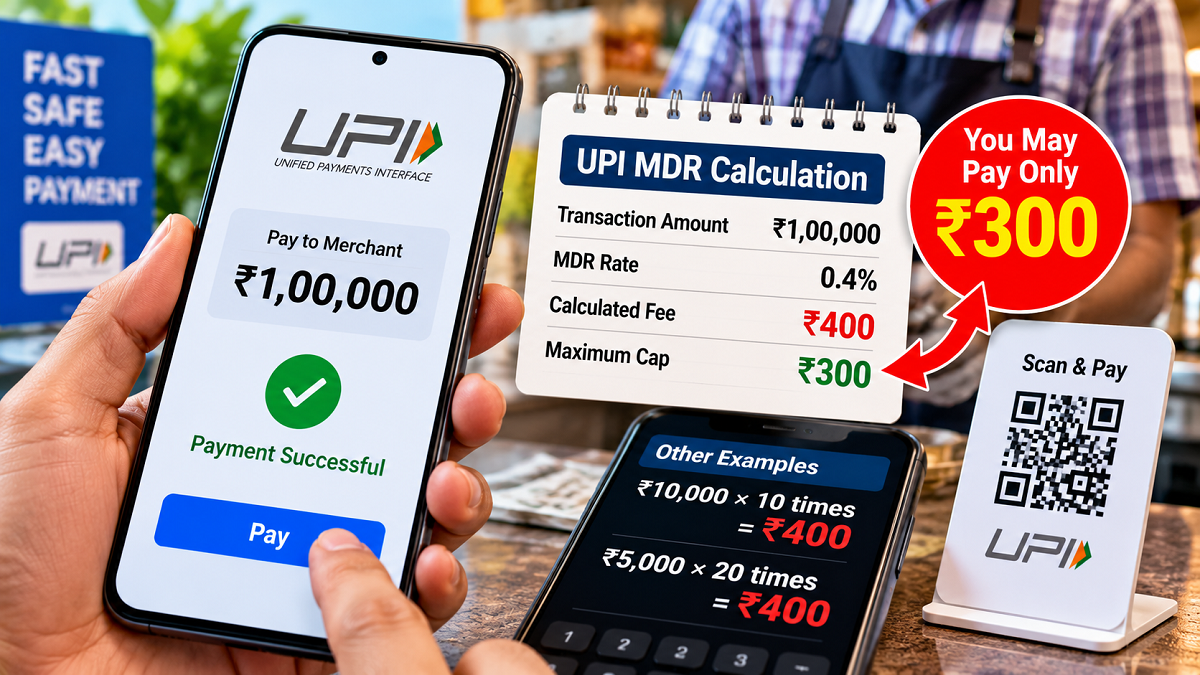
How Much MDR Would Apply to a ₹1 Lakh UPI Payment?
Suppose a customer purchases goods worth ₹1,00,000 from a merchant and makes the entire payment through one eligible UPI transaction.
Under the proposed calculation, MDR would initially be determined at 0.4% of the payment amount.
The calculation would be:
₹1,00,000 × 0.4% = ₹400
However, the reported proposal includes a maximum MDR limit of ₹300 per transaction.
As a result, the hypothetical merchant fee would be restricted to ₹300 instead of ₹400.
| Particulars | Amount |
|---|---|
| UPI merchant payment | ₹1,00,000 |
| Proposed MDR rate | 0.4% |
| Fee before applying cap | ₹400 |
| Proposed maximum fee | ₹300 |
| Hypothetical merchant MDR | ₹300 |
This example assumes that the proposed framework becomes effective and that the payment qualifies for the specified MDR.
It does not mean that every person transferring ₹1 lakh through UPI must pay ₹300.
What Happens If You Divide ₹1 Lakh Into 10 Transactions?
Some customers may consider dividing a large payment into smaller amounts to avoid possible charges.
For example, instead of transferring ₹1 lakh in one transaction, a customer might make ten separate payments of ₹10,000 each.
Under the proposed 0.4% MDR calculation:
₹10,000 × 0.4% = ₹40 per transaction
For ten transactions:
₹40 × 10 = ₹400
Therefore, the total hypothetical MDR would become ₹400.
This would be ₹100 more than the proposed ₹300 maximum applicable to a single eligible ₹1 lakh payment.
What If ₹1 Lakh Is Split Into 20 UPI Payments?
Now consider another example in which the same ₹1 lakh purchase is divided into 20 separate transactions of ₹5,000 each.
At the proposed MDR rate of 0.4%:
₹5,000 × 0.4% = ₹20 per transaction
For 20 transactions:
₹20 × 20 = ₹400
The total merchant fee would again reach ₹400, assuming every transaction qualifies for the proposed charge.
This shows why splitting a payment may not reduce the total MDR under the hypothetical structure.
In fact, the proposed per-transaction cap could make one larger payment less expensive for the merchant than several smaller payments.
₹1 Lakh UPI Payment: Single vs Multiple Transactions
| Payment Method | Number of Transactions | Hypothetical Total MDR |
|---|---|---|
| ₹1,00,000 in one payment | 1 | ₹300 |
| ₹10,000 each | 10 | ₹400 |
| ₹5,000 each | 20 | ₹400 |
These calculations are illustrations based on the reported proposal. They are not a statement of currently applicable UPI charges.
The calculations also exclude any additional taxes or processing conditions that might apply under a future official framework.
Will Customers Have to Pay the Proposed MDR?
This is one of the most important distinctions in the discussion.
MDR is generally associated with the cost of accepting payments for merchants.
If a proposed MDR structure were implemented, the financial impact would depend on the final rules, the payment instrument, the merchant category and the applicable processing arrangements.
The supplied report describes the ₹300 amount as a potential merchant expense.
It does not establish that customers would be required to pay an additional ₹300 when transferring ₹1 lakh.
Consumers should also distinguish between merchant payments and person-to-person transfers.
Sending money to a friend or family member is not the same transaction category as paying a registered merchant for goods or services.
Does the Proposed Charge Apply to Every UPI Payment Above ₹2,000?
Not necessarily.
UPI supports different types of transactions, including transfers linked to bank accounts and payments using certain other supported instruments.
Applicable charges, if any, can depend on the transaction type and the prevailing regulatory framework.
The report discusses a proposed charge on eligible merchant transactions exceeding ₹2,000.
That should not be interpreted as a universal fee on every UPI transfer above this amount.
Any actual change would need to be assessed against official instructions issued by the relevant authorities and payment-system participants.
Is There a Daily MDR Charge for Transferring ₹1 Lakh?
The article's original question refers to a one-day charge, but the proposed MDR calculation is based on individual eligible transactions.
It is not described as a daily maintenance charge for using UPI.
For example, under the hypothetical structure, one qualifying ₹1 lakh merchant transaction could attract a capped MDR of ₹300.
If a merchant received multiple qualifying payments during the same day, the applicable fees would depend on each transaction and the final rules.
Therefore, the number of transactions can matter more than the fact that they occurred on the same day.
When Could New UPI MDR Rules Take Effect?
The supplied report suggested that a revised MDR framework might be considered after Diwali 2026.
However, it did not provide an official effective date.
Until the competent authorities issue a confirmed notification, the proposed rate, eligibility conditions and implementation timeline should be treated as unverified.
Users can monitor announcements from the National Payments Corporation of India (NPCI), the Reserve Bank of India (RBI) and their respective banks or payment service providers.
Official sources include:
What Should UPI Users and Merchants Do?
Customers should avoid assuming that every large UPI payment carries a new transaction fee.
Before making a high-value payment, check the payment application's displayed transaction details and any applicable conditions.
Merchants should review official communications from their acquiring banks or payment service providers rather than changing payment practices based on unconfirmed reports.
It is also important to avoid splitting transactions solely on the assumption that doing so will eliminate payment-processing costs.
As the examples demonstrate, dividing a payment can sometimes produce a higher aggregate fee under a capped per-transaction model.
Final Thoughts
The proposed UPI MDR structure discussed in the October 23 report suggests that eligible merchant transactions above ₹2,000 could attract a 0.4% fee, with a maximum charge of ₹300 per transaction.
Under that hypothetical arrangement, a single ₹1 lakh merchant payment would generate ₹300 in MDR after applying the cap.
Dividing the same amount into ten ₹10,000 payments or twenty ₹5,000 payments could increase the total calculated fee to ₹400.
The key point is that these figures represent potential merchant charges under a reported proposal, not a confirmed fee imposed on every UPI user.
Customers and merchants should wait for official regulatory or NPCI clarification before treating the suggested charges as effective.