
Business
₹5 Lakh FD Returns in 2026: How Much Interest Can You Earn in 5 Years? Check Maturity Calculation

FD Interest Calculator 2026: Fixed deposits remain a popular savings option among Indian households, particularly for people who prefer predictable returns instead of investing their entire savings in market-linked products.
Whether someone is building an emergency fund, saving for a family expense or planning for retirement, a bank fixed deposit can provide a relatively stable investment option with a predetermined interest rate.
One common question among depositors is how much a ₹5 lakh fixed deposit could grow over five years.
The answer depends on several factors, including the bank's interest rate, deposit tenure, interest compounding frequency and whether the account holder qualifies for senior citizen benefits.
For example, an investment of ₹5,00,000 at an annual interest rate of 7%, compounded quarterly for five years, could grow to approximately ₹7.07 lakh before tax.
Here is a detailed explanation of the potential returns, how compound interest works and what investors should consider before opening an FD.
₹5 Lakh FD for 5 Years: How Much Will You Receive?
Suppose you deposit ₹5 lakh in a cumulative fixed deposit offering 7% annual interest.
If the bank compounds the interest every quarter and the money remains invested for five years, the interest earned is added to the deposit balance periodically.
As a result, subsequent interest is calculated on an increasing amount rather than only on the original investment.
Under these assumptions, the deposit would generate approximately ₹2.07 lakh in interest over five years.
The estimated maturity value would therefore be around ₹7.07 lakh.
These calculations are illustrative and do not represent a guaranteed offer from any particular bank.
₹5 Lakh FD Calculation at 7% Annual Interest
| Particulars | Estimated Details |
|---|---|
| Initial investment | ₹5,00,000 |
| Investment period | 5 years |
| Assumed annual interest rate | 7% |
| Compounding frequency | Quarterly |
| Estimated interest earned | ₹2.07 lakh |
| Estimated maturity amount | ₹7.07 lakh |
The figures assume a cumulative deposit with no premature withdrawal. Taxes and any applicable bank-specific adjustments are not deducted.
How Does Compound Interest Increase FD Returns?
Compound interest is one of the most important factors influencing long-term fixed deposit earnings.
In a cumulative FD, interest is periodically added to the outstanding deposit balance.
The next interest calculation is then based on the increased balance.
For instance, a ₹5 lakh deposit earning 7% annual interest does not necessarily produce the same total return under every compounding method.
If interest is compounded quarterly, the amount grows slightly faster than it would with annual compounding at the same nominal annual rate.
This happens because the interest is credited to the calculation balance more frequently.
The longer the investment remains untouched, the more noticeable the effect of compounding can become.
What Is the Difference Between Cumulative and Non-Cumulative FDs?
Banks generally offer different interest payout arrangements.
A cumulative FD is designed for investors who want to receive the accumulated principal and interest at maturity.
A non-cumulative FD, on the other hand, may pay interest monthly, quarterly or at another permitted interval.
Non-cumulative deposits can be useful for retirees and other individuals who prefer regular income.
However, the total accumulated value of a cumulative FD may be higher when interest is reinvested rather than paid out.
The appropriate choice depends on whether the investor needs periodic cash flow or prefers to accumulate savings.
₹5 Lakh FD Returns at Different Interest Rates
Even a small difference in interest rates can affect the final maturity amount over five years.
The following comparison assumes quarterly compounding and an initial investment of ₹5 lakh.
| Annual Interest Rate | Estimated Interest Earned | Maturity Amount |
|---|---|---|
| 6.0% | ₹1,73,428 | ₹6,73,428 |
| 6.5% | ₹1,90,210 | ₹6,90,210 |
| 7.0% | ₹2,07,389 | ₹7,07,389 |
| 7.5% | ₹2,24,974 | ₹7,24,974 |
| 8.0% | ₹2,42,974 | ₹7,42,974 |
Estimated maturity value of a ₹5 lakh FD after 5 years
Illustrative annual interest rates with quarterly compounding; before tax.
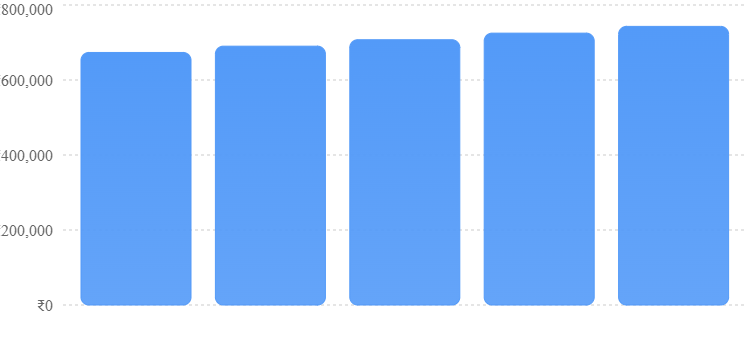
These figures show that selecting a higher interest rate can make a meaningful difference to the maturity value. However, depositors should consider the bank's reliability, deposit insurance coverage and other conditions alongside the advertised rate.
Senior Citizens May Receive Higher FD Interest Rates
Many Indian banks offer preferential FD interest rates to senior citizens, commonly aged 60 years and above.
The additional interest is often around 0.50 percentage points, although the exact benefit depends on the bank, deposit amount, tenure and applicable scheme.
For example, if a regular customer receives 7% annual interest, an eligible senior citizen might receive 7.5% for the same deposit period.
At an assumed 7.5% annual rate with quarterly compounding, a ₹5 lakh FD held for five years would grow to approximately ₹7,24,974.
This includes about ₹2,24,974 in interest.
Compared with the 7% illustration, the senior citizen would earn approximately ₹17,585 more over five years.
These are hypothetical calculations, not verified current interest rates offered by a specific bank.
Is Interest Earned on Fixed Deposits Taxable?
Yes. Interest earned from bank fixed deposits is generally taxable according to the investor's applicable income tax provisions.
The tax treatment can depend on the taxpayer's income, age, tax regime and other relevant circumstances.
Banks may deduct tax at source when applicable conditions and thresholds are met.
However, TDS is not necessarily the final tax liability. Depositors may still need to report their FD interest while filing their income tax returns.
Investors should therefore distinguish between the maturity value calculated before tax and the amount they effectively retain after meeting their tax obligations.
Are Bank Fixed Deposits Completely Risk-Free?
Bank FDs are generally considered relatively low-risk savings products, but they are not entirely free from risk.
Eligible bank deposits are covered by the Deposit Insurance and Credit Guarantee Corporation (DICGC), subject to the applicable rules.
The insurance limit is ₹5 lakh per depositor per insured bank, including principal and interest across eligible deposits held in the same capacity and right.
Therefore, someone placing ₹5 lakh in a single bank should remember that accrued interest could cause the total deposit balance to exceed the insurance limit.
FD investors should also consider inflation, because the purchasing power of their maturity amount may change over time.
What Should You Check Before Opening a ₹5 Lakh FD?
Before investing, compare the interest rates offered for your chosen tenure and confirm whether the quoted rate applies to regular customers or senior citizens.
Check whether interest is compounded quarterly, paid periodically or calculated under another arrangement.
It is also important to understand premature withdrawal penalties, automatic renewal conditions and whether the deposit can be closed before maturity.
Investors who may need funds unexpectedly should consider maintaining sufficient accessible savings rather than locking their entire emergency fund into one long-term deposit.
₹5 Lakh FD Investment 2026: Final Calculation
A ₹5 lakh cumulative fixed deposit held for five years at an assumed 7% annual interest rate, compounded quarterly, could generate approximately ₹2.07 lakh in interest.
The estimated maturity value would be around ₹7.07 lakh before tax.
At a hypothetical senior citizen rate of 7.5%, the same deposit could grow to approximately ₹7.25 lakh.
The actual amount will depend on the interest rate available when the FD is opened, the bank's calculation method and the deposit's terms.
Disclaimer: All interest rates and returns shown are illustrative calculations, not confirmed FD offers from individual banks. Investors should verify the latest applicable rates and conditions before making a deposit.