Business
Petrol and Diesel Prices Today, November 2: Petrol Export Tax Cut to Zero, Check Latest Fuel Rates
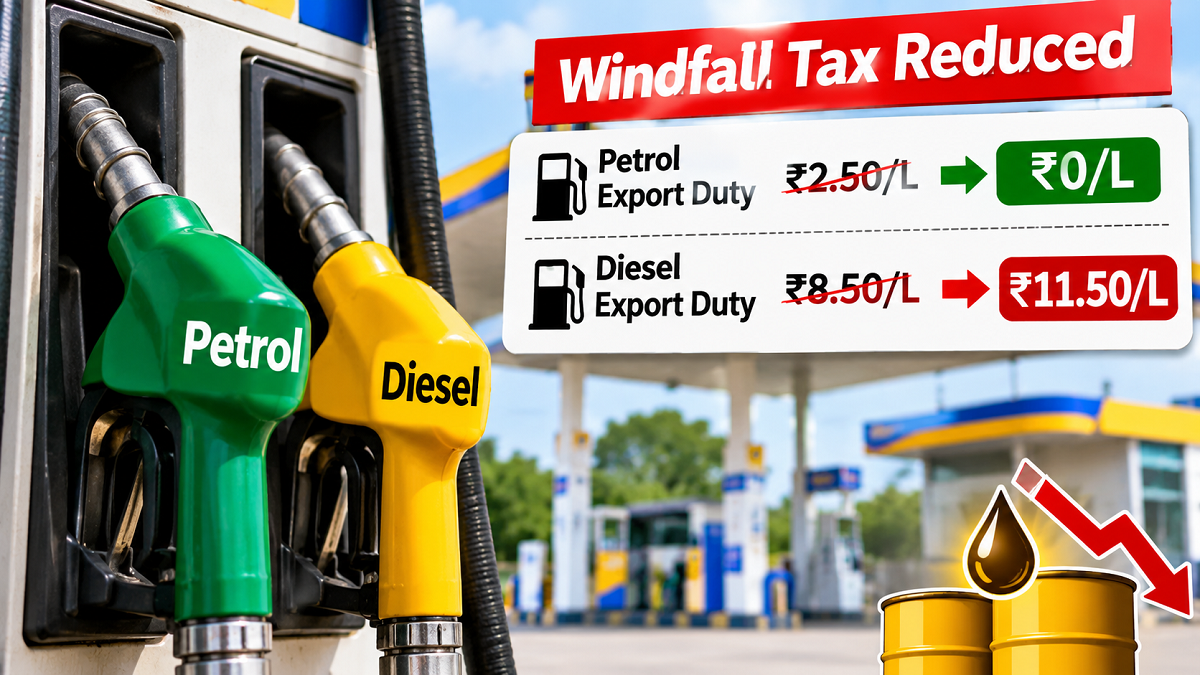
Petrol Diesel Price Today, November 2, 2026: The central government has revised export duties on petroleum products ahead of the festive season, reducing the levy on petrol exports to zero while increasing the duty on diesel exports. However, the latest tax adjustment does not directly affect the prices paid by motorists at petrol pumps.
According to the Finance Ministry's latest revision, the export duty on petrol has been reduced from ₹2.50 per litre to nil. Meanwhile, the levy on diesel exports has increased by ₹3 per litre, taking it from ₹8.50 to ₹11.50 per litre.
The revised duties came into effect on October 31, 2026, and apply to the relevant fortnightly review period.
The government has also increased the export duty on aviation turbine fuel (ATF) from ₹10.50 to ₹11 per litre.
These changes are intended to regulate petroleum exports and support domestic fuel availability amid continuing volatility in international energy markets.
For ordinary consumers, the important point is that the export-duty revision is separate from the retail prices of petrol and diesel.
Petrol and Diesel Prices Remain Unchanged on November 2
Government-owned oil marketing companies, including Indian Oil Corporation, Bharat Petroleum and Hindustan Petroleum, publish retail fuel prices for consumers.
According to the November 2 price report, petrol and diesel rates remained unchanged in the cities covered by the update.
The following rates were reported for selected locations:
| City | Petrol Price | Diesel Price |
|---|---|---|
| Delhi | ₹102.12/litre | ₹95.20/litre |
| Lucknow | ₹102.05/litre | ₹99.28/litre |
| Port Blair | ₹88.66/litre | ₹84.56/litre |
| Chittoor | ₹118.34/litre | ₹106.06/litre |
These figures are based on the published November 2 report. Consumers should confirm the applicable retail price through their oil marketing company or local fuel station before relying on them.
Fuel rates vary across India because of differences in state taxes, transportation expenses and other applicable charges.
Premium Petrol Prices in Delhi
Apart from regular petrol and diesel, some oil companies offer premium fuel variants designed for vehicles requiring or benefiting from higher-octane petrol.
The source report lists the following premium petrol rates for Delhi:
- XP95 petrol: ₹109.24 per litre
- XP100 petrol: ₹167.35 per litre
Premium petrol generally costs more than standard petrol because of its specifications and production requirements.
Vehicle owners should follow their manufacturer's fuel recommendations rather than assume that higher-priced petrol is necessary for every engine.
Government Cuts Petrol Export Duty to Zero
The latest export-tax revision is an important development for India's petroleum industry.
The government has removed the ₹2.50-per-litre export levy on petrol for the current review period.
At the same time, the duty on exported diesel has been raised to ₹11.50 per litre.
The changes were announced for the fortnight beginning October 31, 2026.
The export levy on aviation turbine fuel has also increased slightly to ₹11 per litre.
These duties are different from the taxes applicable to petrol and diesel sold to domestic consumers.
Consequently, a reduction in petrol export duty should not be interpreted as a corresponding reduction in prices at Indian fuel stations.
Why Does the Government Impose Windfall Taxes on Petroleum Exports?
Windfall taxes are generally introduced when businesses receive unusually high profits because of exceptional market conditions.
In the petroleum sector, such measures may be used when international fuel prices rise sharply and exporters have an incentive to sell products overseas.
The government's export-duty framework is also intended to discourage excessive exports when ensuring adequate domestic supplies becomes a priority.
India introduced export levies on diesel and aviation turbine fuel in March 2026 against the backdrop of the West Asia crisis.
Petrol exports were subsequently brought under the framework.
The rates are reviewed periodically, taking into account changes in international crude oil and refined-product prices.
This approach allows the government to adjust duties according to market conditions rather than maintaining a fixed rate indefinitely.
International Crude Oil Prices Remain Volatile
Movements in global crude oil prices continue to influence the international petroleum market.
According to the source report, crude oil benchmarks showed some decline during the November 2 morning trading session.
The reported figures were:
| Crude Oil Benchmark | Reported Price | Reported Decline |
|---|---|---|
| Brent Crude | $111.78/barrel | $1.65 |
| WTI Crude | $102.44/barrel | $1.68 |
These are time-specific market figures quoted in the source article and may change during trading.
Brent crude is an important international benchmark, while West Texas Intermediate (WTI) is widely used to assess oil-market conditions.
Global prices can fluctuate because of geopolitical developments, supply decisions, economic demand and changes in production.
How Does the West Asia Crisis Affect India's Fuel Market?
India imports a substantial share of the crude oil needed to meet domestic demand.
As a result, prolonged increases in international petroleum prices can affect the country's import bill and create pressure on energy-related costs.
The ongoing West Asia crisis has added uncertainty to global oil supplies and shipping routes.
Higher crude oil prices can increase costs for refiners and place pressure on businesses that depend on petroleum products.
However, domestic retail prices do not necessarily move in direct proportion to daily changes in global crude prices.
The final price paid by consumers also reflects taxation, refining and distribution expenses, pricing decisions and other market factors.
Fuel Price Increases: How Does India Compare With Other Countries?
The source report also compares fuel-price increases across several countries during the period of international market disruption.
It claims that petrol and diesel prices in India have increased by approximately 8% to 8.5% during the period considered.
The report provides the following comparative estimates:
| Country | Reported Petrol Increase | Reported Diesel Increase |
|---|---|---|
| India | Around 8%–8.5% | Around 8%–8.5% |
| Myanmar | Nearly 100% | Around 80% |
| UAE | 83.7% | 90.5% |
| Pakistan | 46.9% | 43.6% |
These comparisons should be treated as figures reported by the original publication rather than independently verified like-for-like international statistics.
Fuel-price comparisons between countries can be affected by different measurement periods, taxes, subsidies and currency movements.
Rising Oil Costs Could Put Pressure on Government Finances
Higher international energy prices may also affect government expenditure and broader economic conditions.
The source report cites an assessment attributed to ICRA Chief Economist Aditi Nayar, suggesting that the West Asia crisis could create an additional financial burden of approximately ₹1.35 lakh crore.
The precise scope, assumptions and period covered by this estimate were not independently established from the supplied article.
Nevertheless, sustained increases in global oil prices can influence inflation, transport expenses and the cost of imported energy.
Government policy decisions and oil marketing companies' pricing strategies can affect how much of this pressure reaches consumers.
How to Check the Latest Petrol and Diesel Prices in Your City
Motorists should verify current fuel rates before planning expenses, particularly when travelling between states.
Retail prices may differ even between nearby cities because of local taxes and distribution factors.
Consumers can check rates through the official websites or mobile applications of Indian Oil, Bharat Petroleum and Hindustan Petroleum.
Fuel stations also display the applicable prices for petrol and diesel.
Checking the latest rates directly from an authorised source is especially useful when online reports contain conflicting figures.
Final Takeaway: Export Tax Relief Does Not Mean Cheaper Petrol at Pumps
The latest petroleum-duty revision has reduced the export levy on petrol to zero while increasing the tax on diesel exports to ₹11.50 per litre.
The revised rates apply from October 31, 2026, and are part of the government's response to changing international energy-market conditions.
For motorists, however, the export-duty adjustment does not automatically translate into lower petrol or diesel prices.
Consumers should distinguish between taxes on petroleum exports and retail fuel prices, and check the latest city-specific rates before refuelling.
Sources: Journal India, November 2, 2026; Finance Ministry export-duty revision as reported by PTI/Moneycontrol and Business Standard, October 31, 2026. Retail fuel rates, crude oil quotations and international comparisons are attributed to the supplied source report.