
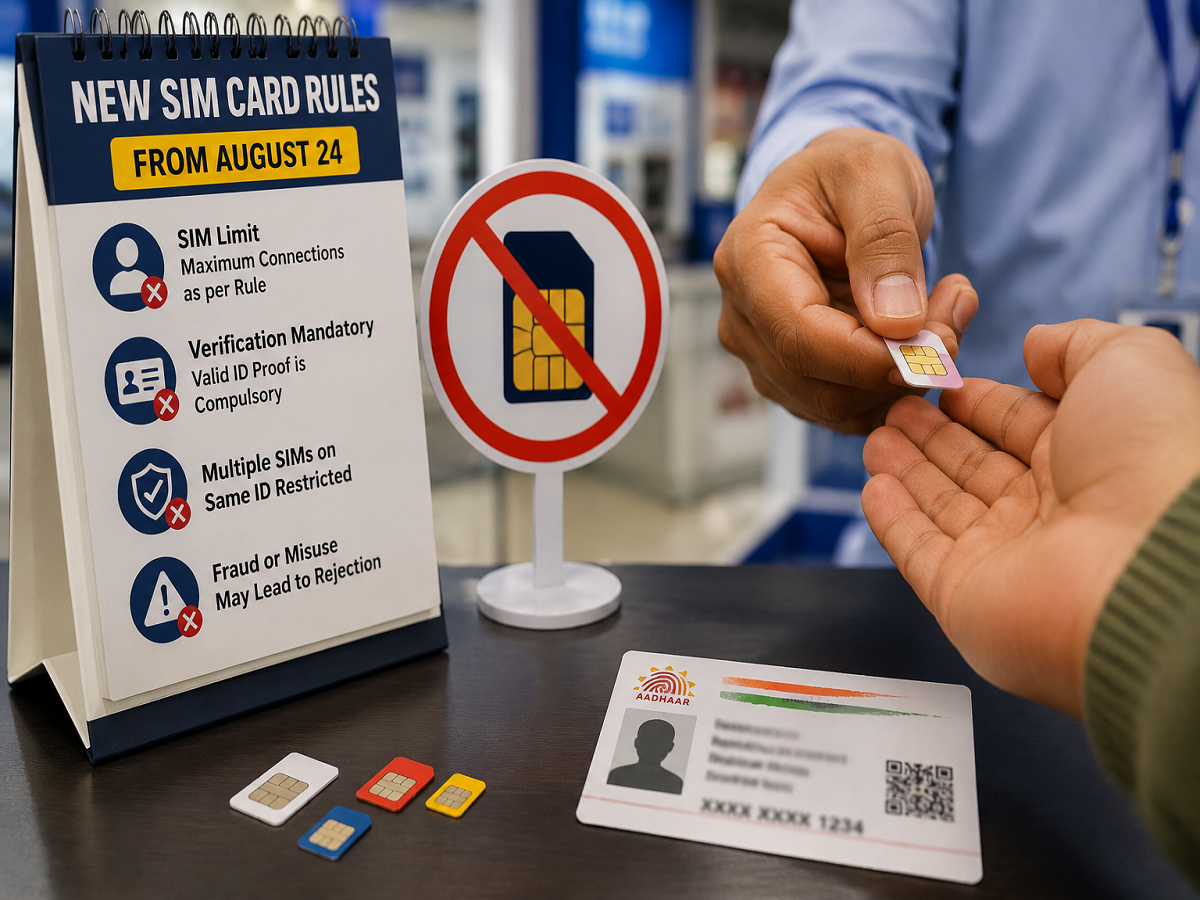
Mobile users in India need to be aware of stricter SIM card rules that take effect from August 24, 2026. Under the Department of Telecommunications (DoT) directive, telecom operators must stop issuing additional mobile connections to customers who have already reached the maximum number of connections permitted in their name.
For most parts of India, an individual can hold up to nine mobile connections. However, the limit is lower in Jammu and Kashmir, Assam and the North-Eastern states, where a person can have a maximum of six connections.
The important point is that the limit itself is not entirely new. What changes from August 24 is its stricter enforcement. Telecom operators will have to identify subscribers who have already reached the permitted ceiling before giving them another connection.
What Changes for SIM Buyers From August 24?
Until now, a person with several mobile numbers could sometimes apply for another connection without the operator immediately identifying all SIMs registered under that person's identity across different telecom companies or service areas.
The new system is intended to close that gap.
From August 24, telecom service providers will have to take technical and organisational measures to identify customers attempting to obtain connections beyond the permitted limit. If the subscriber has already reached the maximum, the company must inform them that another mobile connection cannot be issued.
This means customers planning to buy a new prepaid or postpaid SIM should first know how many active mobile connections are already registered in their name.
How Many SIM Connections Can One Person Have?
For most Indian states and Union Territories, the maximum permitted number is nine connections per person.
The applicable limits are:
| Region | Maximum Mobile Connections |
|---|---|
| Most states and Union Territories | 9 |
| Jammu and Kashmir | 6 |
| Assam | 6 |
| North-Eastern states | 6 |
The ceiling applies to the total number of connections registered in a person's name, rather than separately to each telecom company.
For example, suppose a customer has four connections from one telecom company, three from another and two from a third provider. The total is nine. The customer has therefore reached the applicable limit and cannot simply approach another operator to obtain a tenth connection.
Who Can Be Refused a New SIM?
A customer who has already reached the applicable ceiling can be denied an additional connection.
For example, if you live in a region where the limit is nine and already have nine mobile numbers registered under your identity, your request for a tenth connection can be rejected.
Similarly, in areas where the ceiling is six, a subscriber who has already reached six connections cannot obtain a seventh simply by choosing another telecom operator.
This makes it important to remember that changing operators does not reset the limit.
How Will Telecom Companies Know How Many SIMs You Have?
The DoT's Digital Intelligence Platform (DIP) plays an important role in the new enforcement mechanism.
Telecom operators can use the centralised platform to identify subscribers who have reached the maximum number of permitted connections. The DoT has also made arrangements to provide representative subscriber images through the platform to assist operators in identifying customers seeking additional connections.
The system is intended to make it more difficult for individuals to bypass the connection ceiling by approaching different telecom providers.
Already Have Nine SIMs? Here's the Solution
Reaching the limit does not mean you can never get another number.
If you no longer need one of your existing connections, you can get it disconnected and bring the total number of connections registered in your name below the prescribed ceiling. You can then apply for another SIM, subject to the telecom operator's normal KYC and activation requirements.
This can be particularly useful for people who accumulated multiple numbers over the years and no longer use some of them.
Check for Unknown SIM Cards Registered in Your Name
Another possibility is that you may not actually know about every connection registered using your identity.
An old number may still be active even though you stopped using it years ago. More seriously, a connection could potentially have been obtained using your identity details without your knowledge.
Users can check mobile connections associated with their identity through the government's Sanchar Saathi platform and report numbers that they did not obtain or no longer require.
Check your mobile connections on Sanchar Saathi
Removing unnecessary or unauthorised connections can help bring your total below the applicable limit.
Will Your Existing Nine SIMs Stop Working?
Simply having the maximum permitted number does not mean those connections will automatically stop working on August 24.
The immediate change concerns the issuance of additional connections beyond the prescribed limit. If you already have nine valid connections in a region where nine are permitted, reaching the ceiling means you cannot obtain another one unless the number of connections registered in your name is reduced.
Subscribers who have connections exceeding the permitted limit can face separate action under the applicable DoT rules.
Why Is the Government Tightening SIM Rules?
The stricter verification mechanism is intended to improve accountability in mobile connection issuance and reduce misuse of SIM cards.
Fraudulent or improperly obtained mobile connections can be exploited for cybercrime and other illegal activities. Making telecom operators check a subscriber's existing connections before issuing another number can make such misuse more difficult.
What Mobile Users Should Do Now
If you have only one or two SIM cards, the new enforcement mechanism is unlikely to create any difficulty when you legitimately need another connection.
The rule matters most for people who have accumulated many mobile numbers.
Before applying for a new SIM, check the connections registered in your name. If you find old numbers you no longer use, get them disconnected. If you discover an unfamiliar number, report it through the appropriate Sanchar Saathi facility.
The key takeaway is simple: from August 24, 2026, telecom operators must more strictly enforce the existing connection ceiling. Most users can have up to nine mobile connections, while the limit is six in Jammu and Kashmir, Assam and the North-Eastern states. Once the applicable ceiling is reached, another SIM cannot be issued until the number of connections is brought within the permitted limit.