LPG Cylinder Comparison 2026: Cooking gas has become an essential household expense for millions of Indian families. Whether you live alone, share accommodation with friends or manage a large household, choosing the right LPG cylinder can make a difference to your monthly kitchen budget.
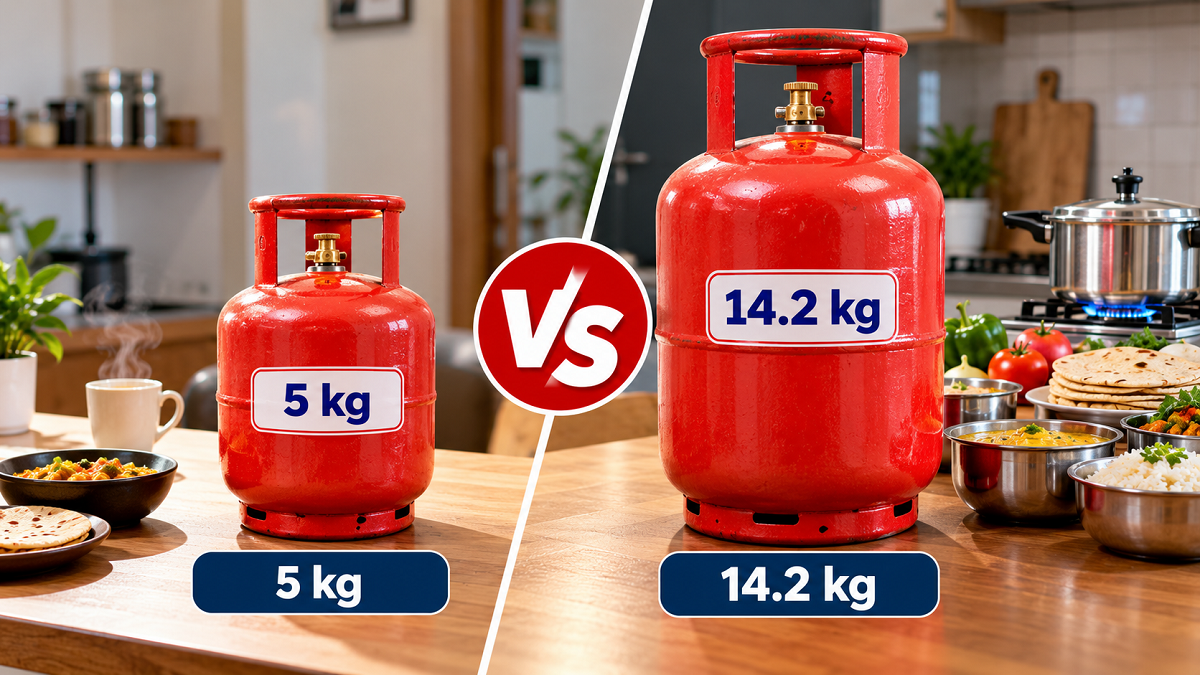
Two common options available to consumers are the compact 5 kg LPG cylinder and the standard 14.2 kg domestic cylinder.
While both serve the same basic purpose, they differ in gas capacity, refill expenses, convenience and suitability for different households.
A 14.2 kg cylinder is generally preferred by families that cook regularly, while a 5 kg cylinder may be more convenient for students, working professionals and people living alone.
However, the smaller cylinder is not necessarily the cheaper option when comparing the cost of gas per kilogram.
Here is a detailed comparison of both cylinder sizes to help you decide which offers better value for your needs.
14.2 kg LPG Cylinder: Why Is It Popular Among Indian Families?
The 14.2 kg domestic LPG cylinder is widely used in Indian households.
It is particularly suitable for families that prepare multiple meals every day and require a regular cooking gas supply.
One of its biggest advantages is the larger quantity of LPG available in a single refill.
This reduces the frequency of refill bookings and makes it more convenient for households with substantial daily gas consumption.
Major Benefits of a 14.2 kg LPG Cylinder
Better value for regular consumption: Depending on the applicable prices and cylinder category, a 14.2 kg domestic refill may offer a lower effective price per kilogram than a smaller 5 kg cylinder.
Suitable for families: Households with several members generally consume more cooking gas, making the larger cylinder a practical choice.
Fewer refill bookings: Because the cylinder contains more LPG, families may not need to arrange replacements as frequently.
Convenient for daily cooking: It is suitable for homes where breakfast, lunch and dinner are prepared regularly.
For some households, a 14.2 kg cylinder may last approximately 30 to 45 days.
However, actual consumption varies considerably depending on family size, cooking frequency, burner efficiency and food preparation habits.
5 kg LPG Cylinder: Who Should Consider Buying It?
A 5 kg LPG cylinder is a compact alternative designed for consumers who need smaller quantities of cooking gas.
It may be particularly useful for people living in rented accommodation, students, working professionals and individuals who cook only occasionally.
The smaller size can make it easier to accommodate in limited spaces, provided that the cylinder is installed and stored according to LPG safety requirements.
Major Benefits of a 5 kg LPG Cylinder
Lower payment per refill: Since the cylinder contains less gas, the amount payable for a single refill may be lower than that of a 14.2 kg cylinder, depending on the applicable pricing category.
Convenient for individuals: A person cooking for one may not require the larger capacity of a standard household cylinder.
Suitable for limited cooking needs: Consumers who frequently eat outside or prepare only simple meals may find the smaller cylinder sufficient.
Compact size: Its smaller physical dimensions may be convenient where space is limited, although safe ventilation and installation remain essential.
However, customers should remember that some 5 kg cylinder categories may have a higher effective LPG price per kilogram.
This means that frequent refilling can become more expensive over time.
5 kg vs 14.2 kg LPG Cylinder: Key Differences
| Feature | 5 kg LPG Cylinder | 14.2 kg LPG Cylinder |
|---|---|---|
| Gas Capacity | 5 kg | 14.2 kg |
| Common Users | Students, individuals, small households | Families and regular domestic users |
| Payment Per Refill | Usually lower | Usually higher |
| Cost Per Kilogram | May be higher | May be lower |
| Refill Frequency | More frequent with regular use | Less frequent for the same consumption |
| Storage Space | More compact | Requires more space |
| Suitable for Heavy Cooking | Less convenient | More convenient |
| Best Use Case | Limited gas consumption | Regular household cooking |
The actual financial advantage depends on local prices, cylinder category and eligibility for any applicable subsidy.
Which LPG Cylinder Is Cheaper Per Kilogram?
Many consumers compare cylinders based only on the amount they pay for a refill.
However, this does not provide a complete picture of the actual cost.
To determine which cylinder offers better value, compare the price per kilogram of LPG.
The calculation is simple:
Cost per kilogram = Refill price ÷ Quantity of LPG
For example, suppose a 5 kg cylinder refill costs ₹500 and a 14.2 kg domestic refill costs ₹950.
The effective prices would be:
| Cylinder Size | Illustrative Refill Price | Cost Per kg |
|---|---|---|
| 5 kg | ₹500 | ₹100.00 |
| 14.2 kg | ₹950 | ₹66.90 |
These are hypothetical prices used only to explain the calculation, not verified market rates.
In this example, the 14.2 kg cylinder provides substantially better value per kilogram.
However, if you use very little gas, the smaller cylinder may still be convenient because the amount payable for each refill is lower.
How Long Does a 5 kg LPG Cylinder Last?
The lifespan of a 5 kg cylinder depends entirely on consumption.
A person who cooks one simple meal daily may use significantly less gas than someone preparing several meals.
For example, if a household consumes approximately 250 grams of LPG daily, a 5 kg cylinder could theoretically last around 20 days.
At a daily consumption of 150 grams, the same cylinder could last approximately 33 days.
These are only mathematical illustrations.
Actual consumption depends on cooking duration, burner settings, utensils and other factors.
Therefore, customers should consider their own cooking habits rather than relying on a fixed number of days.
How Long Can a 14.2 kg LPG Cylinder Last?
A standard 14.2 kg cylinder contains almost three times as much LPG as a 5 kg cylinder.
For a household consuming approximately 350 grams of LPG daily, it could theoretically last around 40 days.
A larger family with heavier cooking requirements may use the cylinder more quickly.
On the other hand, households that cook less frequently may find that it lasts longer.
The important point is that a larger cylinder generally reduces the frequency of refill bookings when compared with a smaller cylinder used under similar conditions.
Which LPG Cylinder Is Better for Students and PG Residents?
Students and working professionals living in rented rooms or paying guest accommodation may prefer a smaller cylinder because their cooking requirements are limited.
A 5 kg cylinder can be practical for someone preparing tea, breakfast or an occasional meal.
However, residents should first confirm whether LPG cylinder use is permitted in their accommodation.
The cylinder should be obtained through an authorised supplier and used only with compatible, approved equipment.
Proper ventilation, safe placement and adherence to fire safety requirements are essential.
A compact cylinder should never be treated as automatically safer simply because it is smaller.
Which Cylinder Should a Family of Four Choose?
For a family of four that cooks meals regularly, the 14.2 kg cylinder is generally the more practical option.
The larger capacity can support daily cooking without requiring frequent replacements.
It may also provide better value per kilogram, depending on the prevailing refill prices.
However, a family that cooks infrequently or has very limited LPG requirements may consider a smaller cylinder if it is available under suitable terms.
The final choice should be based on actual consumption rather than family size alone.
Does the LPG Subsidy Affect the Comparison?
Government subsidy eligibility can influence the effective cost of domestic LPG for qualifying consumers.
However, subsidy availability depends on the applicable scheme, beneficiary eligibility and cylinder category.
Consumers should not assume that every 5 kg or 14.2 kg LPG cylinder qualifies for the same subsidy benefits.
Similarly, a small cylinder sold under a particular commercial or free-trade category may have a different pricing structure from a standard domestic LPG connection.
Before comparing prices, customers should check whether both cylinders belong to comparable domestic categories and whether any subsidy applies.
Important LPG Safety Tips for Every Household
Regardless of cylinder size, safe handling is essential.
Always purchase LPG cylinders through authorised channels and use compatible regulators, hoses and cooking appliances.
Keep cylinders upright in a properly ventilated location.
Avoid placing them near excessive heat or open flames.
If you suspect a gas leak, turn off the regulator if it is safe to do so, avoid operating electrical switches and follow the emergency instructions provided by your LPG supplier.
Never attempt to transfer LPG from one cylinder to another yourself.
Safety should remain a priority when choosing between different cylinder sizes.
Final Verdict: 5 kg or 14.2 kg—Which LPG Cylinder Should You Buy?
The right LPG cylinder depends on your cooking needs, household size and budget.
A 5 kg cylinder can be convenient for students, single occupants and people with limited cooking requirements because the payment per refill is generally smaller.
A 14.2 kg cylinder is usually more practical for families and regular cooking because it contains more gas, requires fewer refill bookings and may offer a lower cost per kilogram.
If your priority is long-term value for regular household cooking, the 14.2 kg cylinder is generally the stronger choice. If you need a smaller quantity of LPG and prefer a lower payment per refill, the 5 kg cylinder may be more suitable.
Before purchasing, compare the current refill prices from your authorised LPG supplier and check the applicable connection, subsidy and safety requirements.
Disclaimer: LPG refill prices, subsidies and cylinder availability vary by location, supplier and product category. The cost examples in this article are illustrative and should not be treated as current market prices.