GaN Charger Technology 2026: Smartphones, laptops, tablets, wireless earbuds, and smartwatches have become essential parts of everyday life. With several smartphone manufacturers no longer including charging adapters in the retail box of certain devices, consumers increasingly need to purchase chargers separately.
While traditional charging adapters remain widely available, a newer technology called Gallium Nitride, commonly known as GaN, is attracting attention because of its compact design, energy efficiency, and ability to deliver relatively high power from a smaller device.
GaN chargers are particularly appealing to people who carry multiple electronic devices and want to reduce the number of adapters they use.
But what exactly is a GaN charger, how does it differ from a conventional silicon-based charger, and is it worth spending extra money on one? Here is a detailed explanation.
What Is a GaN Charger and How Does It Work?
GaN stands for Gallium Nitride, a semiconductor material used in modern power electronics.
Conventional charging adapters commonly rely on silicon-based semiconductor components to regulate and convert electrical energy.
GaN technology allows manufacturers to develop power-switching components that can operate efficiently at high switching frequencies.
This can reduce energy losses and allow certain internal components, including transformers and capacitors, to be made smaller.
As a result, manufacturers can design chargers that deliver substantial power without requiring the bulky construction associated with some older adapters.
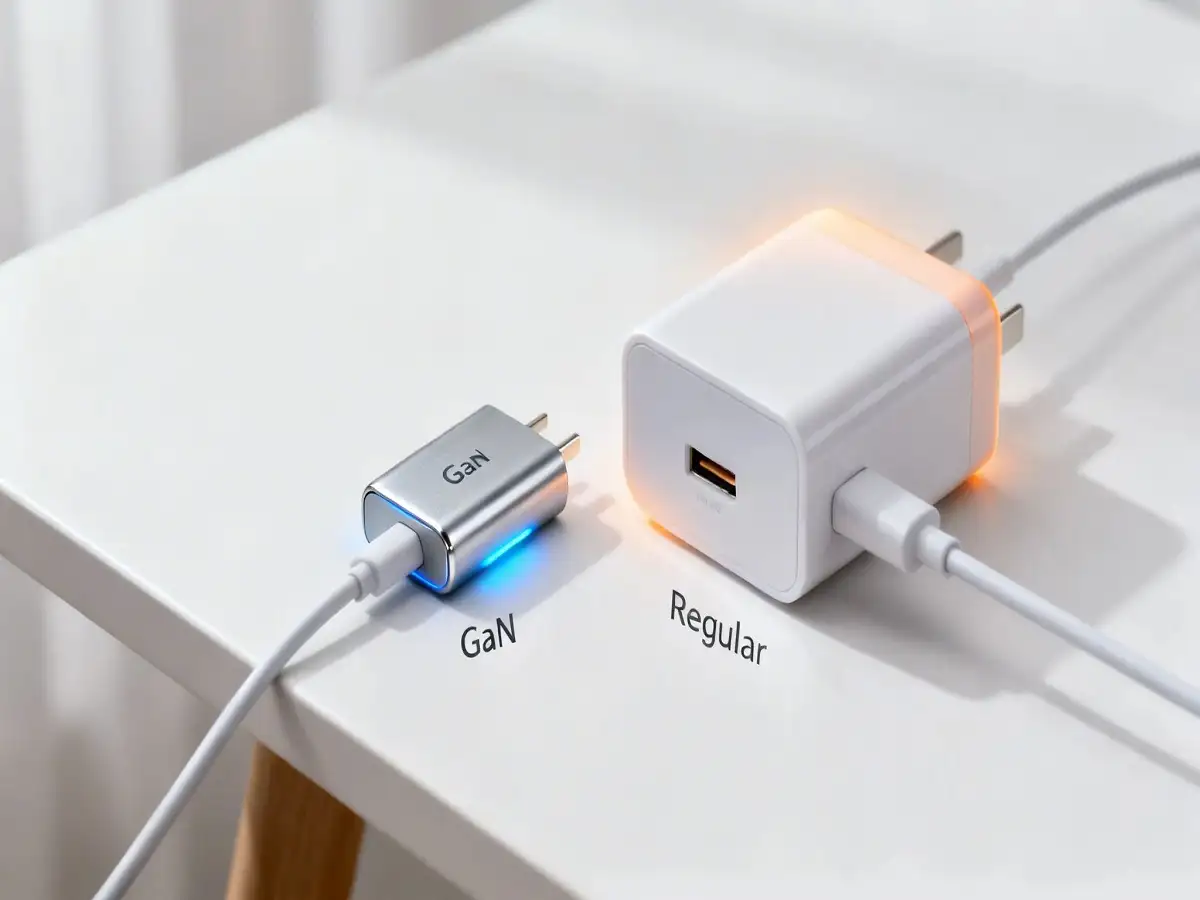
For example, a well-designed 65W GaN charger may be considerably smaller than a traditional 65W adapter.
However, the actual size and performance depend on the charger's overall design, component quality, and safety requirements.
GaN Charger vs Normal Charger: Key Differences
Although both technologies perform the same basic function of charging electronic devices, they can differ in size, efficiency, and design flexibility.
| Feature | GaN Charger | Conventional Silicon Charger |
|---|---|---|
| Semiconductor Technology | Gallium Nitride | Primarily Silicon |
| Physical Size | Often more compact | May be larger at similar power levels |
| Energy Efficiency | Can offer improved efficiency | Depends on design and components |
| Heat Generation | May produce less waste heat | Varies with efficiency and design |
| High-Power Output | Supports compact high-wattage designs | Also supports high-wattage charging |
| Multiple USB Ports | Available on many models | Also available |
| Price | Often more expensive | Frequently more affordable |
| Device Compatibility | Depends on charging protocols | Depends on charging protocols |
It is important to understand that GaN technology does not automatically make every charger faster, safer, or more efficient than every silicon-based alternative.
The quality of the complete charging system matters.
1. Smaller Size Makes GaN Chargers Easier to Carry
One of the biggest advantages of GaN charging technology is its potential to reduce the size of power adapters.
Traditional high-wattage chargers may require relatively large internal components to manage power conversion and heat.
GaN-based designs can use smaller components in certain parts of the power supply, helping manufacturers create compact charging solutions.
For example, travellers may find a small 65W or 100W GaN charger more convenient than carrying separate adapters for a laptop and smartphone.
A compact design also helps reduce clutter around electrical outlets and workstations.
This makes GaN chargers particularly useful for professionals, students, and frequent travellers.
2. Better Power Efficiency May Reduce Energy Waste
Another advantage of GaN technology is its potential to improve power conversion efficiency.
Every charging adapter loses some electrical energy during operation, usually in the form of heat.
GaN transistors can reduce certain switching-related losses, allowing engineers to design efficient power supplies.
Lower energy losses may help reduce unnecessary heat generation.
However, a GaN charger can still become warm during high-power operation, especially when charging a laptop or several devices simultaneously.
Heat generation also depends on ventilation, ambient temperature, charger quality, and the amount of power being delivered.
Users should therefore avoid covering charging adapters with blankets, pillows, or other materials that restrict airflow.
3. One Charger Can Power Multiple Devices
Many modern GaN chargers include multiple USB ports, making them convenient for people who use several gadgets.
Depending on the model, a charger may include two or more USB Type-C ports along with a USB Type-A connection.
This allows users to connect devices such as smartphones, tablets, laptops, earbuds, and other compatible accessories.
For instance, a 100W multiport charger may support simultaneous charging of a laptop and smartphone.
However, the total available wattage is usually shared between connected devices.
A charger advertised as 100W does not necessarily provide 100W through every port at the same time.
Manufacturers generally specify how power is distributed when multiple devices are connected.
Consumers should check these details before purchasing.
4. Does a GaN Charger Charge Your Smartphone Faster?
A common misconception is that every GaN charger automatically charges a phone faster than a conventional adapter.
In reality, charging speed depends on several factors, including the device's supported wattage, charging protocol, cable quality, battery temperature, and battery management system.
For example, if a smartphone supports a maximum charging input of 25W, connecting it to a 100W GaN charger will not automatically make it charge at 100W.
The phone and compatible charger negotiate the appropriate power level.
Some smartphones also use proprietary fast-charging technologies that may require specific adapters and cables.
Therefore, buyers should check whether a charger supports the standards required by their devices, such as USB Power Delivery or other applicable charging protocols.
5. Modern Safety Features Can Protect Connected Devices
Quality charging adapters generally include electrical protection mechanisms designed to reduce the risk of equipment damage.
Depending on the model, these may include overvoltage protection, overcurrent protection, short-circuit protection, and temperature monitoring.
Many chargers also use intelligent power management to regulate output according to connected devices.
For example, a small wireless earbud charging case connected to a compatible 100W adapter will not automatically receive the charger's maximum rated power.
Instead, power delivery is controlled according to the charging system's supported specifications.
However, these safety features are not exclusive to GaN technology.
Well-designed silicon-based chargers can offer similar protections.
Consumers should prioritise reputable manufacturers, applicable safety certifications, and compatibility rather than relying only on the GaN label.
How to Choose the Right GaN Charger
Before purchasing a GaN charger, consumers should consider their actual charging requirements.
A smartphone-only user may not need an expensive 100W adapter if their device supports substantially lower charging power.
On the other hand, someone who regularly charges a laptop, tablet, and smartphone may benefit from a higher-wattage multiport charger.
Check the charger's rated output, USB port configuration, supported charging protocols, and power-sharing specifications.
It is also important to use suitable charging cables, particularly for higher-power USB-C charging.
For buyers in India, checking applicable BIS safety compliance and purchasing from reliable sellers can help reduce the risk of counterfeit or poorly manufactured adapters.
Is a GaN Charger Worth Buying in 2026?
A GaN charger can be a practical investment for users who value portability, efficient power conversion, and the convenience of charging multiple devices.
Its compact construction is particularly useful for travelling or working in environments where electrical outlets are limited.
However, a conventional charger may still be a sensible option for users who only need to charge one device and already own a reliable, compatible adapter.
There is no need to replace a properly functioning charger solely because it uses silicon-based technology.
Final Takeaway
GaN charging technology represents an important development in modern power adapters, allowing manufacturers to create smaller and potentially more efficient chargers without sacrificing high-power capability.
The biggest benefits of GaN chargers are their compact design, potential efficiency improvements, and convenient multi-device charging options.
Nevertheless, charging speed, safety, and overall performance depend on the complete product design and compatibility with the connected device.
Before buying, compare wattage, supported charging standards, safety features, and price to choose the charger that best suits your needs.